A chart shows that the Baltic Dry Index is rising, with Capesize and Panamax freight rates increasing.
2026-11-23 23:14:32
Latest data shows that the Baltic Dry Index (BDI) reached 3000 points on November 23, 2026, a new high since November 12, 2026, representing a 3.52% increase compared to the previous week, the largest increase since November 4, 2026. Looking at the short-term charts, the BDI has seen positive growth 6 times, negative growth 5 times, and zero growth 0 times in the last 11 BDI data points. Specifically, the Panamax Freight Index (BPI) was 2149 points, up 0.42% from the previous week; the Capesize Freight Index (BCI) was 4779 points, up 6.15%; and the Supramax Freight Index (BSI) was 1809 points, down 0.06%. For detailed charts of the latest 720-day and 10-year trends of the Baltic Dry Index and its three main sub-indices, please refer to the charts specially created by FX678. 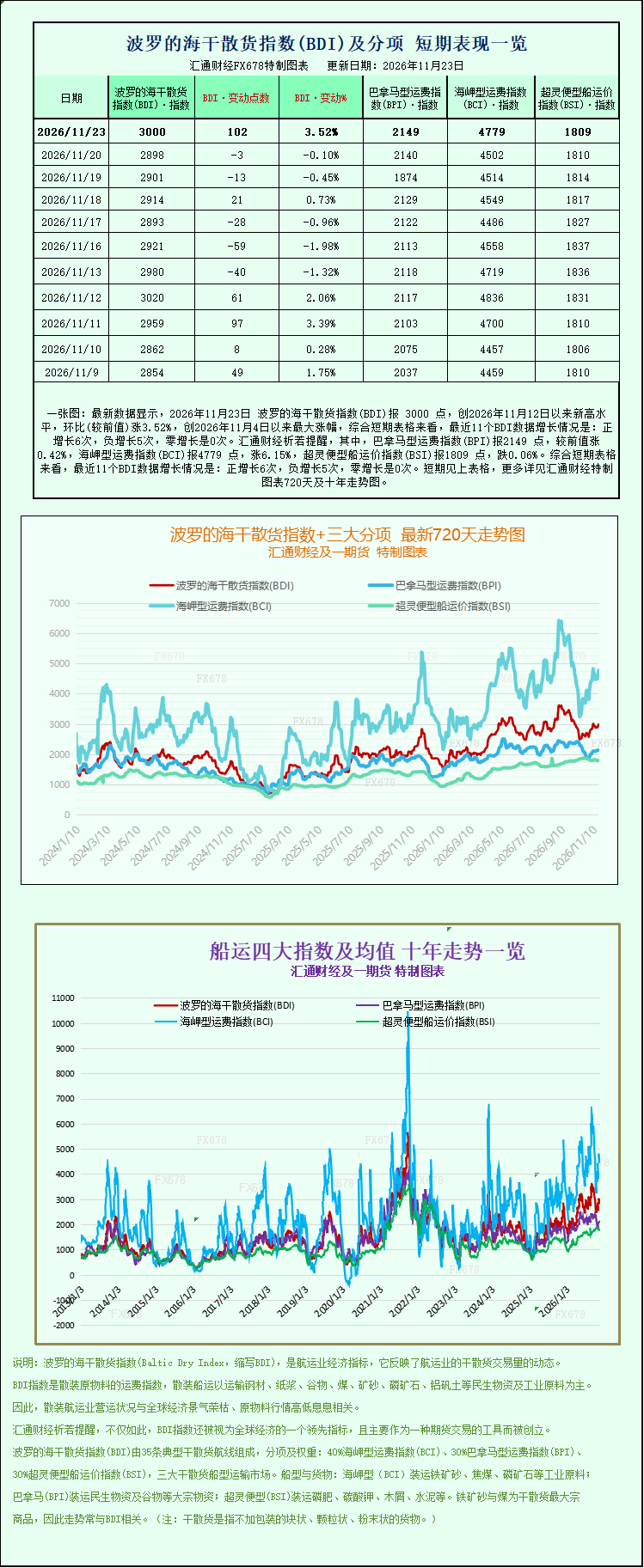 On November 23, 2026, the Baltic Dry Index (BDI), a core shipping index under the Baltic Exchange, rose on Monday, driven by stronger freight rates for Capesize and Panamax vessels. This significantly boosted the overall dry bulk shipping market and positive market sentiment. The BDI, a leading indicator of the global dry bulk shipping industry, tracks freight rates for various types of dry bulk carriers in the international ocean market, covering transoceanic trade in bulk raw materials such as iron ore, coal, and grain. Its fluctuations directly reflect changes in the global physical trade of commodities and are an important leading indicator for observing the vitality of global industrial production, infrastructure demand, and food trade. The index's statistical scope includes freight rate performance for three major dry bulk vessel types: Capesize, Panamax, and Supramax, comprehensively reflecting market order intake and charter rates for vessels of different deadweight tonnages. Latest data shows that the Baltic Dry Index (BDI) rose 102 points, or 3.5%, to close at 3,000 points, a new high since November 12, 2026. After a period of fluctuation and adjustment, the index's return to the 3,000-point mark indicates a phased recovery in the dry bulk shipping market. Looking at different vessel types, the market performance of vessels of different tonnages showed significant divergence. Large vessels were the core driving force behind the index's rise, while small and medium-sized vessels performed weakly, showing a slight decline. Capesize vessels were the biggest contributor to the index's rise. The index for this vessel type surged 277 points, or 6.2%, to close at 4,779 points, also a new high since November 12. Capesize vessels mainly carry bulk commodities of 150,000 tons or more, primarily iron ore and thermal coal. Their routes are concentrated in Australia and Brazil, supplying industrial raw materials to major Asian industrial countries such as China. Their freight rate fluctuations are highly correlated with the raw material procurement rhythm of the steel industry. The corresponding average daily earnings per vessel increased by $2,519 to $39,843. Behind the rise in freight rates are twofold: firstly, freight orders on long-haul routes have returned, overseas mines have maintained a stable delivery pace, and the number of cargoes awaiting shipment on long-haul routes has increased; secondly, the previous port congestion has eased, leading to a temporary tightening of available shipping capacity and pushing up shipowners' quotes. However, it is worth noting that in China, the largest consumer of iron ore, the domestic iron ore spot and futures markets have not strengthened in tandem. Dalian iron ore futures trended downwards on Monday, mainly constrained by persistently weak end-user demand, shrinking profit margins for steel companies, and insufficient willingness among steel mills to actively replenish inventory, resulting in a cautious purchasing pace. In contrast, Singapore iron ore prices, which had previously hit a four-year low, stabilized this week. The divergence in the domestic and international iron ore market trends reflects reality: the rebound in ocean freight rates is not entirely driven by domestic demand in China, but also includes multiple factors such as restocking demand in other overseas regions and changes in shipping route turnover efficiency. The actual demand in the domestic steel industry still faces pressure, which introduces uncertainty for the continued rise of the dry bulk index. The Panamax market also improved, with the Panamax index rising slightly by 9 points to 2149 points, reaching its highest level since October 22, 2026. Panamax vessels have a deadweight tonnage of 60,000-70,000 tons and mainly transport goods such as coal and grain, with trade routes covering multiple food and energy trade routes in the Atlantic and Pacific Oceans. The average daily earnings of this type of vessel increased by $79 to $19,343. The autumn harvest and shipment of grain from grain-exporting countries, along with energy restocking demand in some regions, supported a slight increase in chartering activity for Panamax vessels. Increased demand from charterers led to a moderate rise in freight rates, but the increase was far less than that of Capesize vessels, indicating that the recovery in demand in this segment is relatively limited and more of a marginal improvement. Unlike the previous two vessel types, the Supramax market weakened slightly. The index for this vessel type fell by 1 point, a decrease of 0.1%, closing at 1809 points, a low since November 10th. Supramax vessels are smaller and primarily serve short-haul regional maritime trade, with more fragmented routes. The decline in this vessel type reflects insufficient activity in short-haul regional dry bulk trade, limited supply of short-haul cargoes, relatively ample market capacity, and weak bargaining power among shipowners, making it impossible to replicate the upward trend seen in large ocean-going vessels. The divergence in the trends of the three vessel types reflects the current structural characteristics of the dry bulk market, with price increases concentrated in the large transoceanic long-distance shipping sector, while short-haul regional transport remains under pressure. Market analysts believe that in the short term, the resilience of Capesize freight rates is key to determining the direction of the Baltic Dry Index (BDI). If iron ore and coal shipments continue to be released, freight rates for large vessels are expected to remain high; however, limited profits in China's steel industry will restrict a significant increase in iron ore purchases, limiting further upside potential. Panamax freight rates will depend on the sustainability of global grain trade and coal transportation. Supramax freight rates, on the other hand, need further activation of regional trade demand before improvement is possible. Overall, the dry bulk market is currently experiencing a phase of recovery, but a fully strong trend has not yet formed. Different vessel types are showing uneven performance, and continued monitoring of downstream demand for commodities, the shipping pace of major exporting countries, and global shipping capacity deployment is necessary to further determine the future direction of the shipping market.
- Risk Warning and Disclaimer
- The market involves risk, and trading may not be suitable for all investors. This article is for reference only and does not constitute personal investment advice, nor does it take into account certain users’ specific investment objectives, financial situation, or other needs. Any investment decisions made based on this information are at your own risk.