The Baltic Dry Index (BDI) hit a seven-week high, with freight rates rising across all vessel types.
2026-11-24 23:02:39
On Tuesday, the Baltic Dry Index saw a broad-based rally, with rates rising across all major vessel types, including Capesize, Panamax, and Supramax, reaching a seven-week high and reflecting a significant recovery in sentiment within the international dry bulk shipping market. Dry bulk shipping is a crucial vehicle for global commodity trade, and this index is considered a leading indicator of global physical trade activity. Its fluctuations are closely linked to the cross-border flow of basic commodities such as iron ore, coal, and grain. Therefore, this across-the-board increase has quickly attracted significant attention from shipping companies, commodity traders, and institutional investors. 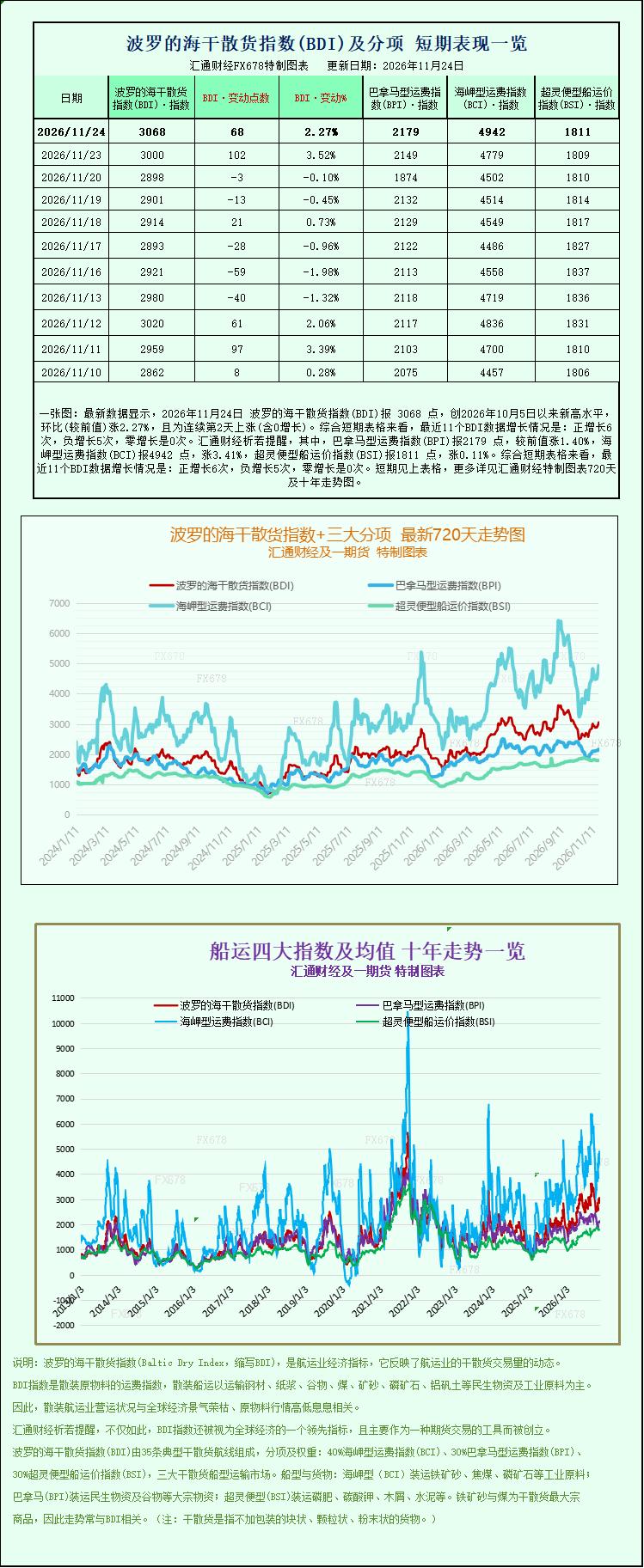 The Baltic Dry Index (BDI), which aggregates spot charter rates for Capesize, Panamax, and Supramax vessels, surged 68 points, or 2.27%, to close at 3068 points, its highest level since October 5, 2026. By vessel type, Capesize vessels, the largest in size, led the market and were the core driver of the index's rise. The Capesize index rose 163 points, or 3.41%, to close at 4942 points, also reaching a high since October 2. Capesize vessels are the largest and most important type of vessel in the dry bulk fleet, with a typical deadweight tonnage of up to 150,000 tons. They primarily handle long-distance, high-volume transport of iron ore and transoceanic coal, and the trade flow of these cargoes directly determines the profitability of this vessel type. Data shows that the average daily earnings for Capesize vessels rose by $1,471 to $41,314. This significant increase in charter earnings indicates a concentrated release of demand for long-distance bulk iron ore and coal cargoes, and a recovery in shipowners' bargaining power. Behind the strength in Capesize freight rates is a shift in short-term sentiment in the iron ore market. Recently, iron ore prices rebounded to a one-week high as market concerns about aggressive interest rate hikes by the Federal Reserve gradually subsided. Previously, the market widely expected the Fed to implement larger interest rate hikes, and a high-interest-rate environment often suppresses the expansionary willingness of manufacturing and infrastructure investment, thus weakening the long-term demand for steelmaking raw materials like iron ore. With this pessimistic expectation cooling, traders and steel mills' willingness to replenish their inventories has rebounded, leading to an increase in ocean-going iron ore shipment orders. However, market rationality remains, and the upside potential for iron ore prices has not fully materialized. Ample spot supply coupled with weak medium- to long-term demand expectations continues to constrain price increases, meaning that the current rebound in Capesize freight rates is unlikely to form a sustained, one-sided surge, and upward pressure persists. Following closely behind is the Panamax sector, which also showed strength. The Panamax index rose slightly by 30 points to 2179 points, a new high since October 21st. Panamax vessels, with a deadweight range mostly between 60,000 and 70,000 tons, are well-suited to the existing Panama Canal navigation restrictions, offering more diversified route networks. They are the main vessel type for transoceanic coal and international grain trade, covering both energy and agricultural products. Their freight rate fluctuations are influenced by both energy demand and the global grain shipping schedule. Correspondingly, the average daily charter yield for Panamax vessels increased by $268 to $19,611. Compared to the significant surge in Capesize cargoes, the Panamax market saw a relatively moderate increase, indirectly indicating that the demand recovery for grain and small-to-medium-sized coal cargoes is slower than that of long-term iron ore contracts. The incremental growth is relatively limited, and this is more of a follow-up to the overall market recovery rather than an independent driver of the market. Supramax vessels, with smaller tonnage and greater port adaptability, saw the weakest increase among the three vessel types. The Supramax index rose 2 points, a mere 0.1%, closing at 1811 points. The advantage of these smaller vessels lies in their ability to dock at numerous small-to-medium-sized ports with limited water depth. Their main cargo sources are regional short-haul bulk cargo, small-batch grain, and building materials. The slight increase reflects that while demand for intra-regional trade and near-sea feeder cargoes has not weakened, the incremental growth is insufficient, and market activity is far less than that of long-haul ocean shipping routes. The divergence in price increases among different vessel types also outlines the current structural characteristics of the dry bulk market: this round of market activity is dominated by demand for large-scale ocean-going coal and mineral transport, while the recovery of near-sea and small-batch bulk trade is relatively weak, demonstrating a very clear structural characteristic of the market. Industry analysts believe that the simultaneous rise in freight rates across all ship types has broken the previous pattern of uneven performance across different vessel types, signaling an improvement in short-term market sentiment. However, this does not indicate that the dry bulk market has entered a sustained upward cycle. On the one hand, this round of increases largely benefited from short-term restocking driven by improved macroeconomic expectations, rather than a trend reversal in global manufacturing and infrastructure demand. On the other hand, pressure on the supply side of the shipping fleet remains persistent. The pace of new ship deliveries, changes in port congestion, shipping policies of major exporting countries, and the subsequent implementation of the Federal Reserve's monetary policy will all continue to influence the future direction of freight rates. Going forward, the market will continue to monitor iron ore shipments from Australia and Brazil, the progress of coal restocking in the Northern Hemisphere during the winter, and the pace of grain shipments from South America. These fundamental variables will determine whether this round of freight rate rebound can continue.
- Risk Warning and Disclaimer
- The market involves risk, and trading may not be suitable for all investors. This article is for reference only and does not constitute personal investment advice, nor does it take into account certain users’ specific investment objectives, financial situation, or other needs. Any investment decisions made based on this information are at your own risk.