CBOT Agricultural Commodities Analysis: Soybean meal prices hit record highs due to crushing bottlenecks and pre-holiday shipments; wheat premiums reignited following attacks on cargo ships and renewed tenders.
2026-11-24 09:28:37
On Monday (November 24), the CBOT grain market entered its typical pre-Thanksgiving holiday trading pattern with reduced volume. Market trends diverged: soybeans rose, driven by strong soybean meal prices, closing up 0.57% at $12.287 per bushel, with gains widening towards the close. Wheat rose slightly, supported by the Russia-Ukraine situation and export tenders, initially gaining slightly before extending its gains driven by concerns about export demand and supply, ultimately closing up 0.21% at $5.955 per bushel. Corn closed up 0.06% at $4.497 per bushel, but initially fell, exhibiting a volatile pattern throughout the day. On the fundamentals front, processing plants and ethanol plants raised corn and soybean basis spreads to attract farmers to deliver before the end of the month. Domestically, the US corn harvest is 94% complete, and the soybean harvest is essentially finished, with selling pressure nearing its end. On the export side, weekly corn inspections reached 1,190,786 tons, higher than trade expectations, while soybean inspections reached 1,555,054 tons, within the expected range. US exporters also sold 110,000 tons of white wheat, and tenders for 800,000 tons of wheat from Pakistan, 120,000 tons from Jordan, and 50,000 tons from Bangladesh were launched in quick succession. Soybean meal spot supply was slow to replenish due to delayed autumn harvests and declining crushing plant inventories. Pre-holiday concentrated deliveries further tightened supply, with January soybean meal futures hitting a one-month high. Regarding the Russia-Ukraine situation, a Russian cargo ship in the Baltic Sea was attacked and caught fire by a drone. This route has become an important export channel for Russia to alleviate global supply pressure since Black Sea shipping was disrupted in August, leading to increased expectations of supply disruptions. On the surface, the holiday factor led to a contraction in trading volume and a narrowing of volatility, but the adjustment of basis quotes, the frequent occurrence of export sales and tenders, and the structurally tight supply of soybean meal are accumulating sentiment chips for the post-holiday market.  As of 09:01 AM today (November 24th) in the Asian morning session, here is a summary of the price changes for related commodities.
 According to FX678's observations, estimates from overseas traders show that on Monday (November 23), the speculative positions of commodity funds on corn futures, soybean futures, wheat futures, soybean meal futures, and soybean oil futures at the Chicago Board of Trade (CBOT), namely the net positions and average net positions of CBOT commodity funds, are shown in the chart below created by FX678.
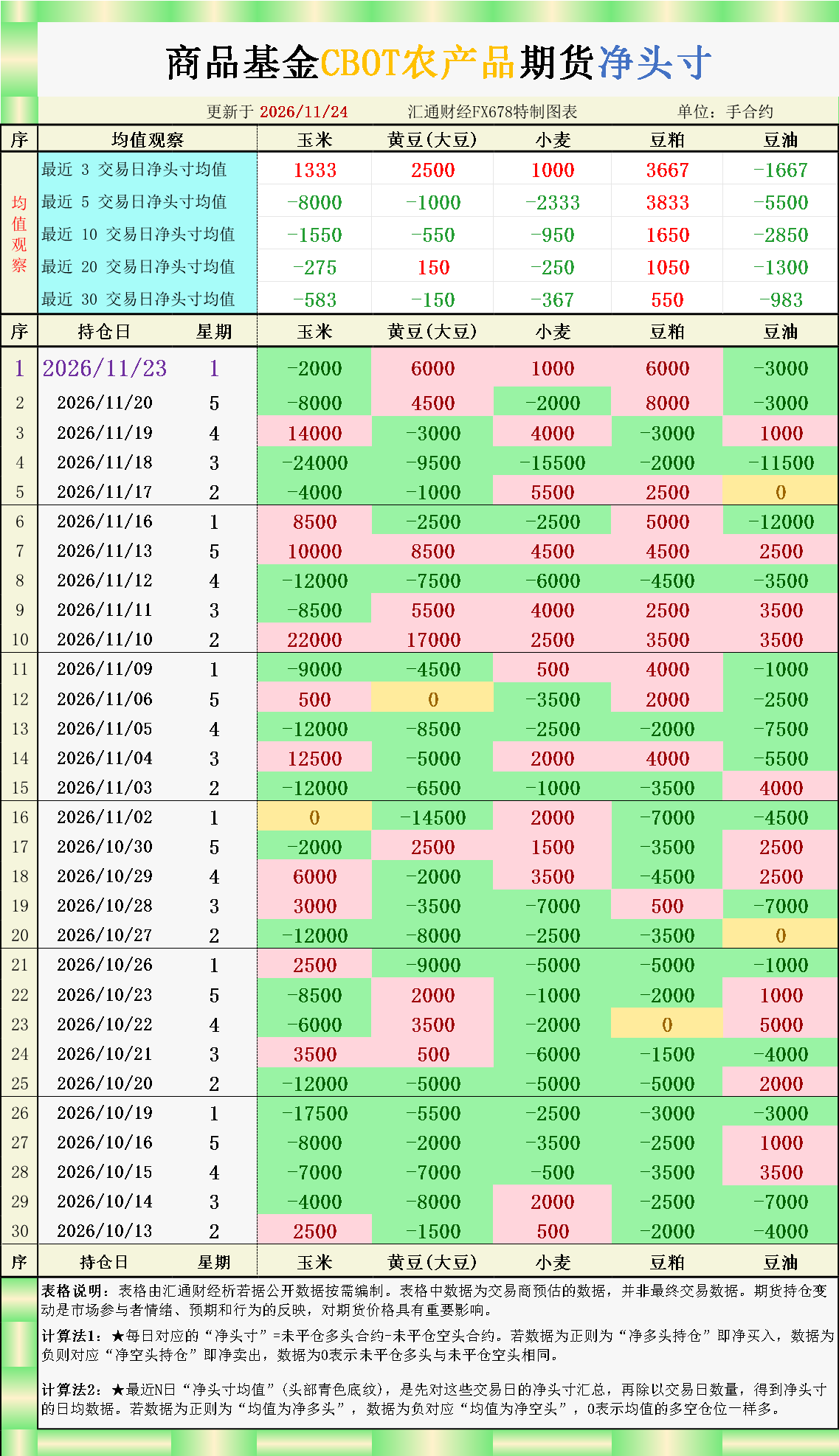 The following is an interpretation of the net positions and averages in the above position chart: [CBOT corn speculative positions are net selling 2000 contracts; the average net position over the past 3 trading days is net buying 1333 contracts; the average net position over the past 5 trading days is net selling 8000 contracts; the average net position over the past 10 trading days is net selling 1550 contracts; the average net position over the past 20 trading days is net selling 275 contracts; and the average net position over the past 30 trading days is net selling 583 contracts. The divergence between the daily net selling and the 3-day average net buying indicates that short sellers retested the market after a short-term pullback before the holiday. However, the 5-day and 10-day averages still show a predominance of net selling, indicating that the medium-term bearish tone remains unchanged. The net short position reached an extreme value at the 5-day average before converging marginally, suggesting that bearish momentum is weakening but has not yet reversed.] [CBOT soybean speculative positions are net buying at 6,000 contracts; the average net position over the past 3 trading days is net buying at 2,500 contracts; the average net position over the past 5 trading days is net selling at 1,000 contracts; the average net position over the past 10 trading days is net selling at 550 contracts; the average net position over the past 20 trading days is net buying at 150 contracts; and the average net position over the past 30 trading days is net selling at 150 contracts. The single-day net buying of 6,000 contracts is significantly higher than the 3-day average, and the 20-day average has turned positive while the 30-day average is close to neutral, indicating that bulls are covering their previous net short positions, and sentiment is shifting from bearish to neutral-to-bullish. The 5-day and 10-day averages are still net selling, indicating that this reversal is still in its early stages and needs confirmation in subsequent trading days.] [CBOT wheat speculative positions are net buys of 1,000 contracts; the average net position over the past 3 trading days is also net buys of 1,000 contracts; the average net position over the past 5 trading days is net sells of 2,333 contracts; the average net position over the past 10 trading days is net sells of 950 contracts; the average net position over the past 20 trading days is net sells of 250 contracts; and the average net position over the past 30 trading days is net sells of 367 contracts. The daily and 3-day averages are both net buys of 1,000 contracts, showing a consistent direction but moderate strength; the 5-day average of net sells of 2,333 contracts indicates significant short-selling pressure previously, and the current phase is a short-covering phase. The 20-day and 30-day averages are still net sells, but the absolute values are narrowing, indicating a recovery in sentiment, but a clear bullish trend has not yet formed.] [CBOT soybean meal speculative positions are net buys of 6,000 contracts; the average net position over the past 3 trading days is 3,667 contracts; the average net position over the past 5 trading days is 3,833 contracts; the average net position over the past 10 trading days is 1,650 contracts; the average net position over the past 20 trading days is 1,050 contracts; and the average net position over the past 30 trading days is 550 contracts. The averages from 3 to 30 days are all net buys, and the averages decrease progressively from shortest to longest, exhibiting a typical "continuous accumulation of long positions and a stable trend" structure. This is the only one of the five commodities to form a fully net long position, which is highly consistent with the price performance of soybean meal reaching a one-month high, and also confirms the fundamental logic of tight spot supply.] [CBOT soybean oil speculative positions are net sold at 3,000 contracts; the average net position over the past 3 trading days is net sold at 1,667 contracts; the average net position over the past 5 trading days is net sold at 5,500 contracts; the average net position over the past 10 trading days is net sold at 2,850 contracts; the average net position over the past 20 trading days is net sold at 1,300 contracts; and the average net position over the past 30 trading days is net sold at 983 contracts. All averages from 3 to 30 days show net selling, indicating a complete and stable short-selling structure. The 5-day average net selling of 5,500 contracts is an extreme value across all periods, indicating a previous concentrated short-selling effort; the current daily net selling of 3,000 contracts is lower than the 5-day average, suggesting that short-selling momentum is weakening marginally but the direction remains unchanged. Soybean oil lacks an independent bullish logic, and its position structure is consistent with its fundamentals, which passively follow the crushing cycle.] CBOT grain positions, basis, and international supply and demand reveal new market trends. Detailed analysis of each commodity is provided below:
As of 09:01 AM today (November 24th) in the Asian morning session, here is a summary of the price changes for related commodities. According to FX678's observations, estimates from overseas traders show that on Monday (November 23), the speculative positions of commodity funds on corn futures, soybean futures, wheat futures, soybean meal futures, and soybean oil futures at the Chicago Board of Trade (CBOT), namely the net positions and average net positions of CBOT commodity funds, are shown in the chart below created by FX678. The following is an interpretation of the net positions and averages in the above position chart: [CBOT corn speculative positions are net selling 2000 contracts; the average net position over the past 3 trading days is net buying 1333 contracts; the average net position over the past 5 trading days is net selling 8000 contracts; the average net position over the past 10 trading days is net selling 1550 contracts; the average net position over the past 20 trading days is net selling 275 contracts; and the average net position over the past 30 trading days is net selling 583 contracts. The divergence between the daily net selling and the 3-day average net buying indicates that short sellers retested the market after a short-term pullback before the holiday. However, the 5-day and 10-day averages still show a predominance of net selling, indicating that the medium-term bearish tone remains unchanged. The net short position reached an extreme value at the 5-day average before converging marginally, suggesting that bearish momentum is weakening but has not yet reversed.] [CBOT soybean speculative positions are net buying at 6,000 contracts; the average net position over the past 3 trading days is net buying at 2,500 contracts; the average net position over the past 5 trading days is net selling at 1,000 contracts; the average net position over the past 10 trading days is net selling at 550 contracts; the average net position over the past 20 trading days is net buying at 150 contracts; and the average net position over the past 30 trading days is net selling at 150 contracts. The single-day net buying of 6,000 contracts is significantly higher than the 3-day average, and the 20-day average has turned positive while the 30-day average is close to neutral, indicating that bulls are covering their previous net short positions, and sentiment is shifting from bearish to neutral-to-bullish. The 5-day and 10-day averages are still net selling, indicating that this reversal is still in its early stages and needs confirmation in subsequent trading days.] [CBOT wheat speculative positions are net buys of 1,000 contracts; the average net position over the past 3 trading days is also net buys of 1,000 contracts; the average net position over the past 5 trading days is net sells of 2,333 contracts; the average net position over the past 10 trading days is net sells of 950 contracts; the average net position over the past 20 trading days is net sells of 250 contracts; and the average net position over the past 30 trading days is net sells of 367 contracts. The daily and 3-day averages are both net buys of 1,000 contracts, showing a consistent direction but moderate strength; the 5-day average of net sells of 2,333 contracts indicates significant short-selling pressure previously, and the current phase is a short-covering phase. The 20-day and 30-day averages are still net sells, but the absolute values are narrowing, indicating a recovery in sentiment, but a clear bullish trend has not yet formed.] [CBOT soybean meal speculative positions are net buys of 6,000 contracts; the average net position over the past 3 trading days is 3,667 contracts; the average net position over the past 5 trading days is 3,833 contracts; the average net position over the past 10 trading days is 1,650 contracts; the average net position over the past 20 trading days is 1,050 contracts; and the average net position over the past 30 trading days is 550 contracts. The averages from 3 to 30 days are all net buys, and the averages decrease progressively from shortest to longest, exhibiting a typical "continuous accumulation of long positions and a stable trend" structure. This is the only one of the five commodities to form a fully net long position, which is highly consistent with the price performance of soybean meal reaching a one-month high, and also confirms the fundamental logic of tight spot supply.] [CBOT soybean oil speculative positions are net sold at 3,000 contracts; the average net position over the past 3 trading days is net sold at 1,667 contracts; the average net position over the past 5 trading days is net sold at 5,500 contracts; the average net position over the past 10 trading days is net sold at 2,850 contracts; the average net position over the past 20 trading days is net sold at 1,300 contracts; and the average net position over the past 30 trading days is net sold at 983 contracts. All averages from 3 to 30 days show net selling, indicating a complete and stable short-selling structure. The 5-day average net selling of 5,500 contracts is an extreme value across all periods, indicating a previous concentrated short-selling effort; the current daily net selling of 3,000 contracts is lower than the 5-day average, suggesting that short-selling momentum is weakening marginally but the direction remains unchanged. Soybean oil lacks an independent bullish logic, and its position structure is consistent with its fundamentals, which passively follow the crushing cycle.] CBOT grain positions, basis, and international supply and demand reveal new market trends. Detailed analysis of each commodity is provided below:Corn: The divergence between the strengthening basis and the stagnant price action indicates that the bearish momentum is weakening.
Corn saw a net speculative sell-off of 2,000 contracts in a single day, but the 3-day average was a net buy of 1,333 contracts. This divergence indicates that short sellers covered their positions after exerting concentrated pressure in the previous period, and then tentatively added to short positions again on Monday. The 5-day average net sell-off of 8,000 contracts represents the greatest short-selling pressure across all timeframes. The 10-day, 20-day, and 30-day averages were net sell-offs of 1,550, 275, and 583 contracts respectively, showing a gradually converging trend. This suggests that the medium-term short positions have been largely digested after the concentrated release within the 5-day window, and the current short selling is more of a short-term test rather than a trend-driven shorting. The fundamentals echoed this: processing plants and ethanol plants raised basis spreads to attract farmer deliveries. The Illinois Decatur corn basis spread was raised by 5 cents/bushel, and the Nebraska Blair Grain Depot basis spread was also raised by 5 cents/bushel, reflecting tight channel inventories and sluggish farmer sales. The US domestic corn harvest is 94% complete, and selling pressure is nearing its end. Weekly export inspections reached 1,190,786 tons, exceeding trade expectations. The CIF barge basis for the near-month contract was 84 cents/bushel, and for December it was 94 cents/bushel. FOB prices were 106 to 110 cents/bushel, indicating relatively strong spot demand. The futures market closed flat at $4.497/bushel, having briefly dipped to $4.322/bushel before recovering, suggesting effective buying support around $4.32/bushel. The combination of open interest and basis points to "short selling pressure weakening and market consolidation." If export sales continue to be strong after the holiday, short covering may drive the market upward. If farmers resume sales after the holiday, causing the basis to fall, the risk of a further decline in the market will increase.Soybeans: Bullish covering is beginning to emerge, but the driving force is in soybean meal, not soybeans.
Soybean net buying reached 6,000 contracts in a single day, significantly higher than the 3-day average net buying of 2,500 contracts. The 20-day average net buying of 150 contracts has turned positive, while the 30-day average net selling of 150 contracts is close to neutral. The position structure indicates that the bulls are shifting from net short to neutral-to-bullish. However, the 5-day and 10-day averages are still net selling of 1,000 and 550 contracts respectively, suggesting that the shift is still in its early stages. In terms of price, soybeans closed 8 cents higher at $12.287 per bushel. The increase was mainly driven by soybean meal demand rather than by soybeans' own exports—weekly export inspections of 1,555,054 tons were within the expected trade range and did not constitute additional bullish factors. The basis structure shows a near-term weakness and a far-term strength: November-loading soybeans are trading at a premium of 106 cents/bushel to January futures, December contracts are holding steady at 110 cents, January contracts are rising to 115 cents, and February contracts are trading at a premium of 106 cents to March futures, up 1 cent. The strengthening of far-month contracts reflects improved expectations, while the pressure on near-month contracts indicates that spot supply is not tight. The combination of open interest and basis suggests that the bullish sentiment in soybeans is "borrowed"—once soybean meal pipelines are replenished and crushing resumes, the narrowing of the soybean meal premium will drag down soybean prices. Whether soybeans can hold above $12/bushel after the holiday depends on whether the tight soybean meal spot supply continues into December.Soybean meal: The only commodity among the five with a fully net long position, and the most stable bullish trend.
Soybean meal saw a net inflow of 6,000 lots in a single day. The 3-day, 5-day, 10-day, 20-day, and 30-day average net inflows were 3,667, 3,833, 1,650, 1,050, and 550 lots respectively, all showing net inflows with the average decreasing from short to long term, forming a typical bullish trend structure of "the most aggressive recent buying and the lightest long-term positions." In terms of price, January soybean meal futures rose $4.20 to $344.50 per short ton, a one-month high, highly consistent with the open interest structure. Fundamentals are solid: delayed autumn soybean harvests led to decreased crushing plant inventories, with some plants slowing down or shutting down, resulting in slow replenishment of soybean meal supply channels for one or two months; concentrated pre-holiday customer pickups limited supply at some facilities in the Midwest; and the sale of 100,000 tons of soybean meal to Spain opened an export window. The overall stable basis indicates that the tightness is more reflected in the futures premium and inter-month structure than in spot prices. The overall net long position and the new price high corroborate each other, but it also means that the long positions are relatively crowded. If the operating rate rebounds after the holiday and the pipeline is replenished, the $344.50/short ton level will face profit-taking pressure; conversely, if exports continue to increase, $350/short ton is not out of reach.Soybean oil: Complete short-term structure, passively following the pressing rhythm.
Soybean oil saw a net sell of 3,000 contracts in a single day, with net selling across the 3- to 30-day moving averages. The 5-day moving average of net sell of 5,500 contracts was an extreme value, indicating a complete and stable short-selling structure. While the current daily net sell is below the 5-day moving average, the short-selling momentum is weakening marginally, but the overall direction remains unchanged. Soybean oil lacks independent open interest and basis signals; its logic must be deduced from the crushing chain: tight soybean meal supply and suppressed crushing operations mean limited marginal increases in soybean oil supply, providing potential support. However, if strong soybean meal prices drive a recovery in crushing profits and a rebound in operating rates, increased soybean oil supply will create pressure. The persistent net short position aligns with this passive pattern—traders are not betting on independent soybean oil price movements but rather using it as a hedge or follow-the-leader position in the soybean chain. Post-holiday soybean oil's direction will depend on crushing operating rates: faster-than-expected recovery will put downward pressure, while continued tight soybean meal supply and low crushing levels will provide support.Wheat: Sentiment recovery during short covering, premium built on expectations.
Wheat saw a net inflow of 1,000 contracts on the day, mirroring the 3-day average of 1,000 contracts, indicating a consistent but moderate trend. The 5-day average of net outflows of 2,333 contracts suggests significant short-selling pressure previously, with the market currently in a short-covering phase. The 20-day and 30-day averages of net outflows of 250 and 367 contracts respectively have narrowed in absolute terms, indicating a recovery in sentiment but without a clear bullish trend. Wheat closed 3-1/2 cents higher at $5.955 per bushel, after initially rising only 3/4 cent to $5.75 per bushel. This shift from weakness to strength reflects increased market sensitivity to supply-side news. Support comes from two aspects: New disturbances have emerged in the Russia-Ukraine situation, with a Russian cargo ship in the Baltic Sea being attacked and caught fire by a drone. Since Black Sea shipping exports were disrupted in August, Russia has significantly expanded its Baltic Sea exports, and this disruption will marginally tighten global supply. Import demand is being released intensively, with Pakistan's 800,000-ton tender closing on November 30th, Bangladesh's lowest bid of 50,000 tons assessed at $322.92/ton CIF liner out, Jordan seeking up to 120,000 tons, and US exporters selling an additional 110,000 tons of white wheat. On the basis, US Plains Hard Red Winter Wheat has strengthened in some grain depots, with farmers having largely completed planting and some not selling this year, resulting in a lack of selling pressure supporting the basis. The winter wheat good-to-excellent rating is estimated at 54%, and planting progress at 96%, indicating stable crop conditions and not constituting a bearish factor. The short covering in open positions and the price's shift from weakness to strength corroborate each other, but the premium is based on "supply disruption expectations + tender confirmation" rather than actual production reduction, making it highly sensitive to disproven assumptions. Post-holiday trends will depend on whether Baltic Sea logistics are substantially disrupted and the final pricing of Pakistan's tender.Summarize
The latest open interest paints a clear picture of market sentiment: soybean meal is the only commodity with a net long position across the board, representing the most stable but also the most crowded uptrend; soybean long positions are beginning to recover, but confidence stems from soybean meal rather than its own exports; wheat is in a period of short covering and sentiment recovery, with the premium depending on the realization of expectations; corn short momentum is waning, the basis is stronger than the futures market, and it is in a state of consolidation; soybean oil has a complete short structure, passively following the crushing schedule. A common characteristic of these five commodities is that "spot signals are stronger than futures performance," with the information from basis and export transactions outweighing price volatility, which is particularly evident against the backdrop of reduced trading volume during the holiday. In the first week after the holiday, crushing capacity utilization, weekly export sales, shipping activity in the Black Sea and Baltic Sea, and the pricing of Pakistan's 800,000-ton tender will determine whether the current structural divergence continues or narrows. Looking ahead, for soybeans, watch for support at $12/bushel and resistance at $12.50/bushel. For soybean meal, test the sustainability of the new high of $344.50/short ton. For corn, observe whether there is support below $4.32/bushel and whether exports can continue. For wheat, watch for buying support below $5.75/bushel and whether the premium of $5.955/bushel can be maintained.- Risk Warning and Disclaimer
- The market involves risk, and trading may not be suitable for all investors. This article is for reference only and does not constitute personal investment advice, nor does it take into account certain users’ specific investment objectives, financial situation, or other needs. Any investment decisions made based on this information are at your own risk.