Will the Fed raise interest rates three times? BlackRock: The market is overthinking it.
2026-11-24 11:40:33
On Tuesday (November 24) during the Asian session, the US dollar index fluctuated narrowly, currently trading around 104.30, having touched 104.53 overnight, a new high since April 2025. Supporting this round of dollar strength is the market's bet on continued interest rate hikes by the Federal Reserve. However, BlackRock, the world's largest asset manager, believes this bet has been overextended. In its weekly market commentary, BlackRock judged that the market has overpriced in Fed rate hikes. It agrees with the expectation of a 25 basis point rate hike in December, but does not agree with pricing in up to three rate hikes in the next 12 months, currently only anticipating one more in the first half of 2027. Its core logic is that the energy shock from the Middle East conflict peaked in September, and with the sharp decline in crude oil and refined product prices this month, its contribution to US inflation will turn negative. 
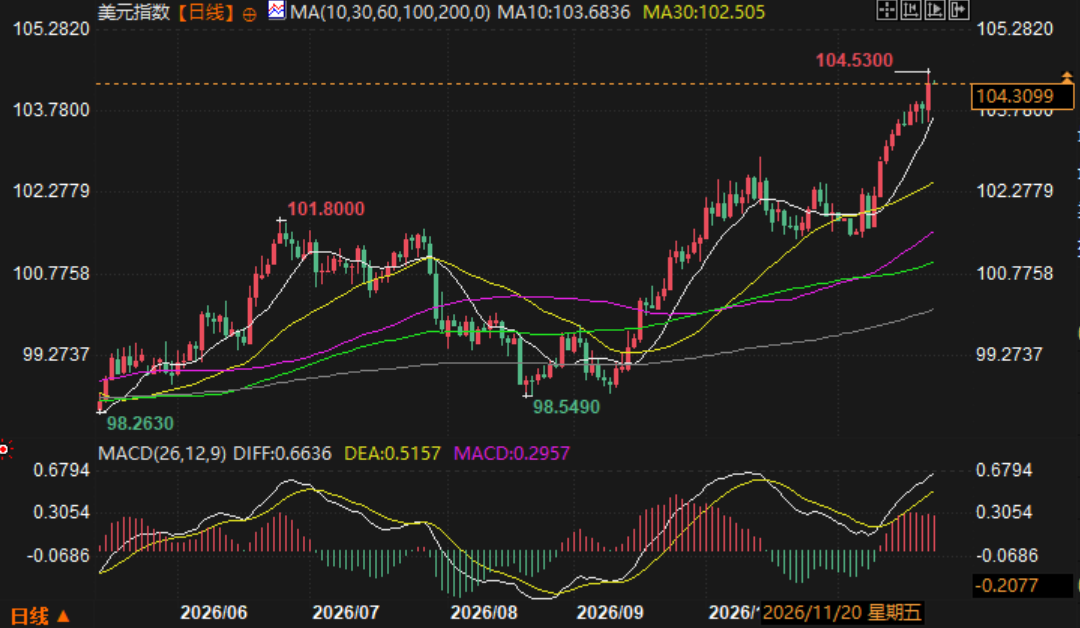 (US Dollar Index Daily Chart, Source: FX678) At 11:39 Beijing time, the US Dollar Index was at 104.25.
The energy shock has peaked: from boosting it by 1.5 percentage points to dragging it down by 0.8 percentage points.
BlackRock estimates that soaring energy prices pushed up overall U.S. inflation by 1.5 percentage points at their peak in September. This contribution will reverse as Brent crude, gasoline, and diesel prices all fell sharply this month: from pushing up inflation this year to dragging it down by 0.8 percentage points by the end of 2027. Lower fuel costs will also further depress core inflation through lower transportation service prices. In addition to energy, BlackRock expects price pressures from tariffs and AI infrastructure to ease next year, but the pace of decline will be uneven across different components. It also warns that tighter financial conditions and uncertainty surrounding AI spending could dampen demand and hiring in 2027, further limiting price pressures.Why still raise interest rates? Strong economy, tight labor market, and wage growth of approximately 4%.
BlackRock did not predict an early end to tightening. The US economy remains strong, the labor market is tight, and wage growth is around 4%, significantly higher than its target of 2%-2.5%, which it considers in line with the Fed's target. This keeps core services inflation high, and BlackRock expects core inflation to be closer to 3% rather than the Fed's 2% target. It also noted that the neutral interest rate may be higher than previously assumed, meaning there is still room for further tightening even if energy pressures ease. This contrasts sharply with statements from Fed officials. On the same day, New York Fed President Williams stated that he would not rule out raising interest rates at two consecutive meetings if necessary, and that the Fed would respond if inflationary pressures do not ease. BlackRock's assessment implies a slower pace of rate hikes. October's PCE inflation data, especially service prices, will be key to determining which side's assessment is correct.Beyond the Federal Reserve: Europe may maintain austerity measures for longer.
BlackRock also expects the European Central Bank to raise interest rates next month. It notes that the policy outlook beyond December depends on whether energy-driven price pressures continue to transmit to core inflation; the previous rise in natural gas prices is still being passed on to European consumers, making European inflation more persistent than in the US. As a net energy exporter, the US is better positioned to absorb this shock. Regarding growth, BlackRock expects US growth of 2%–2.5% this year, slowing to above 2% in 2027, due to slower growth in AI spending and the gradual fading of the boost from tax cuts.Portfolio strategy: Short-term coupon bonds + Inflation-protected bonds
With 2-year and 10-year Treasury yields rising to multi-decade highs this year, BlackRock believes that the market's long-term expectation of a structural rise in interest rates has largely been priced into bonds. It favors short- to medium-term Treasury bonds to capture coupon income and hedge against interest rate volatility; meanwhile, it has strengthened its strategic overweighting of inflation-protected bonds as a hedge against supply-driven inflation. It should be noted that the above comments were written before Monday's sharp rebound in US stocks. The previous week, Nvidia's solid earnings and Anthropic's record IPO failed to boost AI sentiment, and the S&P 500 briefly fell into correction territory. If BlackRock's assessment is correct and the market shifts to a more dovish Fed path, short-term bonds will benefit, and pressure on interest rate-sensitive stocks will ease. (US Dollar Index Daily Chart, Source: FX678) At 11:39 Beijing time, the US Dollar Index was at 104.25.
- Risk Warning and Disclaimer
- The market involves risk, and trading may not be suitable for all investors. This article is for reference only and does not constitute personal investment advice, nor does it take into account certain users’ specific investment objectives, financial situation, or other needs. Any investment decisions made based on this information are at your own risk.