Gold has rebounded from its lows of over a year and may be entering a period of consolidation and bottoming out.
2026-11-24 10:24:35
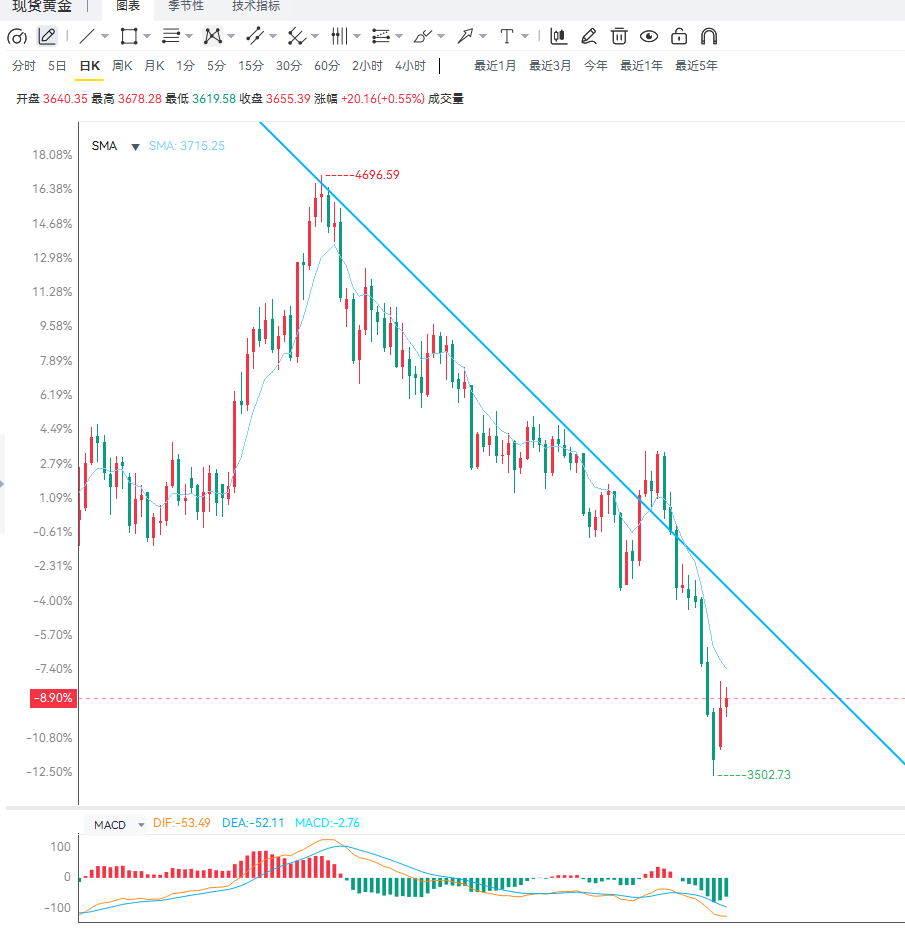
Gold (XAU/USD) rebounded from a more than one-year low to around $3,650 in early Asian trading on Tuesday, continuing its daily bottom-fishing rally . The precious metal had previously fallen to its lowest level in over a year, and this rebound suggests an initial return of buying interest after a period of continuous declines.  The rebound is driven by three factors. First, there's the marginal recovery in risk appetite – Jensen Huang has returned as CEO of Nvidia, alleviating the AI trading panic triggered by the executive change. This change has a dual effect on gold: the easing of panic in equity assets weakens safe-haven buying of gold, but the shift in market sentiment from extremes to stability itself provides a window for recovery in oversold assets. Second, there's technical bottom-fishing and short covering . After continuous declines to over a year's lows, the willingness of short sellers to push prices down further has weakened, forming short-term support. Regarding interest rate expectations, traders still expect the Fed to raise rates by 25 basis points in December , but according to the CME FedWatch tool, the probability of a significant 50 basis point rate hike has been completely ruled out . It's important to clarify that rate hikes put downward pressure on gold – gold does not generate interest income, and rising interest rates weaken its relative attractiveness. This also means that the current gold price rebound is occurring against the backdrop of "rate hikes still on the way," and its nature is more like an oversold correction than a trend reversal. The next focus for the market is the US October Personal Consumption Expenditures (PCE) price index, released on Wednesday, which is the Federal Reserve's most closely watched inflation indicator. This report will provide clues about the subsequent interest rate path: if the inflation reading is overheated, it will push up the dollar and suppress dollar-denominated gold ; conversely, it may provide room for a continued rebound. TD Securities has offered a rather informative assessment of the current situation. The bank believes that gold has "finally gained some breathing room," with signs of a weakening recent sell-off, but also emphasizes that "the pace of the sell-off has indeed slowed, but the market remains quite fragile, and there are now more substantial signs of outflows from global ETF holdings." In TD Securities' view, this does not constitute a "complete surrender of the gold bullish logic," but rather "more like a matter of capital flows, as global markets are being forced to repric the interest rate path." The bank further points out that these changes "ultimately reinforce the gold market's concerns about a weak stock market, a spiral of rising interest payments, stagflation, and fiscal dominance, which we believe will remain the core drivers of gold's long-term upward trend." This assessment reveals the core contradiction currently facing gold: short-term pressure from capital flows and interest rate repricing, and long-term support from fiscal policy and stagflation logic . These two factors are not contradictory but rather exist on different time horizons—providing a theoretical basis for the characterization of a "rebound but not a reversal." Regarding Fed officials, Williams ' speech generally aligned with existing tone. The FXS speech tracker gave it a 6.2/10 score, in line with historical averages, indicating a hawkish inclination towards stability. He emphasized that the Fed "still has work to do" to bring inflation back to 2%, and projected inflation at 3.5% by the end of 2026 , with the target not being reached until 2028 ; while acknowledging that price pressures have not spread widely, he acknowledged that inflation risks are skewed to the upside . This combination points to a "higher for longer" policy stance, rather than an imminent shift to easing. The FXS Fed Sentiment Index rose 0.35 points to 152.49 , well above the neutral line of 100, reinforcing the market's understanding that high interest rates will persist for a considerable period, which provides support for the dollar in terms of interest rate expectations. From a technical perspective, gold's oversold rebound continues on the daily chart, with prices recovering from a more than one-year low. However, it's crucial to understand the layered resistance structure. The first resistance level is $3720 – this is the first key level to test the continuation of the rebound . A decisive break above this level could lead to a further test of the downtrend line near $3830 . The strategic significance of $3830 surpasses that of $3720: it corresponds to the trendline resistance formed during the previous decline, and whether it can be recovered is the dividing line between a "recovery from oversold conditions" and a "trend reversal." On the downside, $3550 is a significant support level; failure to break this level could lead to consolidation and bottoming. On the 4-hour chart, short-term momentum has strengthened after the rebound from the lows, but no effective resistance has yet been broken. Two levels need to be observed: first, whether $3720 can be reached and held – this is the first criterion for the continuation of the short-term rebound; second, whether the lower Bollinger Band at $3585 can hold – a break below this level would test the important support at $3550.
 Editor's Summary: The current rebound in gold prices from a more than one-year low needs precise definition—it's a correction from oversold conditions, not a trend reversal. Buying interest has returned, the probability of a 50 basis point rate hike has been completely ruled out, and TD Securities has confirmed a slowdown in the selling pace. However, the suppressing factors are also real: TD Securities explicitly points out that " the market remains quite fragile, and there are more substantial signs of outflows from global ETFs," and characterizes the current situation as a " cash flow problem" rather than a "capitulation of the bulls" —meaning that the selling pressure comes from forced repricing, not a collapse of fundamental confidence. Therefore, once the rate hike path is repriced, the selling pressure may naturally subside, and a short-term oscillating rebound is expected, awaiting a stress test.
The rebound is driven by three factors. First, there's the marginal recovery in risk appetite – Jensen Huang has returned as CEO of Nvidia, alleviating the AI trading panic triggered by the executive change. This change has a dual effect on gold: the easing of panic in equity assets weakens safe-haven buying of gold, but the shift in market sentiment from extremes to stability itself provides a window for recovery in oversold assets. Second, there's technical bottom-fishing and short covering . After continuous declines to over a year's lows, the willingness of short sellers to push prices down further has weakened, forming short-term support. Regarding interest rate expectations, traders still expect the Fed to raise rates by 25 basis points in December , but according to the CME FedWatch tool, the probability of a significant 50 basis point rate hike has been completely ruled out . It's important to clarify that rate hikes put downward pressure on gold – gold does not generate interest income, and rising interest rates weaken its relative attractiveness. This also means that the current gold price rebound is occurring against the backdrop of "rate hikes still on the way," and its nature is more like an oversold correction than a trend reversal. The next focus for the market is the US October Personal Consumption Expenditures (PCE) price index, released on Wednesday, which is the Federal Reserve's most closely watched inflation indicator. This report will provide clues about the subsequent interest rate path: if the inflation reading is overheated, it will push up the dollar and suppress dollar-denominated gold ; conversely, it may provide room for a continued rebound. TD Securities has offered a rather informative assessment of the current situation. The bank believes that gold has "finally gained some breathing room," with signs of a weakening recent sell-off, but also emphasizes that "the pace of the sell-off has indeed slowed, but the market remains quite fragile, and there are now more substantial signs of outflows from global ETF holdings." In TD Securities' view, this does not constitute a "complete surrender of the gold bullish logic," but rather "more like a matter of capital flows, as global markets are being forced to repric the interest rate path." The bank further points out that these changes "ultimately reinforce the gold market's concerns about a weak stock market, a spiral of rising interest payments, stagflation, and fiscal dominance, which we believe will remain the core drivers of gold's long-term upward trend." This assessment reveals the core contradiction currently facing gold: short-term pressure from capital flows and interest rate repricing, and long-term support from fiscal policy and stagflation logic . These two factors are not contradictory but rather exist on different time horizons—providing a theoretical basis for the characterization of a "rebound but not a reversal." Regarding Fed officials, Williams ' speech generally aligned with existing tone. The FXS speech tracker gave it a 6.2/10 score, in line with historical averages, indicating a hawkish inclination towards stability. He emphasized that the Fed "still has work to do" to bring inflation back to 2%, and projected inflation at 3.5% by the end of 2026 , with the target not being reached until 2028 ; while acknowledging that price pressures have not spread widely, he acknowledged that inflation risks are skewed to the upside . This combination points to a "higher for longer" policy stance, rather than an imminent shift to easing. The FXS Fed Sentiment Index rose 0.35 points to 152.49 , well above the neutral line of 100, reinforcing the market's understanding that high interest rates will persist for a considerable period, which provides support for the dollar in terms of interest rate expectations. From a technical perspective, gold's oversold rebound continues on the daily chart, with prices recovering from a more than one-year low. However, it's crucial to understand the layered resistance structure. The first resistance level is $3720 – this is the first key level to test the continuation of the rebound . A decisive break above this level could lead to a further test of the downtrend line near $3830 . The strategic significance of $3830 surpasses that of $3720: it corresponds to the trendline resistance formed during the previous decline, and whether it can be recovered is the dividing line between a "recovery from oversold conditions" and a "trend reversal." On the downside, $3550 is a significant support level; failure to break this level could lead to consolidation and bottoming. On the 4-hour chart, short-term momentum has strengthened after the rebound from the lows, but no effective resistance has yet been broken. Two levels need to be observed: first, whether $3720 can be reached and held – this is the first criterion for the continuation of the short-term rebound; second, whether the lower Bollinger Band at $3585 can hold – a break below this level would test the important support at $3550. Editor's Summary: The current rebound in gold prices from a more than one-year low needs precise definition—it's a correction from oversold conditions, not a trend reversal. Buying interest has returned, the probability of a 50 basis point rate hike has been completely ruled out, and TD Securities has confirmed a slowdown in the selling pace. However, the suppressing factors are also real: TD Securities explicitly points out that " the market remains quite fragile, and there are more substantial signs of outflows from global ETFs," and characterizes the current situation as a " cash flow problem" rather than a "capitulation of the bulls" —meaning that the selling pressure comes from forced repricing, not a collapse of fundamental confidence. Therefore, once the rate hike path is repriced, the selling pressure may naturally subside, and a short-term oscillating rebound is expected, awaiting a stress test.
- Risk Warning and Disclaimer
- The market involves risk, and trading may not be suitable for all investors. This article is for reference only and does not constitute personal investment advice, nor does it take into account certain users’ specific investment objectives, financial situation, or other needs. Any investment decisions made based on this information are at your own risk.