Why did Brent crude oil prices only fall and not rise after three oil tankers struck landmines?
2026-11-24 14:10:32
On Tuesday (November 24) during Asian trading hours, Brent crude futures fluctuated lower, briefly touching $88.22 per barrel, the lowest since late August. It is currently trading around $88.85 per barrel, down about 0.5%. Iran reported that three oil tankers struck mines and caught fire in the Strait of Hormuz, and the US is reportedly investigating a possible cyberattack on up to 50 energy vessels. In the past, such news would have been enough to send oil prices soaring, but this time Brent crude only hovered around $89, close to a three-month low. The market is no longer paying for a "war risk premium," and the pricing focus has shifted to the accumulating supply glut. However, analysts warn that the buffer is still thin, and if a genuine supply disruption occurs, prices will still react sharply. 
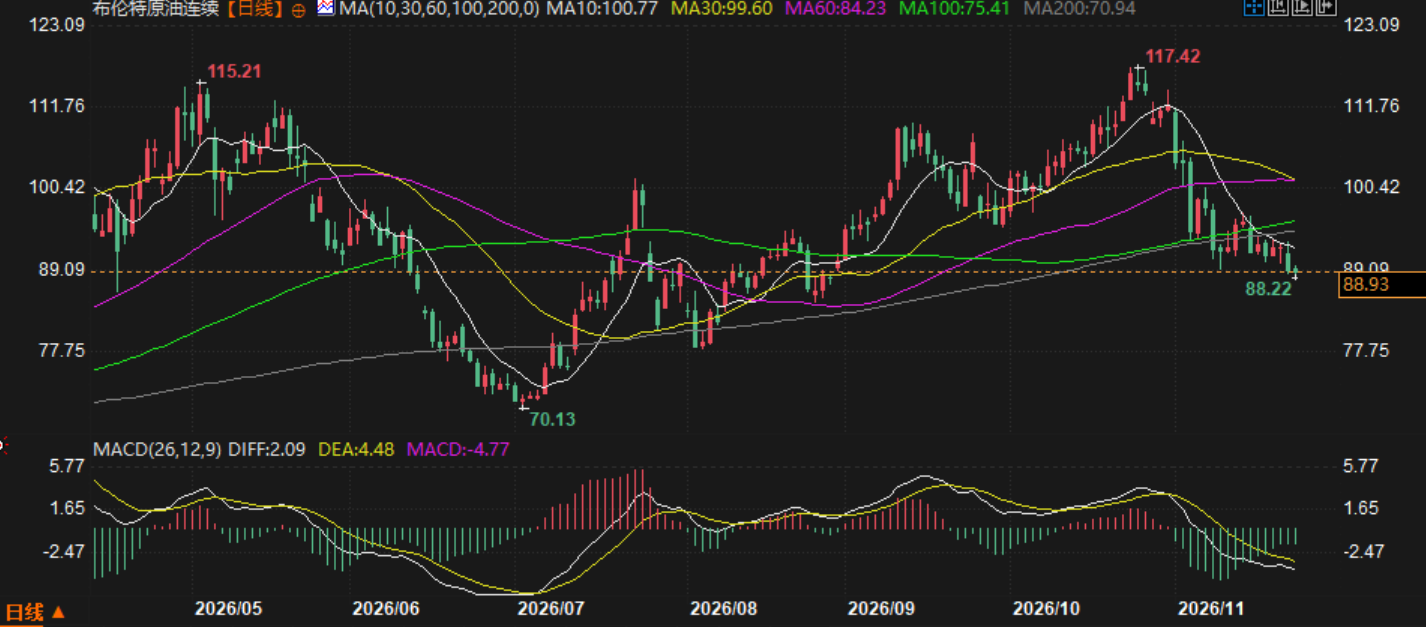 (Brent crude oil futures daily chart, source: EasyTrade) At 14:07 Beijing time, Brent crude oil futures were trading at $88.82 per barrel.
The news is still alarming, but the price remains unresponsive.
The Iranian Revolutionary Guard Navy, via Iran's Press TV, claimed that three "violations" by oil tankers struck mines and caught fire in the Strait of Hormuz on Monday, a claim that has not yet been independently confirmed. The Wall Street Journal also reported that the US is investigating whether Iran was involved in cyberattacks against up to 50 energy vessels. The market's indifference is news in itself. In previous months, any incident in the Strait would have been considered part of the risk premium; now, traders are more inclined to view such frictions as a persistent "background cost" rather than a reason to push up oil prices. Price trajectories also reflect this shift in sentiment. Brent crude closed at its lowest level since August 31 on Monday and hovered around $89 a barrel in early trading on Tuesday; US crude futures fell below $80, hitting a low of $79.20 a barrel, the lowest since August 10. While both are still well above the level of around $72 before the outbreak of the US-Iran conflict at the end of February, the continued decline this month clearly shows that the dominant logic has changed.Supply is catching up: October inventories increased by 52 million barrels
The real changes are coming from the supply side. Deutsche Bank stated that global observable liquid inventories increased by 52 million barrels in October, implying a supply surplus of approximately 1.7 million barrels per day; mounting evidence suggests the market is rebalancing towards a surplus, although temporary disruptions may delay this process. Libya is also seeing replenishment. The head of the country's national oil company stated that the Sharara pipeline has reopened, and crude oil has begun being pumped into the Akakus storage facility in Zawiya. Preliminary media investigations also indicate that U.S. crude oil and refined product inventories likely continued to rise last week.Not back to normal yet: From "acute scarcity" to "persistent vulnerability"
However, analysts do not believe the crisis is over. ANZ Bank points out that despite improvements in inventories and refined product supplies, the oil market remains under severe pressure. The bank believes that prices, spreads, refining margins, and investor positioning all indicate that traders are increasingly confident the situation will normalize; however, logistics remain constrained and inventory buffers are thin. In its view, the oil market is shifting from "acute scarcity" to "persistent fragility," rather than a full return to normalcy. This distinction will determine subsequent price behavior. A market with thin buffers, even if daily news loses its driving force, can still react sharply to a genuine supply shock.The impact extends beyond oil: inflation, interest rate hike path, and gold.
The decline in crude oil prices is directly entering the discussion of inflation and interest rates. BlackRock argued this week that the energy shock's impact on US inflation has peaked and will become a drag next year, giving the Federal Reserve less room to raise interest rates than the market expected. Conversely, New York Fed President Williams still views the outlook for energy prices as uncertain, calling it a key driver of current high inflation. If the oversupply described by Deutsche Bank is indeed confirmed, lower oil prices will reinforce the assessment of a "shorter rate hike cycle," thereby easing pressure on bonds. This also leaves room for gold to recover—during war, oil prices pushed up interest rate expectations, causing gold prices to fall.Conclusion
The risks remain concentrated in the Strait. The true extent of those buffers will only be tested if there is a confirmed escalation that actually cuts off traffic, rather than just another news item that fails to push prices up. (Brent crude oil futures daily chart, source: EasyTrade) At 14:07 Beijing time, Brent crude oil futures were trading at $88.82 per barrel.- Risk Warning and Disclaimer
- The market involves risk, and trading may not be suitable for all investors. This article is for reference only and does not constitute personal investment advice, nor does it take into account certain users’ specific investment objectives, financial situation, or other needs. Any investment decisions made based on this information are at your own risk.