The USD/JPY pair rebounded slightly, approaching a resistance zone, and awaits a directional move.
2026-11-24 14:48:32
The dollar traded around 159.20 against the yen on Tuesday. The core driver of this volatility was not Japanese data, but rather traders' heightened vigilance regarding potential government intervention – the market widely recalls the joint US-Japan currency intervention in July and August , which significantly reversed the yen's weakness in a short period, and this memory effect continues to constrain the exchange rate's upside potential.  Japanese Finance Minister Satsuki Katayama warned last week against “unilateral, rapid” exchange rate fluctuations , stating explicitly that the government will “continue to coordinate closely with the U.S. Treasury and respond appropriately.” This statement carries two layers of information: first, “unilateral, rapid” is a common intervention trigger phrase used by Japanese authorities; once the exchange rate moves excessively in one direction in the short term, the threshold for actual intervention is lowered; second, “close coordination with the U.S. Treasury” directly points to the possibility of joint action , rather than mere verbal intervention. For bulls, this means that the risk-reward ratio for chasing higher levels is deteriorating near key psychological levels . The Bank of Japan's policy path constitutes another variable. Most economists expect the Bank of Japan to implement its third interest rate hike this year at its December meeting, followed by another hike before the end of March , citing the bank's continued focus on inflation and a weak currency. This expectation itself supports the yen. However, there is also disagreement in the market— traders remain uncertain about the timing of the next monetary policy decision , which limits further upside for the yen and, conversely, provides support for the currency pair. In other words, "interest rate hike expectations" are bullish for the yen, while "uncertainty about the timing" is bearish , creating a fragile balance between the two forces at the current level. Bank of Japan Governor Kazuo Ueda 's speech provided further detail into this balance. The FXS speech tracker gave it an 8/10 rating, higher than the historical baseline of 7.5/10 , indicating a slightly hawkish tone . Key points included: emphasizing the risk of inflation exceeding the price target and the intention to continue raising interest rates while conditions remain accommodative; focusing on anchoring core inflation around 2%; and acknowledging that exchange rate volatility and a weak yen could further push up prices —this is particularly crucial, as it implies that the weak yen itself has been factored into inflation considerations , thus raising the upper limit of the authorities' tolerance for exchange rate appreciation. Kazuo Ueda's other statements point to a cautious, data-dependent approach: he believes that consumption should resume moderate growth as wages rise; simulation results show that accelerating the sale of ETFs will not seriously damage the fiscal situation , which strengthens confidence that the economy can withstand gradual tightening; however, he also warns that rising oil prices and a weak yen could erode real household income , and that the transmission of exchange rate fluctuations to inflation and expectations may be stronger than before . The combined meaning of these statements is that the Bank of Japan has the space and willingness to continue raising interest rates, but the pace and timing will depend on data , which precisely explains why the expectation of rate hikes is clear, but the timing remains ambiguous. At the cross-market level, Commerzbank's analysis provides an important transmission chain. The bank points out that "the US Treasury market rose sharply as investors sought safe havens and reassessed the outlook for US monetary policy" ; at the foreign exchange level, "the dollar fell 110 points against the yen to 158.60 on Friday, dragged down by declining US Treasury yields, and also fell 110 points for the week." This observation reveals an easily overlooked mechanism— when US Treasury yields fall due to safe-haven demand, the USD/JPY interest rate differential narrows, weakening the support for USD/JPY . In other words, the current yen strength is more a passive result of the "dollar side" than an active strength of the "yen side." The next focus is on the US October Personal Consumption Expenditures (PCE) price index released on Wednesday . If the report shows higher-than-expected inflation, it will provide upward momentum for USD/JPY ; conversely, it may exacerbate downward pressure on the exchange rate. Technically, USD/JPY maintains a mildly bullish bias on the daily chart, with the price above both the 100-day simple moving average and the 20-day Bollinger Band middle line , indicating potential demand during pullbacks. The Relative Strength Index (RSI) is at 52.76 , above the neutral line, pointing to stable rather than aggressive momentum , with the price moving upward from the lower edge of the recent range. On the upside, 159.80 forms a key resistance level. Higher resistance lies at the upper Bollinger Band around 160.25, where the rebound after the 61.8% retracement to 159.74 may begin to appear "overstretched." On the downside, the 100-day SMA at 158.70 coincides perfectly with the 20-day Bollinger Band middle line at 158.70, forming a tight support zone – the most solid support level in this round, as it is confirmed by both trend and volatility indicators.
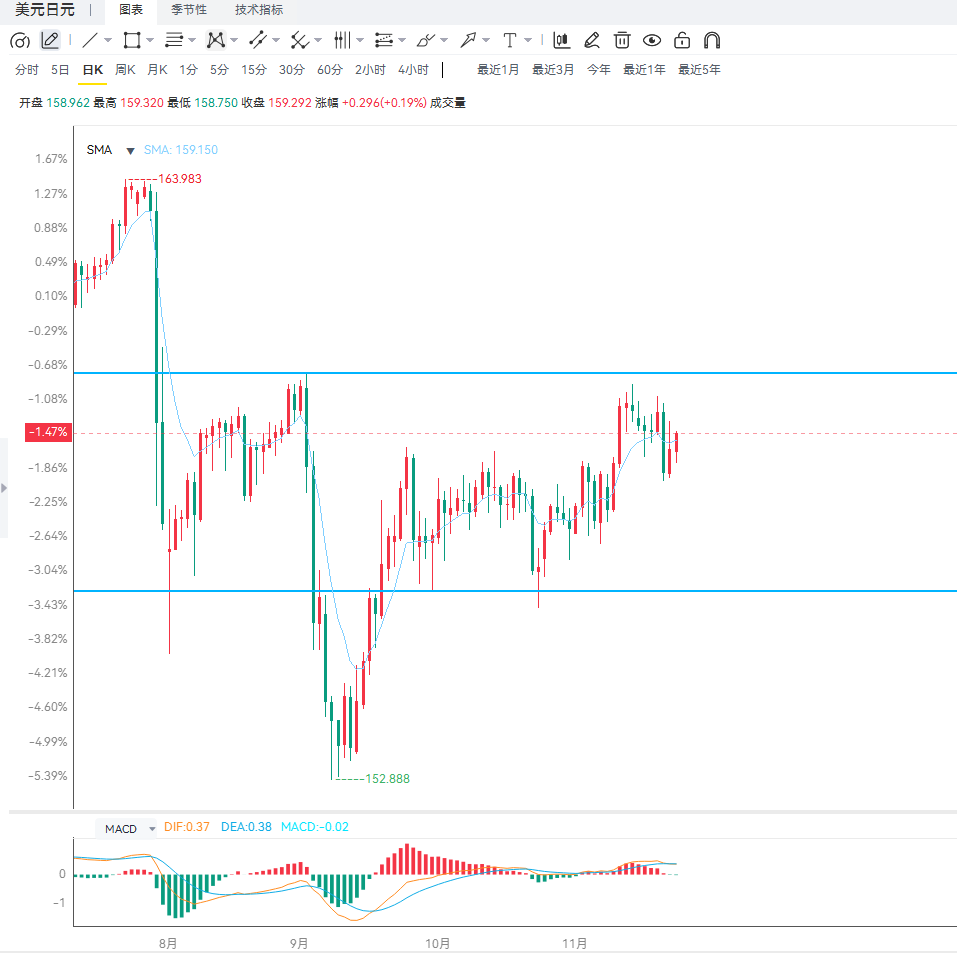 Editor's Summary: The USD/JPY pair is currently in a narrow, two-way consolidation range. The upside is limited by intervention warnings – Katayama Satsuki warned of "one-sided, rapid" fluctuations and clearly coordinated with the US Treasury. Downside support comes from the combined effects of interest rate hike expectations and safe-haven demand for US Treasuries. However, the transmission chain revealed by Commerzbank is more crucial: rising US Treasuries due to safe-haven demand and declining yields have narrowed the USD/JPY interest rate differential, weakening support for the USD/JPY. This means the current yen strength is a result of a weakening dollar, not a proactive move by the yen. Once US Treasury yields rise again, this support will weaken. Structurally, the 100-day moving average at 158.75 perfectly coincides with the Bollinger Middle Band, forming a double-confirmed tight demand zone, followed by the 50% retracement at 158.44. If the Bank of Japan holds rates steady or releases dovish signals in December, the yen may quickly give back its recent gains. Conversely, if US Treasury yields continue to decline and actual intervention occurs, the exchange rate could accelerate towards 157.14. Key events to watch include Wednesday's actual PCE readings, whether Japanese authorities escalate their warnings from verbal to concrete actions, the direction of US Treasury yields, the timing of the Bank of Japan's December decision, and Kazuo Ueda's subsequent statements regarding the transmission of inflation through exchange rates.
Japanese Finance Minister Satsuki Katayama warned last week against “unilateral, rapid” exchange rate fluctuations , stating explicitly that the government will “continue to coordinate closely with the U.S. Treasury and respond appropriately.” This statement carries two layers of information: first, “unilateral, rapid” is a common intervention trigger phrase used by Japanese authorities; once the exchange rate moves excessively in one direction in the short term, the threshold for actual intervention is lowered; second, “close coordination with the U.S. Treasury” directly points to the possibility of joint action , rather than mere verbal intervention. For bulls, this means that the risk-reward ratio for chasing higher levels is deteriorating near key psychological levels . The Bank of Japan's policy path constitutes another variable. Most economists expect the Bank of Japan to implement its third interest rate hike this year at its December meeting, followed by another hike before the end of March , citing the bank's continued focus on inflation and a weak currency. This expectation itself supports the yen. However, there is also disagreement in the market— traders remain uncertain about the timing of the next monetary policy decision , which limits further upside for the yen and, conversely, provides support for the currency pair. In other words, "interest rate hike expectations" are bullish for the yen, while "uncertainty about the timing" is bearish , creating a fragile balance between the two forces at the current level. Bank of Japan Governor Kazuo Ueda 's speech provided further detail into this balance. The FXS speech tracker gave it an 8/10 rating, higher than the historical baseline of 7.5/10 , indicating a slightly hawkish tone . Key points included: emphasizing the risk of inflation exceeding the price target and the intention to continue raising interest rates while conditions remain accommodative; focusing on anchoring core inflation around 2%; and acknowledging that exchange rate volatility and a weak yen could further push up prices —this is particularly crucial, as it implies that the weak yen itself has been factored into inflation considerations , thus raising the upper limit of the authorities' tolerance for exchange rate appreciation. Kazuo Ueda's other statements point to a cautious, data-dependent approach: he believes that consumption should resume moderate growth as wages rise; simulation results show that accelerating the sale of ETFs will not seriously damage the fiscal situation , which strengthens confidence that the economy can withstand gradual tightening; however, he also warns that rising oil prices and a weak yen could erode real household income , and that the transmission of exchange rate fluctuations to inflation and expectations may be stronger than before . The combined meaning of these statements is that the Bank of Japan has the space and willingness to continue raising interest rates, but the pace and timing will depend on data , which precisely explains why the expectation of rate hikes is clear, but the timing remains ambiguous. At the cross-market level, Commerzbank's analysis provides an important transmission chain. The bank points out that "the US Treasury market rose sharply as investors sought safe havens and reassessed the outlook for US monetary policy" ; at the foreign exchange level, "the dollar fell 110 points against the yen to 158.60 on Friday, dragged down by declining US Treasury yields, and also fell 110 points for the week." This observation reveals an easily overlooked mechanism— when US Treasury yields fall due to safe-haven demand, the USD/JPY interest rate differential narrows, weakening the support for USD/JPY . In other words, the current yen strength is more a passive result of the "dollar side" than an active strength of the "yen side." The next focus is on the US October Personal Consumption Expenditures (PCE) price index released on Wednesday . If the report shows higher-than-expected inflation, it will provide upward momentum for USD/JPY ; conversely, it may exacerbate downward pressure on the exchange rate. Technically, USD/JPY maintains a mildly bullish bias on the daily chart, with the price above both the 100-day simple moving average and the 20-day Bollinger Band middle line , indicating potential demand during pullbacks. The Relative Strength Index (RSI) is at 52.76 , above the neutral line, pointing to stable rather than aggressive momentum , with the price moving upward from the lower edge of the recent range. On the upside, 159.80 forms a key resistance level. Higher resistance lies at the upper Bollinger Band around 160.25, where the rebound after the 61.8% retracement to 159.74 may begin to appear "overstretched." On the downside, the 100-day SMA at 158.70 coincides perfectly with the 20-day Bollinger Band middle line at 158.70, forming a tight support zone – the most solid support level in this round, as it is confirmed by both trend and volatility indicators. Editor's Summary: The USD/JPY pair is currently in a narrow, two-way consolidation range. The upside is limited by intervention warnings – Katayama Satsuki warned of "one-sided, rapid" fluctuations and clearly coordinated with the US Treasury. Downside support comes from the combined effects of interest rate hike expectations and safe-haven demand for US Treasuries. However, the transmission chain revealed by Commerzbank is more crucial: rising US Treasuries due to safe-haven demand and declining yields have narrowed the USD/JPY interest rate differential, weakening support for the USD/JPY. This means the current yen strength is a result of a weakening dollar, not a proactive move by the yen. Once US Treasury yields rise again, this support will weaken. Structurally, the 100-day moving average at 158.75 perfectly coincides with the Bollinger Middle Band, forming a double-confirmed tight demand zone, followed by the 50% retracement at 158.44. If the Bank of Japan holds rates steady or releases dovish signals in December, the yen may quickly give back its recent gains. Conversely, if US Treasury yields continue to decline and actual intervention occurs, the exchange rate could accelerate towards 157.14. Key events to watch include Wednesday's actual PCE readings, whether Japanese authorities escalate their warnings from verbal to concrete actions, the direction of US Treasury yields, the timing of the Bank of Japan's December decision, and Kazuo Ueda's subsequent statements regarding the transmission of inflation through exchange rates.
- Risk Warning and Disclaimer
- The market involves risk, and trading may not be suitable for all investors. This article is for reference only and does not constitute personal investment advice, nor does it take into account certain users’ specific investment objectives, financial situation, or other needs. Any investment decisions made based on this information are at your own risk.