Geopolitical premiums recede, Europe sees more electric vehicles, and the crude oil supply and demand landscape is entering a new equilibrium.
2026-11-24 15:16:33
On Tuesday (November 24th) during the Asian and European sessions, crude oil prices continued to decline, primarily due to the rapid clearing of the Middle East geopolitical risk premium and the improvement in the supply-demand imbalance. Iran stated that it has not withdrawn from the Nuclear Non-Proliferation Treaty and maintains channels for negotiation and communication; the US is currently prioritizing economic sanctions to exert pressure, making a large-scale military conflict in the short term unlikely. Even with sporadic reports of attacks in the Taiwan Strait, it is difficult to sustain a rise in oil prices. The market focus is gradually shifting to supply and demand fundamentals, coupled with the continued penetration of electric vehicles in Europe suppressing long-term crude oil demand. The recovery in supply is pushing oil prices towards a new equilibrium range, and the OPEC+ meeting on November 29th will be the most important short-term observation point. 
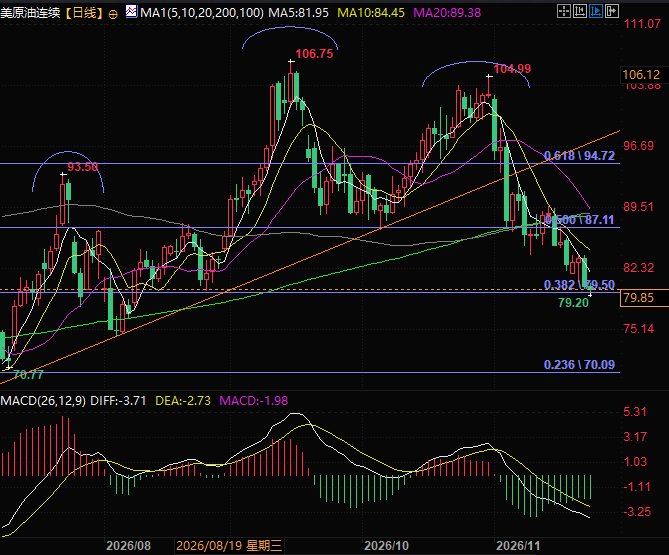 (WTI crude oil futures daily chart, source: EasyTrade) At 15:11 Beijing time, WTI crude oil futures are currently trading at $79.83 per barrel.
US-Iran rivalry: Window for negotiation remains, risk of large-scale conflict in the short term is limited.
The core logic behind the recent continuous weakness in crude oil prices is the rapid dissipation of the geopolitical risk premium in the Middle East. Iran has not withdrawn from the Nuclear Non-Proliferation Treaty and continues to express its willingness to negotiate. Iranian Foreign Ministry spokesman Bagaei stated that as long as the US fulfills its promises and meets Iran's demands, security in the Strait of Hormuz and the region can be restored in the shortest possible time. Previously, Iranian Foreign Minister Araqchi also signaled that the strait could be reopened to traffic within two hours if certain conditions were met. The US strategy focuses on escalating economic sanctions. Trump has stated that if negotiations fail by the end of the year, he will only consider restarting strikes against Iran after the New Year, and there are no immediate plans for military escalation in the short term. Early on the morning of the 24th local time, news broke that three oil tankers had struck mines and caught fire in the Strait of Hormuz. The vessels were under US escort at the time of the incident, and the Iranian Revolutionary Guard announced the attack. However, this news did not lead to a significant rebound in oil prices, reflecting the current market sentiment: sporadic shipping disturbances can only bring temporary disruptions and are unlikely to support a sustained war premium. According to Kpler data, in the ten-day period ending November 19, the average daily crude oil transport volume in the Strait of Hormuz was approximately 9.5 million barrels, a significant recovery from the lows in October, indicating that the physical flow of crude oil has returned to normal.On the demand side: Accelerated electrification in Europe is suppressing the upper limit of crude oil demand in the long term.
Electrification in the transportation sector is reshaping the long-term ceiling of crude oil demand, continuously exerting structural pressure on the upside potential of oil prices. Data from the European Automobile Manufacturers Association (ACEA) for October new car registrations shows that pure electric, plug-in hybrid, and conventional hybrid vehicles accounted for approximately 75% of new car sales; gasoline vehicles accounted for only 16.9%, and diesel vehicles further declined to 5.4%. Pure electric vehicles alone accounted for 29.8% of sales, a significant increase from only 18.9% in the same period last year. High fuel costs, government subsidies in various countries, and abundant vehicle supply are all driving this transformation, with many car owners choosing hybrid models to hedge against the risks of fluctuating oil prices. It is worth noting that most of the new market share for electric vehicles has been captured by Chinese automakers, while European domestic automakers continue to lose market share. Signs of weak short-term demand are also emerging: Indian refiners are shifting their purchases to crude oil from West Africa and other Middle Eastern sources, and the discount of Russian Urals crude oil relative to Brent crude has widened from $1-2 per barrel two weeks ago to $2-3 per barrel. Transportation costs, export delays, and declining oil prices are continuously squeezing the profits of crude oil sellers.Supply recovery: Global supply has shifted from tight to loose, and oil prices have entered a new supply-demand balance.
Increased supply is the most direct driver of this round of oil price decline. The restart of the Sharara pipeline in Libya has allowed crude oil to be re-injected into the Akakas storage tanks in Zawiya, filling the 350,000-barrel-per-day supply gap caused by the previous pipeline shutdown by armed groups. Coupled with the continued recovery of Middle Eastern crude oil exports, the physical market is showing signs of easing. The IEA, in its November oil report, pointed out that for the first time since the outbreak of the conflict related to Iran, global crude oil supply has exceeded demand, and the fourth quarter will see a supply surplus. JPMorgan Chase also predicts that Brent crude oil prices will likely remain in the $70 range in the first half of 2027. The North Sea Brent spot premium has also fallen from its extreme high of $31 in early October to around $1, significantly easing the previous tight spot market situation.Short-term key focus: Closely monitor the OPEC+ policy meeting on November 29.
While the current market theme is oversupply coupled with the long-term demand suppression caused by electrification, traders cannot ignore the key risk factor: the OPEC+ meeting on November 29th. The market has already priced in the oversupply expectation. If the oil-producing alliance chooses to maintain the current production cuts and tighten the 2027 production baseline, the market's oversupply expectation will be corrected, and oil prices may have a chance to rebound. However, if signals are released to ease production cuts and even increase production, the oversupply logic will be further strengthened, opening up downside potential for oil prices. Overall, the main theme of crude oil trading has shifted from "Middle East supply disruption fears" to "oversupply + long-term demand suppression by electrification." Subsequent geopolitical news is likely to only bring intraday pulse fluctuations. Before the OPEC+ meeting concludes, the focus of trend trading should be on the oil-producing alliance's production policy statements. Technical Analysis: Oil prices continue to test the 0.382 Fibonacci retracement level of 79.50. A significant rebound occurred previously, but this rebound is weak and may set the stage for a later break below this level. The head and shoulders pattern continues to gain momentum, with the measured decline of the pattern around 70. (WTI crude oil futures daily chart, source: EasyTrade) At 15:11 Beijing time, WTI crude oil futures are currently trading at $79.83 per barrel.
- Risk Warning and Disclaimer
- The market involves risk, and trading may not be suitable for all investors. This article is for reference only and does not constitute personal investment advice, nor does it take into account certain users’ specific investment objectives, financial situation, or other needs. Any investment decisions made based on this information are at your own risk.