The recovery in AI-driven market conditions has fueled hawkish expectations, leading to a continued strengthening of the US dollar. When will it weaken?
2026-11-24 16:58:32
On Tuesday (November 24), the US dollar index continued to strengthen, currently trading around 104.26. The reversal in Nvidia's personnel decisions ignited a rebound in the AI sector, market risk appetite quickly recovered, and funds rapidly flowed back to the US to buy US stocks. Meanwhile, traders revised their expectations for a Federal Reserve rate hike upwards, and the continued prominence of the US's macroeconomic advantages over non-US economies further strengthened the dollar, with the dollar hitting a more than 19-month high against the euro. However, whether this strong rally can continue depends on subsequent inflation, economic data, and the sustainability of the AI theme. 
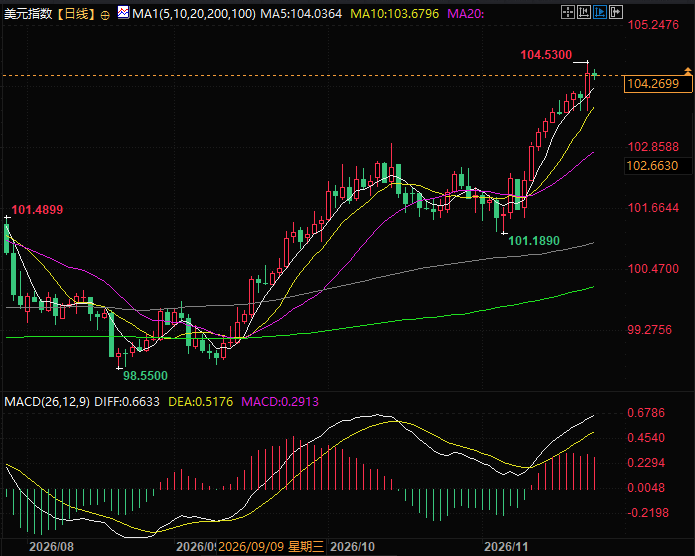 (US Dollar Index Daily Chart, Source: FX678) At 16:53 Beijing time, the US Dollar Index is currently at 104.28.
Event Catalyst: Nvidia saga reverses course, pushing up pricing in hawkish Fed stance.
The news of Jensen Huang's return to Nvidia ignited sentiment in the AI sector, with Nvidia's stock price surging 33% in a single day, driving a significant rebound in US risk assets. Following the stock market recovery, traders increased their bets, anticipating a more hawkish Federal Reserve policy. This led to a continued strengthening of the US dollar, with the dollar index rising 0.5% to 104.36, reaching a more than 19-month high against the euro. Currently, the market is pricing in a 96% probability of a 25 basis point rate hike by the Fed in December, completely ruling out the possibility of a 50 basis point hike this year. Simultaneously, the market is pricing in a 63% probability of another rate hike in January next year. This rising interest rate expectation directly supports US Treasury yields, which is beneficial to the US dollar.Macroeconomic Support: Widening expectations across economies further support the US dollar.
Another underlying logic behind the current strengthening of the US dollar is the divergence in macroeconomic expectations between the US and non-US economies. Deutsche Bank analyst Tim Baker points out that recent US economic data has consistently exceeded expectations, while data from the Eurozone, Canada, Australia and New Zealand, and the Nordic countries has turned negative (with more instances of data falling short of expectations), and many economic indicators have continued to underperform market expectations. The widening growth advantage of the US relative to non-US economies has led to a continuous flow of funds into dollar assets, consolidating the dollar's strength. However, Baker also cautions that such relative data advantages typically revert to the mean, and while the current dollar rally may be nearing a temporary peak, this does not mean the short-term trend will immediately reverse.The US dollar is trending weaker; conditions are needed.
First, if inflation stickiness subsides, expectations for Fed rate hikes will cool. For example, a significant decline in US PCE inflation data would lead the market to lower its expectations for subsequent rate hikes, and even begin trading in rate cuts, causing US Treasury yields to fall and narrowing the interest rate differential between the US and non-US currencies. This is the most crucial driving factor. Currently, Fed officials like Williams continue to emphasize high inflation and do not rule out consecutive rate hikes. Until inflation shows significant easing, the support for the dollar from interest rates will be difficult to eliminate. Second, the resilience of the US economy is weakening, while non-US data is recovering. Weakening core indicators such as US employment and PMI, coupled with improved economic data from the Eurozone, Canada, Australia, and New Zealand, reverses cross-border expectation gaps, leading to capital inflows back to non-US assets. Then, the AI-driven logic is again hampered, with the market lowering its expectations for US technology capital expenditure and long-term growth. This slows the influx of new funds into the US technology sector, consequently weakening the dollar's growth premium.Summarize:
The current strength of the US dollar is a result of three factors: hawkish interest rate expectations, the relative economic advantage of the US, and capital inflows driven by AI. Even if the data advantage may have peaked, the dollar is unlikely to experience a sustained correction before the PCE inflation data is released and there is a substantial shift in Fed policy expectations. It is more likely to maintain a slightly bullish, volatile pattern. Like gold, technical factors and intraday strength should still be monitored. The recent exceptionally strong performance of the dollar may have already reflected the aforementioned positive factors, and the current upward trend may be nearing its end. (US Dollar Index Daily Chart, Source: FX678) At 16:53 Beijing time, the US Dollar Index is currently at 104.28.
- Risk Warning and Disclaimer
- The market involves risk, and trading may not be suitable for all investors. This article is for reference only and does not constitute personal investment advice, nor does it take into account certain users’ specific investment objectives, financial situation, or other needs. Any investment decisions made based on this information are at your own risk.