With a series of hawkish statements, which country's policy expectations are harder to break: the euro or the dollar?
2026-11-24 17:00:33
On Tuesday, November 24th, the euro traded in a narrow range against the dollar around 1.0900, having recently touched a low of 1.0880 before recovering slightly. Market risk appetite improved following Nvidia's reappointment of Jensen Huang as CEO, leading to increased global investor willingness to allocate to risk assets. Meanwhile, expectations of further tightening by the European Central Bank continued to provide fundamental support for the euro, while weaker-than-expected US business activity data put some pressure on the dollar. Overall, the current exchange rate fluctuations reflect more of a marginal shift in risk sentiment than a fundamental reversal in the underlying economic landscape. 
Global risk sentiment and technology sector dynamics
On November 23, Nvidia's board of directors announced that Jensen Huang would return as president, CEO, and board member. Following the announcement, Nvidia's stock price rebounded,带动 the overall technology sector to strengthen, and risk assets were generally sought after. In the currency market, this recovery in risk appetite indirectly supported the euro, as the euro, as a major non-dollar reserve currency, often receives inflows when global risk sentiment improves. However, this support is more driven by short-term sentiment than by a significant improvement in the Eurozone's economic fundamentals. Investors are focused on whether the technology sector's capital expenditure cycle can be sustained and the impact of related investments on global growth expectations.European Central Bank's Policy Path
The European Central Bank's (ECB) deposit facility rate remains at 2.50%, having been raised twice this year. Latest data shows that Eurozone inflation continues to be affected by high energy prices, with the inflation rate reaching 3.8% in September. The market has almost fully priced in another 25 basis point rate hike at the December 17 meeting and anticipates one or two more adjustments in 2027. Gediminas Szymkus, Governor of the Central Bank of Lithuania, stated that the December rate hike may not be sufficient to ultimately stabilize inflation, noting that the subsequent path will depend on the outcome of wage negotiations and the actual development of the second-round effect. ECB President Christine Lagarde previously emphasized that policy will remain data-dependent and assessed on a meeting-by-meeting basis, without presupposing a specific path. For traders, the ECB's hawkish stance forms a core support for the euro, but energy price volatility and fiscal uncertainty remain variables that need continuous monitoring.US economic data and the Federal Reserve's stance
The preliminary U.S. Purchasing Managers' Index (PMI) for November showed the composite index falling to 54.6 from 55.9 in October, the manufacturing index at 54.5, and the services index at 54.7. All three indices remained above the 50-point threshold separating expansion from contraction, indicating continued economic expansion, albeit at a slower pace than the previous month. Chris Williamson, chief global business economist at S&P Global, noted that the survey data still points to an annualized GDP growth rate of around 3% in the fourth quarter. John Williams, president of the New York Federal Reserve, stated that inflation remains too high, currently at around 3.5%, and the Fed still has considerable work to do to bring inflation back to its 2% target in a timely and sustainable manner. He emphasized that action must be taken over time, and did not rule out the possibility of consecutive rate hikes. The market currently prices in a 94% to 95% probability of a 25-basis-point rate hike on December 9th. The slowdown in U.S. business activity data put some pressure on the dollar, but the Fed's hawkish stance continues to support it, resulting in a roughly balanced market.Eurozone internal differences and fundamental balance
The Eurozone's composite Purchasing Managers' Index (PMI) remained unchanged at 51.7 in November, slightly below expectations. Germany's composite index rose to 55.0, its highest level since March 2022, with particularly strong performance in the manufacturing sector; France's composite index fell to 46.2, a six-month low, with a widening contraction in manufacturing output. This internal divergence reflects the coexistence of resilience in Germany's industrial sector and weak domestic demand in France. Continued political and fiscal uncertainty in France continues to dampen market interest in the euro, while German data provides some offsetting effect. The current slight rebound in the euro against the dollar reflects more of an improvement in global risk sentiment than a fundamental advantage for the euro relative to the dollar. The subsequent evolution of energy prices, wage growth, and the fiscal situations of member states will continue to determine the size of the European Central Bank's policy space.Technical Analysis and Market Structure
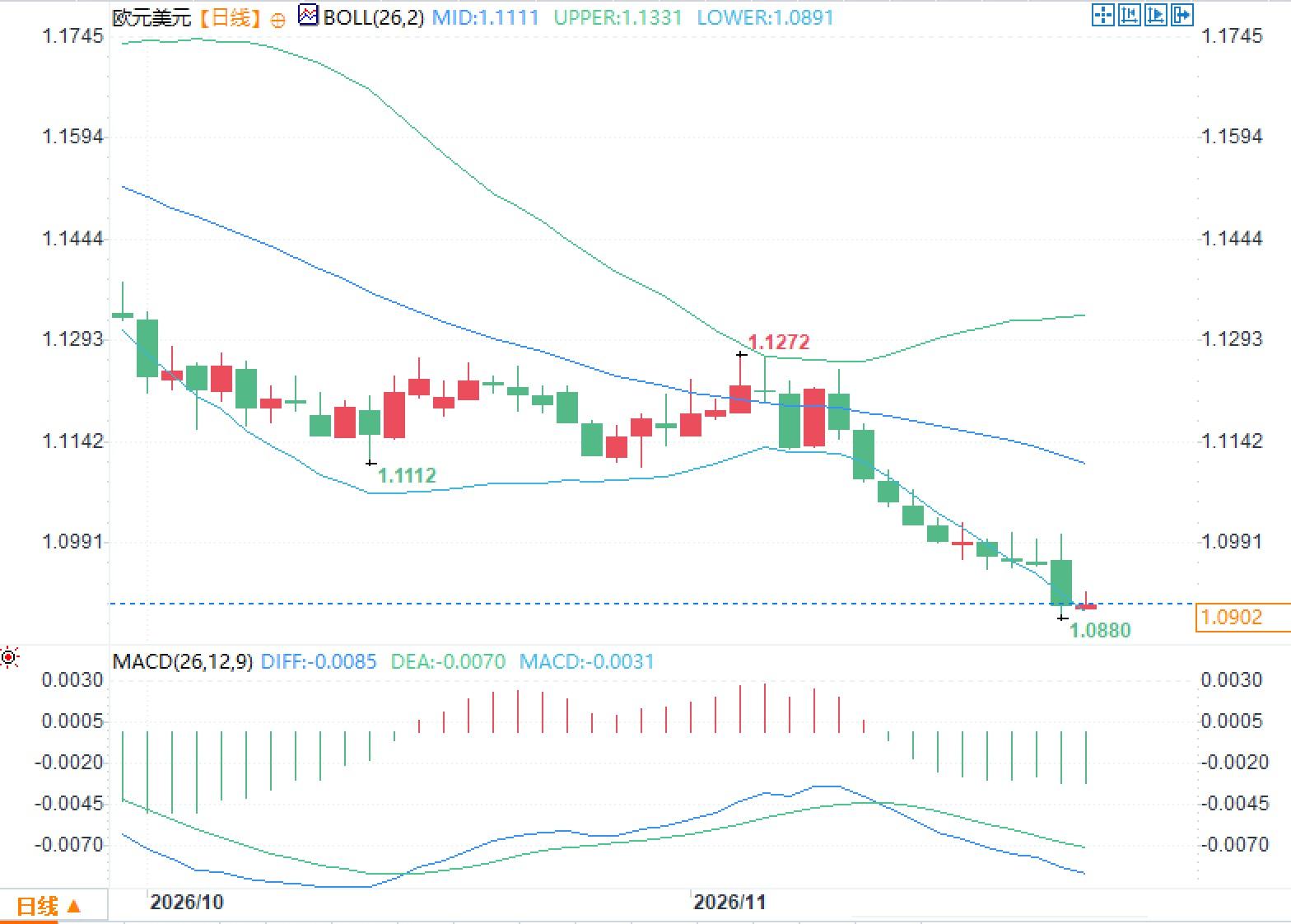
From the daily chart, the EUR/USD pair is currently trading near the lower Bollinger Band. The middle Bollinger Band is around 1.1111, the upper band is around 1.1331, and the lower band is around 1.0891. The MACD indicator shows a DIFF value of approximately -0.0085 and a DEA value of approximately -0.0070, with the histogram below the zero line. The price has generally trended downwards since October, with recent volatility increasing.
- Risk Warning and Disclaimer
- The market involves risk, and trading may not be suitable for all investors. This article is for reference only and does not constitute personal investment advice, nor does it take into account certain users’ specific investment objectives, financial situation, or other needs. Any investment decisions made based on this information are at your own risk.