Interest rate hikes may have peaked! The Reserve Bank of Australia speaks out, saying today's CPI will determine expectations for further rate cuts.
2026-11-25 08:22:32
On Wednesday (November 25) during Asian trading hours, the Australian dollar fluctuated slightly lower against the US dollar, currently trading around 0.6630, down about 0.12%. The Reserve Bank of Australia has now raised interest rates five times, bringing the cash rate to 4.85%, a new 18-year high. David Jacobs pointed out at a public event in Sydney that the real cash rate is already higher than the neutral rate, and monetary policy is generally in a restrictive state, but the suppression of various economic sectors is not even. 
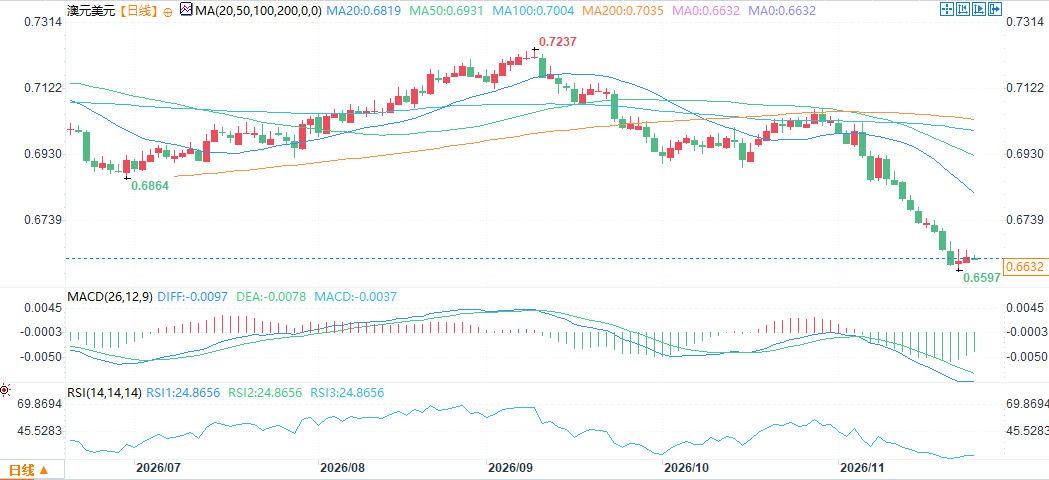 (Australian dollar against US dollar daily chart, source: EasyForex) At 8:18 Beijing time, the Australian dollar was trading at 0.6630/31 against the US dollar.
Industry divergence: Real estate under pressure, but corporate lending remains hot.
The impact of this round of interest rate hikes on the Australian economy exhibits distinct structural differences. The real estate sector, most sensitive to interest rates, has been hit hardest, with significantly increased mortgage payments directly suppressing housing demand and transaction activity in the existing housing market. Pressure for price adjustments is gradually emerging, with transaction volumes in some areas already showing a marked decline, and developers' willingness to start new projects also being inhibited. David Jacobs, in a public event in Sydney, specifically warned that if the adjustment in the real estate market exceeds current market expectations, the tightening policy, through the wealth effect, contraction in construction investment, and transmission across related industrial chains, could have a stronger drag on the overall economy than models predict. A larger price correction in the housing market would have a cascading effect on bank asset quality, consumer confidence, and local government tax revenue, thus amplifying the restrictive effects of monetary policy. In stark contrast to the real estate market is the corporate credit market. Despite the nominal cash rate rising to an 18-year high of 4.85%, market credit spreads have remained relatively low, and corporate loan demand remains strong. Many companies can still obtain financing at acceptable costs for equipment upgrades, inventory replenishment, or expansion investments. This contradiction of "nominal tightening, actual easing" reflects the uneven perception of policy interest rates within the real economy. Jacobs offers the explanation that investment intentions are currently significantly stronger than savings intentions globally, which may be pushing up the neutral interest rate level. Once the neutral interest rate rises, the actual tightening effect corresponding to the same cash rate will be weakened, resulting in a situation where "it appears restrictive on paper, but feels weak in practice." This divergence implies a structural blockage in the policy transmission mechanism, and relying solely on interest rate figures to judge the strength of tightening may underestimate or overestimate the true impact.Policy signals: The interest rate hike cycle has likely peaked, but a rate cut should not be expected too early.
Jacobs' speech did not directly provide a final conclusion for the Monetary Policy Committee, but the signal he conveyed was highly consistent with mainstream market judgment: the Reserve Bank of Australia's current rate hike cycle has most likely ended. The current real cash rate is already higher than the estimated neutral rate, and monetary policy is generally in a restrictive state, providing a basis for further declines in inflation. Theoretically, a policy peak would benefit a weaker Australian dollar and lower short-term yields, and market expectations for future easing may gradually rise. However, the assessment that the neutral rate may be pushed up also brings two-way risks. On the one hand, if the global savings-investment imbalance persists, a rise in the neutral rate would weaken the tightening effect of existing policies, leading to a slower-than-expected decline in inflation; on the other hand, if inflation shows stronger stickiness, especially if service price and wage growth fail to cool down in time, then the market's current pricing of a 2027 rate cut schedule may be forced to be postponed. Jacobs emphasized that whether current policies are sufficient to tame inflation still needs to be fully assessed by the Board based on subsequent data, rather than the market unilaterally locking in a path in advance. Therefore, although the probability of the rate hike cycle peaking is high, expecting a significant rate cut too early is unrealistic. Policymakers need to strike a careful balance between “preventing excessive tightening” and “ensuring a sustainable decline in inflation”, as any premature shift could undermine the gains made in previous tightening measures.Key data approaching: October CPI becomes an immediate test
Australia's October CPI data, to be released on Wednesday, will be the most direct indicator of the effectiveness of current policies. The market is particularly focused on core inflation figures, such as the cut-off mean. If core inflation remains strong, it will further confirm Jacobs' assessment of "tightening on paper, limited real constraints," weakening market pricing in a 2027 rate cut and potentially pushing up medium-term interest rate expectations. Currently, the market widely expects the December 7-8 policy meeting to keep interest rates unchanged. The October unemployment rate has risen to 4.9%, indicating a cooling labor market, which supports the policy stance. Most institutions are betting on the first rate cut in the second half of 2027. The strength of the CPI data will directly affect market confidence in this timeline: if inflation falls more than expected, rate cut expectations may be brought forward; if stickiness remains evident, the market will reassess the neutral interest rate level and the true extent of policy constraints. In the short term, the data results will also affect the Australian dollar exchange rate, bond yields, and the performance of interest rate-sensitive sectors in the stock market. For investors and policy observers, the October CPI is not just a routine release, but a crucial moment to verify whether the effects of this round of tightening have been fully transmitted to the real economy. (Australian dollar against US dollar daily chart, source: EasyForex) At 8:18 Beijing time, the Australian dollar was trading at 0.6630/31 against the US dollar.- Risk Warning and Disclaimer
- The market involves risk, and trading may not be suitable for all investors. This article is for reference only and does not constitute personal investment advice, nor does it take into account certain users’ specific investment objectives, financial situation, or other needs. Any investment decisions made based on this information are at your own risk.