ING: The US dollar is soaring, EM funds are fleeing en masse, and the winds of change have shifted in the foreign exchange market!
2026-11-25 17:16:35
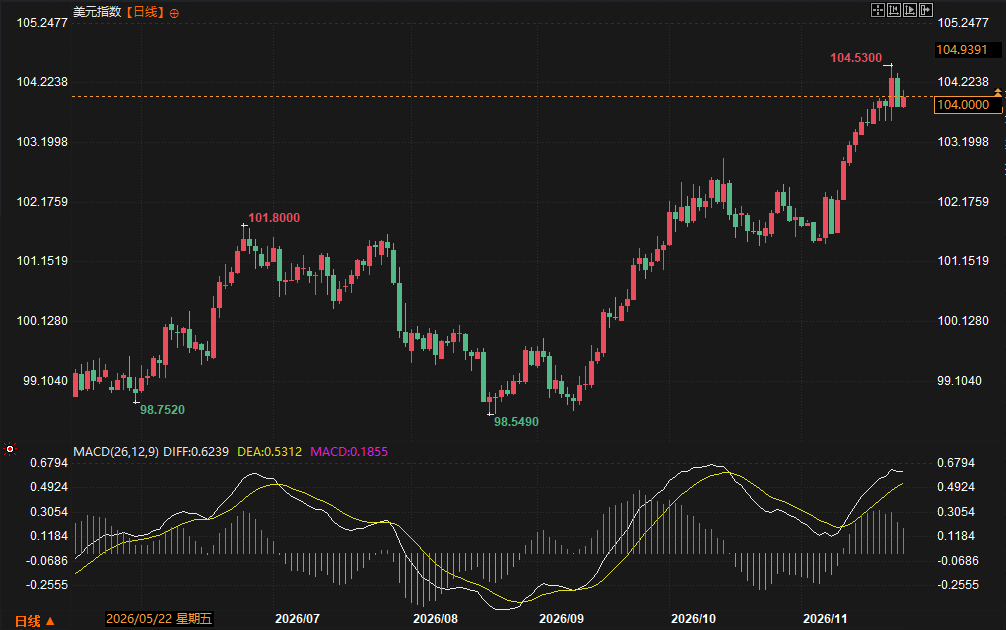
ING Bank believes that the recent performance of the US dollar has become the focus of the foreign exchange market. The US dollar index has been strengthening since near its August lows, accelerating its upward trend since October, and has at times approached or touched its recent highs, currently remaining in a relatively high range. The core driver of this rally is not a single factor, but rather a convergence of macroeconomic environment, policy expectations, and capital flows. 
Capital repatriation from emerging markets is a key driver
Market observations show a clear trend of position liquidation and capital repatriation in emerging market forex (EMFX). When risk appetite declines, investors tend to reduce their exposure to high-yield, high-volatility assets, with funds flowing back into dollar assets. Commodity currencies and Latin American currencies are the first to be affected, with currencies like the Australian dollar experiencing a rapid decline after a brief rebound, breaking through key support levels. Industrial metal prices are under pressure, with copper prices falling below a significant psychological level, further dragging down resource-exporting currencies. This "risk-averse" process strengthens the safe-haven and liquidity attributes of the US dollar. When global growth prospects face greater uncertainty, the US dollar often becomes the preferred safe haven for funds. Forex traders are generally focused on whether the adjustment in EM currencies will deepen further and whether this will continue to support the relative strength of the US dollar.New tariffs anticipated, coupled with concerns about growth.
The US government's investigation into excess manufacturing capacity has drawn significant market attention. Reports suggest potential tariffs on economies including China, the EU, and several trading partners, with expected rates within a certain range. If implemented, such policies would raise import costs and potentially put additional pressure on global trade and industrial activity. Against this backdrop, commodity prices are generally under pressure, further weakening export-dependent currencies. The market generally believes this environment is unlikely to reverse quickly in the short term, and a preference for defensive currencies such as the US dollar, Japanese yen, and Swiss franc is likely to continue. For forex traders, this means non-US dollar currencies, especially commodity and emerging market currencies, face stronger headwinds.The Fed's stance and inflation data provide additional support.
The Federal Reserve continued to send hawkish signals, and the market remained highly sensitive to the future direction of policy rates. A significant rebound in US consumer confidence, coupled with the trajectory of inflation data such as core PCE, reinforced the narrative that interest rates may remain high for an extended period. Yield curve dynamics also pointed to downward pressure on pro-cyclical currencies and support for the US dollar. It is worth noting that some argue the dollar's relative short-term interest rate differential may have already overshooted, but the continued adjustment of EM and commodity currencies remains a significant positive for the dollar. As long as inflation data does not significantly disappoint, the dollar's attractiveness near its current high levels is unlikely to diminish quickly.Overall meaning of the foreign exchange market
In summary, the current environment exhibits several distinct characteristics: the US dollar benefits from capital inflows and policy uncertainty; commodities and emerging market currencies are under pressure; and defensive currencies are relatively favored. Risk appetite in the foreign exchange market is shifting, with traders focusing more on macroeconomic drivers and capital flows rather than simply short-term fluctuations. Developments in tariff policy, Federal Reserve communications, inflation and confidence data, and the sustainability of EM capital flows will continue to dominate the medium-term trajectory of the US dollar and major currency pairs.
- Risk Warning and Disclaimer
- The market involves risk, and trading may not be suitable for all investors. This article is for reference only and does not constitute personal investment advice, nor does it take into account certain users’ specific investment objectives, financial situation, or other needs. Any investment decisions made based on this information are at your own risk.