Germany's third-quarter growth revised down to 0.1%: Can the euro withstand the decline in investment?
2026-11-25 17:54:32
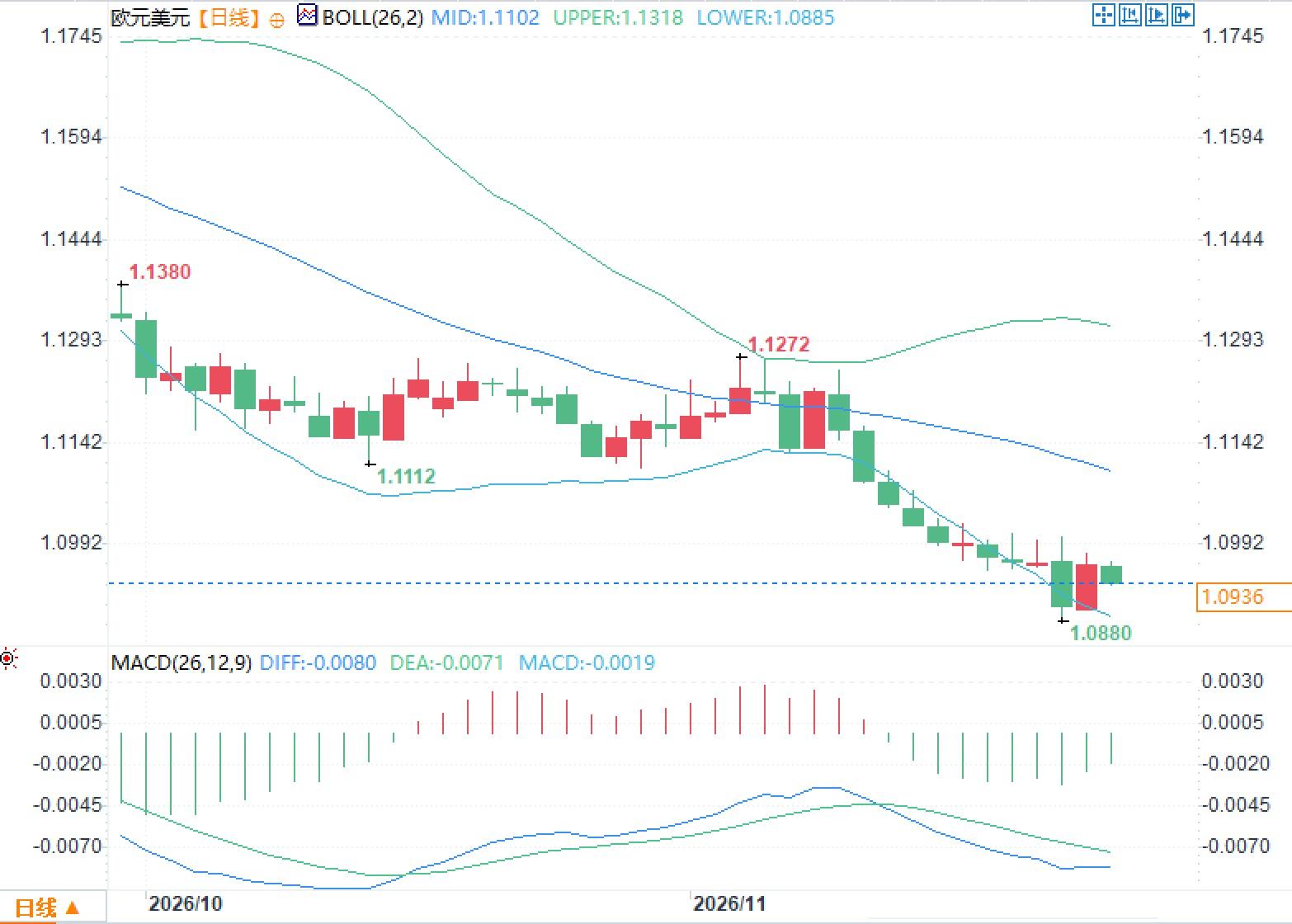
On Wednesday, November 25th, the euro traded around 1.094 against the US dollar after the German Federal Statistical Office released detailed third-quarter GDP figures. Adjusted for price, seasonal, and calendar changes, GDP grew by 0.1% quarter-on-quarter, a downward revision of 0.1 percentage points from the preliminary estimate of 0.2% at the end of October; year-on-year growth was 1.1%. The data confirms that the relatively strong expansionary pace in the first half of the year slowed significantly during the summer, with market focus concentrated on the extent of the decline in investment and the offsetting effect of public spending. 
Key data from the revised third-quarter GDP figures
The Federal Statistical Office of Germany confirmed that final consumption expenditure rose slightly by 0.1% quarter-on-quarter in the third quarter, with household consumption increasing by 0.1% and government consumption by 0.3%. Gross fixed capital formation fell by 1.2% quarter-on-quarter, with investment in machinery and equipment down 3.5% and construction investment down 0.3%. Goods exports fell by 0.8% quarter-on-quarter, while imports declined even more, with net exports contributing approximately 0.1 percentage points to growth. At current prices, GDP reached €1,186.88 billion in the third quarter, a year-on-year increase of 4.4%. Employment decreased by 0.5% year-on-year to 45.7 million. The downward revision was mainly due to weaker-than-expected export and retail data for September. Despite the slowdown in quarter-on-quarter growth, it has recorded positive growth for four consecutive quarters. The added value of the information and communication services sector rose by 1.5% quarter-on-quarter, indicating that some service sectors remain resilient, while the manufacturing sector was under pressure due to transportation restrictions and declining turnover in some industries.A comparison between declining private investment and support from public spending.
The sharp decline in capital investment was the most prominent structural feature of the third quarter. Michael Herzum, an economist at United Investment, pointed out that private investment remains a weak link in Germany's recovery. He stated that heightened geopolitical uncertainty during the summer dampened business investment, emphasizing the importance of businesses resuming investment to expand production. Jörg Kremer, chief economist at Commerzbank, believes that weak investment reflects businesses' disappointment with the government's failure to advance economic reforms. The divergence between public spending and private investment indicates that the recovery currently relies more on fiscal expansion than on businesses' own capacity expansion. The 0.3% increase in government consumption corresponds to spending on infrastructure and defense, while private sector investment in machinery and equipment is under pressure due to declining orders and commercial vehicle registrations.Export fluctuations and changes in external demand
Exports benefited from the global AI-related investment boom in the first half of the year, with the pharmaceutical industry experiencing additional demand ahead of new tariffs, and chemical companies also receiving temporary support. The situation reversed in the third quarter, with exports of automobiles, chemicals, and metals declining, resulting in an overall 0.8% quarter-on-quarter decrease in merchandise exports. Imports declined more than exports, meaning net exports still made a small positive contribution to growth. The German central bank previously stated that activity would accelerate again in the fourth quarter, and exports are expected to regain momentum. Current data shows that the pace of external demand has shifted from rapid expansion in the first half of the year to a more restrained state. Services exports also declined by 1.7%, further illustrating that the cooling demand is not limited to goods trade.Full-year growth path and policy background
Despite a slowdown in the third quarter, the German economy is still on track for its best full-year performance since 2022. Government economic advisors predict GDP growth of 1.3% in 2026 and 1% in 2027. The Bundesbank notes that expansionary fiscal policy continues to provide momentum, with industry benefiting from both domestic demand and global trade expansion, and output and exports expected to rebound in the fourth quarter. Chancellor Friedrich Merz's government is pushing forward a large-scale public spending plan aimed at strengthening infrastructure and defense capabilities. This fiscal path is a major support for the current recovery. However, continued weakness in private investment means that the sustainability of growth remains constrained if business investment intentions fail to recover. The Bundesbank also cautions that inflation may rise in early 2027 due to factors such as the expiration of fuel subsidies, and the transmission of energy costs to other prices also needs attention.Frequently Asked Questions
Question 1: Why was Germany's third-quarter GDP revised down from the initial estimate of 0.2% to 0.1%? Answer: Mainly due to weaker-than-expected exports and retail sales in September, and a larger decline in fixed capital formation, particularly in machinery and equipment investment, offsetting some of the contributions from consumption and net exports. Question 2: What are the main reasons for the decline in private investment? Answer: Michael Helzum pointed out that geopolitical uncertainty dampened business investment; Jörg Kremer emphasized businesses' disappointment with insufficient progress in reforms. Machinery and equipment investment fell by 3.5% quarter-on-quarter, becoming the most significant drag. Question 3: Can public spending support the annual growth target? Answer: Government consumption grew by 0.3%, with large-scale infrastructure and defense spending plans remaining the main drivers. Advisors predict 1.3% growth in 2026, and the German central bank also believes that activity will accelerate in the fourth quarter, but the speed of recovery in private investment will determine the breadth of the recovery.- Risk Warning and Disclaimer
- The market involves risk, and trading may not be suitable for all investors. This article is for reference only and does not constitute personal investment advice, nor does it take into account certain users’ specific investment objectives, financial situation, or other needs. Any investment decisions made based on this information are at your own risk.