Why did the Australian dollar fall by 1% despite October's CPI rising to a three-year high?
2026-11-25 19:42:35
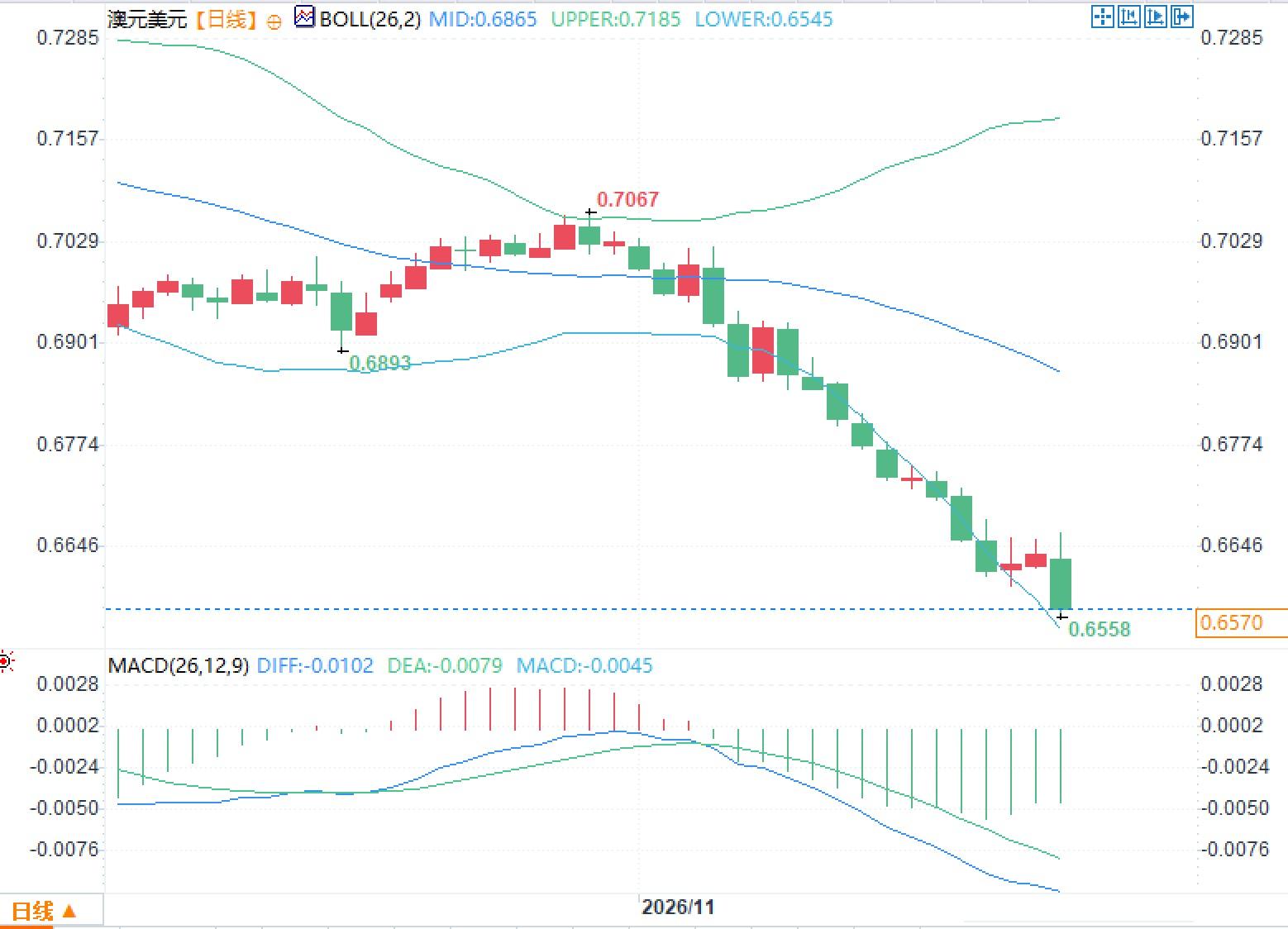
On Wednesday, November 25th, the Australian dollar was trading around 0.657 against the US dollar, down about 1% on the day. Data released by the Australian Bureau of Statistics that day showed that the overall CPI rose to 4.9% year-on-year in October, a significant acceleration from 4.3% in September; the trimmed mean, excluding volatility, rose to 3.8% year-on-year, higher than the market expectation of 3.6% and the previous value. This data should have reinforced the narrative of "high interest rates for longer," but the Australian dollar failed to receive sustained support. Instead, it weakened significantly against the backdrop of declining global risk appetite, renewed pressure on US stock index futures, and renewed tariff-related concerns. The Reserve Bank of Australia raised its cash rate target to 4.85% in early November and clearly stated that it would assess the policy's effects. Cash rate futures pricing indicates that the market still expects a 97% probability of keeping interest rates unchanged in December and February next year, suggesting that monthly inflation data has a far lower impact on the policy path than quarterly data. 
Higher-than-expected inflation failed to translate into sustained support for the Australian dollar.
October's trimmed mean inflation rose to 3.8% from 3.6%, while the overall CPI surged to a three-year high of 4.9%, primarily driven by a 6.3% increase in fuel prices and persistently high housing costs. The exclusion of fuel prices from the trimmed mean suggests that core price pressures have spread. The Reserve Bank of Australia (RBA) revised its inflation outlook upward in its November monetary policy statement, expecting both overall and core inflation to remain above the upper limit of the 3% target range until the end of 2027. However, monthly CPI data has a short history and is highly volatile, leading the market to generally view it as a leading indicator of quarterly inflation rather than a definitive indicator. Cash rate futures showed almost no significant repricing after the data release, with traders still expecting the December 8 meeting to maintain the rate at 4.85%. In an environment where capital preservation takes precedence over yield hunting, relatively high interest rates offer limited appeal to risk-sensitive currencies.Differences between the Reserve Bank of Australia's policy path and market pricing
The Reserve Bank of Australia (RBA) has raised interest rates by a total of 125 basis points since the beginning of the year. At its November meeting, it raised the cash rate to 4.85% by a 6-3 vote, with most members acknowledging that the policy might be overly tight and putting pressure on the labor market. The unemployment rate rose to a five-year high of 4.9% in September, and economic growth momentum slowed. Despite a rebound in core inflation in October, economists from several institutions maintain their assessment that the rate hike cycle is nearing its end, believing the RBA will observe data in the coming months rather than act immediately. The discrepancy between market pricing and the central bank's forward guidance has deprived the Australian dollar of additional support for upward revisions in interest rate expectations. Quarterly inflation data will be released in January next year, becoming a key juncture for assessing the central bank's resolve. Until then, the fact that policy rates are within a restrictive range has been fully priced in, making the Australian dollar more susceptible to changes in global liquidity and risk appetite.Cross-analysis of technical structure and fundamentals
From a daily chart perspective, the Australian dollar against the US dollar has been trading below the middle Bollinger Band after retreating from its highs, with the price near the lower band. The middle band is around 0.6865, the upper band is 0.7185, and the lower band is 0.6545. The MACD indicator is below the zero line, with both the DIFF and DEA lines negative, and the histogram remaining negative, indicating weak short-term momentum. Although monthly inflation data shows that price pressures persist, it has not changed the market consensus that the Reserve Bank of Australia will maintain a wait-and-see approach in the short term. Both technical and fundamental factors present a consistent weak characteristic at the current stage. Going forward, attention will shift to quarterly inflation data and the stability of global risk assets, rather than short-term fluctuations in a single technical indicator.Frequently Asked Questions
Question 1: Why did the Australian dollar still decline significantly after October's inflation exceeded expectations? Answer: Monthly CPI fluctuations are large and have a lower weighting than quarterly data. Market pricing indicates a very high probability that the Reserve Bank of Australia (RBA) will maintain its interest rate unchanged in December. Meanwhile, declining global risk appetite and pressure on US stock index futures have dominated short-term capital flows, overshadowing the support from domestic data. Question 2: The RBA's cash rate has reached 4.85%, why has it failed to provide sustained support for the Australian dollar? Answer: The marginal effect of interest rate advantages weakens in an environment prioritizing capital preservation. The unemployment rate has risen to 4.9% and growth has slowed, leading the market to expect the interest rate hike cycle to be nearing its end. As a risk-sensitive currency, the Australian dollar's performance depends more on global risk sentiment than on absolute interest rate levels. Question 3: What factors might affect the Australian dollar's short-term performance? Answer: The quarterly inflation data to be released in January next year will be a key indicator of the RBA's policy resolve. Whether global risk assets stabilize and changes in risk appetite remain the main external variables determining the relative strength of the Australian dollar at this stage.- Risk Warning and Disclaimer
- The market involves risk, and trading may not be suitable for all investors. This article is for reference only and does not constitute personal investment advice, nor does it take into account certain users’ specific investment objectives, financial situation, or other needs. Any investment decisions made based on this information are at your own risk.