Crude oil price forecast: Supply growth puts downward pressure on prices.
2026-11-26 00:50:33
West Texas Intermediate (WTI) crude oil is attempting to find support around $80, but rising global supply coupled with weak demand is hindering a sustained recovery in oil prices.  The latest supply and demand balance data shows that the short-term situation has offset market expectations of a tight global crude oil supply. As of the week ending November 20th, the latest EIA weekly report shows that US commercial crude oil inventories recorded a slight increase, less than the market had previously expected. The EIA weekly report released on November 25th showed that commercial crude oil inventories were 418.9 million barrels, an increase of 1.109 million barrels from the previous week; Cushing delivery center inventories also fell by 534,000 barrels to 25.61 million barrels. This marks the second consecutive week of inventory accumulation, but the rate of increase has narrowed significantly, and has not further amplified the pressure of domestic oversupply. US commercial crude oil inventories were 418.9 million barrels, 3.4% lower than the five-year average of 433.6 million barrels. Supply remains ample . US crude oil supply remains sufficient. The latest EIA data shows that US crude oil production was 14.065 million barrels per day this week, an increase of 33,000 barrels per day from the previous week; production continues to reach new highs, with the four-week average remaining above 14.02 million barrels, 2.1% higher than the same period last year. This production level provides ample buffer for the US domestic market, unless refinery purchases, crude oil exports, or production disruptions consume the increased crude oil. In a global supply-demand tight environment, stable or even continuously rising production can replenish inventories. When interpreting WTI prices, the focus should not be on single-week inventory increases, but rather on the trend of domestic supply and demand. The inventory accumulation of 1.109 million barrels was weaker than the market expectation of 2.06 million barrels, mitigating to some extent the short-selling impact of the previous continuous inventory accumulation; however, the continuous rise in inventories for two weeks still suppresses the bullish logic of inventory reduction. The data is also affected by import and export rhythms and refinery operating rates. Commercial crude oil inventories are a core indicator for judging the immediate crude oil supply of refineries. During the same statistical period, US strategic petroleum reserves decreased by 2.896 million barrels, falling to 273.5 million barrels. In addition, refinery operations rebounded significantly this week, with refinery capacity utilization rising 1.8 percentage points week-on-week to 97.5%. The increase in crude oil processing volume provides potential support for subsequent inventory reduction. However, crude oil exports fell by 1.219 million barrels per day week-on-week, with weakening exports being a major driver of this inventory accumulation. The fundamentals are mixed . Currently, the short-term fundamentals for WTI are mixed. The continuous accumulation of domestic inventories coupled with high production continues to limit the upside potential of oil prices. However, the current inventory accumulation is less than expected, and the rebound in refinery operations has weakened the bearish momentum. If inventories subsequently return to storage, and refinery operations or exports absorb the increased supply, the bearish logic will weaken. New supply disruptions, weather-related production cuts, and a continued recovery in refined product demand could all potentially break the current expectation of ample supply. Technical analysis of the chart.
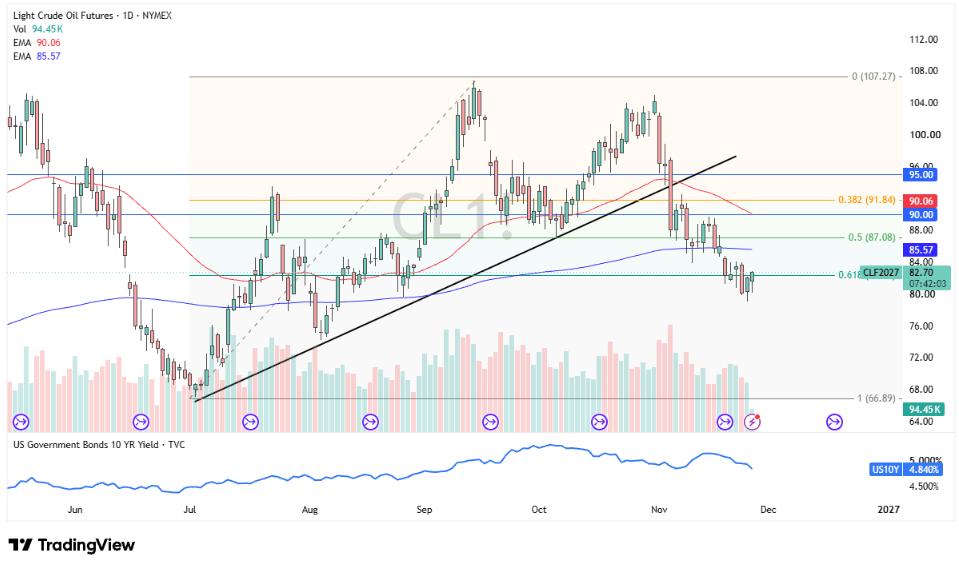 WTI crude oil is quoted at $83.26, near the 61.8% Fibonacci retracement level, with resistance at $90. Technically, WTI crude oil is indeed testing support around $80. After falling back to this range, the price rebounded, providing trading opportunities for short-term traders. However, it's important to note that Thanksgiving is the following day in the US, which will significantly tighten market liquidity. Brent Crude Oil Price Forecast Brent crude oil inventories are showing marginal improvement, but remain exposed to global shipping risks. The International Energy Agency (IEA) November 2026 Oil Market Report estimates that global crude oil supply in October was 105.4 million barrels per day, an increase of 2.3 million barrels from September; inventories increased by 52 million barrels, the first accumulation since June, mainly due to an increase of 86 million barrels in floating storage. These figures are monthly estimates and do not equate to daily flow data or current price signals. The IEA also noted that onshore inventories continued to decline, reaching their lowest level since 2016. Global crude oil inventories increased by 52 million barrels in October, after decreasing by 10 million barrels in September. Weakening Demand Expectations Weak demand is a major challenge for bulls. The IEA forecasts that global crude oil demand will fall by 2.7 million barrels per day to 102.3 million barrels per day in 2026, before rebounding by 2 million barrels per day in 2027. Analysts believe that as disruptions to the fuel and feedstock supply chains gradually subside, the year-on-year decline in demand will narrow later this year; however, high oil prices and improved energy efficiency will suppress growth in transportation fuel demand. This forecast is subject to change, and the final supply and demand dynamics will depend on the speed of recovery in Gulf region crude oil exports and whether there will be further attacks disrupting exports. Key Focus on Export Changes For Brent crude, the main upside risks come from renewed disruptions to exports, port operations, and tanker shipping. The IEA noted that ongoing attacks on shipping and energy facilities have led to increased freight rates on some routes. Despite these risks, Gulf crude oil exports are recovering, with October exports still 26% lower than pre-war levels, and current volumes significantly below normal production capacity. The corresponding bearish logic lies in the rapid increase in crude oil supply in October. If this supply flow continues, floating crude oil at sea will gradually be converted into deliverable spot goods. Of course, my assessment is conditional: if exports continue to recover and demand remains weak, the scarcity premium for Brent crude will weaken; conversely, if shipping is disrupted again, the scarcity premium will quickly return. Technical Outlook
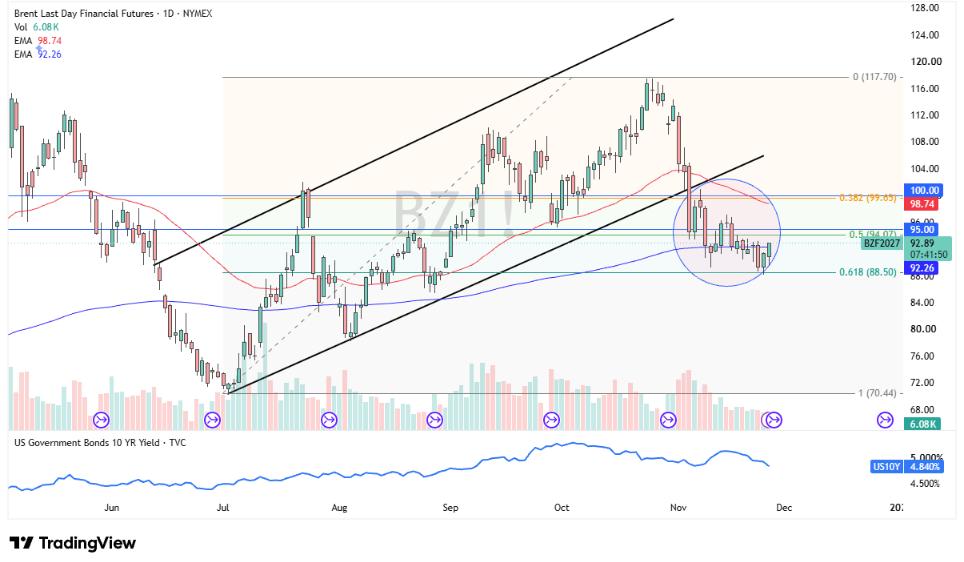 Brent crude is currently trading at $93.42, fluctuating between the $95 resistance level and the $88.50 Fibonacci support level. The next EIA weekly crude oil report will be released after the Thanksgiving holiday. Oil prices are likely to remain range-bound, fluctuating around the 200-day exponential moving average (EMA). Overall, the short-term outlook is neutral to bullish; the long-term direction still needs further confirmation.
The latest supply and demand balance data shows that the short-term situation has offset market expectations of a tight global crude oil supply. As of the week ending November 20th, the latest EIA weekly report shows that US commercial crude oil inventories recorded a slight increase, less than the market had previously expected. The EIA weekly report released on November 25th showed that commercial crude oil inventories were 418.9 million barrels, an increase of 1.109 million barrels from the previous week; Cushing delivery center inventories also fell by 534,000 barrels to 25.61 million barrels. This marks the second consecutive week of inventory accumulation, but the rate of increase has narrowed significantly, and has not further amplified the pressure of domestic oversupply. US commercial crude oil inventories were 418.9 million barrels, 3.4% lower than the five-year average of 433.6 million barrels. Supply remains ample . US crude oil supply remains sufficient. The latest EIA data shows that US crude oil production was 14.065 million barrels per day this week, an increase of 33,000 barrels per day from the previous week; production continues to reach new highs, with the four-week average remaining above 14.02 million barrels, 2.1% higher than the same period last year. This production level provides ample buffer for the US domestic market, unless refinery purchases, crude oil exports, or production disruptions consume the increased crude oil. In a global supply-demand tight environment, stable or even continuously rising production can replenish inventories. When interpreting WTI prices, the focus should not be on single-week inventory increases, but rather on the trend of domestic supply and demand. The inventory accumulation of 1.109 million barrels was weaker than the market expectation of 2.06 million barrels, mitigating to some extent the short-selling impact of the previous continuous inventory accumulation; however, the continuous rise in inventories for two weeks still suppresses the bullish logic of inventory reduction. The data is also affected by import and export rhythms and refinery operating rates. Commercial crude oil inventories are a core indicator for judging the immediate crude oil supply of refineries. During the same statistical period, US strategic petroleum reserves decreased by 2.896 million barrels, falling to 273.5 million barrels. In addition, refinery operations rebounded significantly this week, with refinery capacity utilization rising 1.8 percentage points week-on-week to 97.5%. The increase in crude oil processing volume provides potential support for subsequent inventory reduction. However, crude oil exports fell by 1.219 million barrels per day week-on-week, with weakening exports being a major driver of this inventory accumulation. The fundamentals are mixed . Currently, the short-term fundamentals for WTI are mixed. The continuous accumulation of domestic inventories coupled with high production continues to limit the upside potential of oil prices. However, the current inventory accumulation is less than expected, and the rebound in refinery operations has weakened the bearish momentum. If inventories subsequently return to storage, and refinery operations or exports absorb the increased supply, the bearish logic will weaken. New supply disruptions, weather-related production cuts, and a continued recovery in refined product demand could all potentially break the current expectation of ample supply. Technical analysis of the chart. WTI crude oil is quoted at $83.26, near the 61.8% Fibonacci retracement level, with resistance at $90. Technically, WTI crude oil is indeed testing support around $80. After falling back to this range, the price rebounded, providing trading opportunities for short-term traders. However, it's important to note that Thanksgiving is the following day in the US, which will significantly tighten market liquidity. Brent Crude Oil Price Forecast Brent crude oil inventories are showing marginal improvement, but remain exposed to global shipping risks. The International Energy Agency (IEA) November 2026 Oil Market Report estimates that global crude oil supply in October was 105.4 million barrels per day, an increase of 2.3 million barrels from September; inventories increased by 52 million barrels, the first accumulation since June, mainly due to an increase of 86 million barrels in floating storage. These figures are monthly estimates and do not equate to daily flow data or current price signals. The IEA also noted that onshore inventories continued to decline, reaching their lowest level since 2016. Global crude oil inventories increased by 52 million barrels in October, after decreasing by 10 million barrels in September. Weakening Demand Expectations Weak demand is a major challenge for bulls. The IEA forecasts that global crude oil demand will fall by 2.7 million barrels per day to 102.3 million barrels per day in 2026, before rebounding by 2 million barrels per day in 2027. Analysts believe that as disruptions to the fuel and feedstock supply chains gradually subside, the year-on-year decline in demand will narrow later this year; however, high oil prices and improved energy efficiency will suppress growth in transportation fuel demand. This forecast is subject to change, and the final supply and demand dynamics will depend on the speed of recovery in Gulf region crude oil exports and whether there will be further attacks disrupting exports. Key Focus on Export Changes For Brent crude, the main upside risks come from renewed disruptions to exports, port operations, and tanker shipping. The IEA noted that ongoing attacks on shipping and energy facilities have led to increased freight rates on some routes. Despite these risks, Gulf crude oil exports are recovering, with October exports still 26% lower than pre-war levels, and current volumes significantly below normal production capacity. The corresponding bearish logic lies in the rapid increase in crude oil supply in October. If this supply flow continues, floating crude oil at sea will gradually be converted into deliverable spot goods. Of course, my assessment is conditional: if exports continue to recover and demand remains weak, the scarcity premium for Brent crude will weaken; conversely, if shipping is disrupted again, the scarcity premium will quickly return. Technical Outlook Brent crude is currently trading at $93.42, fluctuating between the $95 resistance level and the $88.50 Fibonacci support level. The next EIA weekly crude oil report will be released after the Thanksgiving holiday. Oil prices are likely to remain range-bound, fluctuating around the 200-day exponential moving average (EMA). Overall, the short-term outlook is neutral to bullish; the long-term direction still needs further confirmation.
- Risk Warning and Disclaimer
- The market involves risk, and trading may not be suitable for all investors. This article is for reference only and does not constitute personal investment advice, nor does it take into account certain users’ specific investment objectives, financial situation, or other needs. Any investment decisions made based on this information are at your own risk.