A seasoned industry expert has made a significant statement: the sharp drop is merely a temporary correction, and the foundation for a long-term bull market in gold remains intact.
2026-11-26 11:58:33
Faced with the dismal performance of gold prices, which have plummeted from their January highs, pessimism has spread across the market, with many fearing a repeat of history. However, Felix Zulauf, a seasoned investor with over half a century of experience in the market, offers a completely different perspective. He firmly believes that the current decline is merely a normal correction within a long-term uptrend, and the long-term bull market foundation for gold remains unshaken.
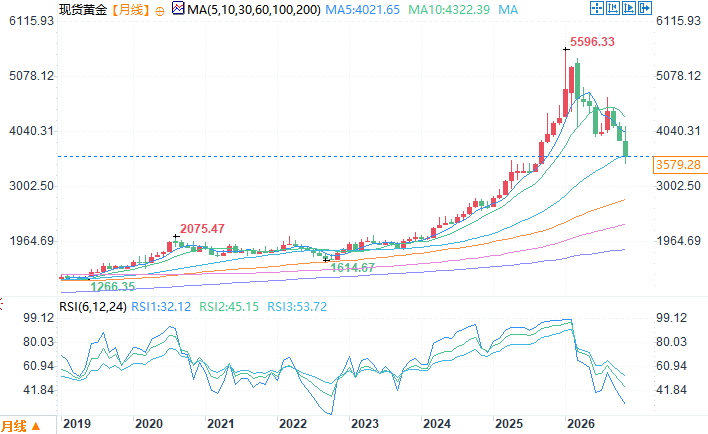 Spot gold monthly chart source: FX678. At 11:51 AM Beijing time on November 26th, spot gold was trading at $3579.28 per ounce.
A single failed transaction became a cautionary tale for investors.
This profound market insight stems from a painful lesson learned by Zuraf in his early years. Back in 1980, gold had just reached an all-time high of $850 per ounce, while silver surged to $50 before declining. At only 30 years old, he bought silver at $36, hoping to catch a rebound. But the market ruthlessly shattered his prediction. He recalled, "I thought I was incredibly clever, but within days the price plummeted from $36 to $18. I had no choice but to cut my losses, losing half my capital. I could only turn off the monitor, unable to bear looking at it anymore." This unforgettable experience gave him a far deeper understanding of market cycles and trends than most people could comprehend.Understanding inflation cycles and avoiding the misconception that history repeats itself.
Gold prices have fallen by more than a third from their peak at the beginning of the year, leading the market to widely compare them to the prolonged slump following the gold price peak in 1980. Zuraf explicitly denied this. When questioned by an industry media host, he stated, "It's neither 1980 nor 1976; this year we've simply reached a significant mid-term high." His core judgment points to a deep analysis of the long-term inflation cycle. The end of the gold bull market in the 1970s stemmed from then-Federal Reserve Chairman Paul Volcker's forceful tightening of the monetary supply, which completely crushed inflation, followed by a forty-year period of declining inflation. Zuraf believes that this long deflationary cycle has completely ended, replaced by a long-term upward trend in inflation. This will inevitably provide long-term upward momentum for gold. The current decline is merely a phase correction in a long-term upward trend . He predicts that before a real crisis emerges, gold is likely to rebound to previous highs or even break new records.Exploring the root causes of the plunge, bottoming signals are gradually emerging.
Looking back at the recent plunge in gold prices from their peak to around $3,500, a drop of 37%, Zuraf attributed the decline to two core factors. Firstly, margin call pressures, with the stock market downturn forcing leveraged investors to sell off various assets at any cost. Secondly, the impact on the bond market, with both nominal and real interest rates rising simultaneously, became a key negative factor suppressing gold prices. He also admitted that the magnitude of the price drop exceeded his expectations, and while the breach of the previously key $3,800 level was somewhat disappointing, he believed that the $3,500 area was sufficient to form a solid bottom, and the current widespread bearish sentiment was unfounded. He published his assessment on Tuesday, and by Wednesday morning, gold had fallen below $3,500, reaching $3,482 per ounce, while silver had also fallen below $40. Even though the latest inflation data supports expectations of a Fed rate hike next month, with the core PCE price index rising 3.3% year-on-year to a new high since 2023, it has not changed his medium-term judgment. He said that his various indicators have released positive signals and the market will bottom out in just a few days.Diversified asset allocation, adhering to the long-term core value of gold
In terms of asset allocation, Zuraf is extremely confident in gold. He began investing in physical gold as early as the early 2000s at a price of $250 to $300 per ounce, believing that below $4,000 is an excellent buying range. He has now unwound his previous hedging protection and points to the fact that major Asian central banks have increased their gold holdings for 24 consecutive months, with a single-month increase of 26 tons in October, providing strong evidence for his judgment. However, he holds a completely different and cautious attitude towards stocks and bonds. He believes that US stocks will rebound in the short term, but the crowding out of funds caused by the artificial intelligence boom will trigger a deep correction of about 30% for the S&P 500 and about 50% for the Nasdaq. He also considers bonds to be the least worthwhile asset to hold over the next decade, predicting that major governments may default on their debts in the early 2030s, with bondholders suffering the greatest losses.Conclusion
Against the backdrop of monetary illusion, Felix Zuraf firmly believes that gold is the only true currency. He predicts that after the tax-loss sell-off ends in mid-December, the gold market will officially begin its recovery, pointing investors to a clear long-term allocation direction in a volatile market. Spot gold monthly chart source: FX678. At 11:51 AM Beijing time on November 26th, spot gold was trading at $3579.28 per ounce.
- Risk Warning and Disclaimer
- The market involves risk, and trading may not be suitable for all investors. This article is for reference only and does not constitute personal investment advice, nor does it take into account certain users’ specific investment objectives, financial situation, or other needs. Any investment decisions made based on this information are at your own risk.