With liquidity tightening around Thanksgiving, has the current pullback in the USD/CAD pair ended?
2026-11-26 14:16:35
On Thursday (November 26) during Asian trading hours, the US dollar rose slightly against the Canadian dollar, ending a two-day losing streak. Yesterday, it briefly dipped below 1.4200, hitting a two-week low. Currently trading around 1.4220, it is up about 0.04%, with bullish momentum weak and the two sides locked in a tug-of-war. The US dollar stabilized after a two-day correction, benefiting from rising expectations of a hawkish rate hike by the Federal Reserve and renewed escalation of conflicts in the Middle East, providing upward pull for the USD/CAD pair. However, the continued recovery in oil prices provided support for the Canadian dollar, limiting further gains for the pair. 
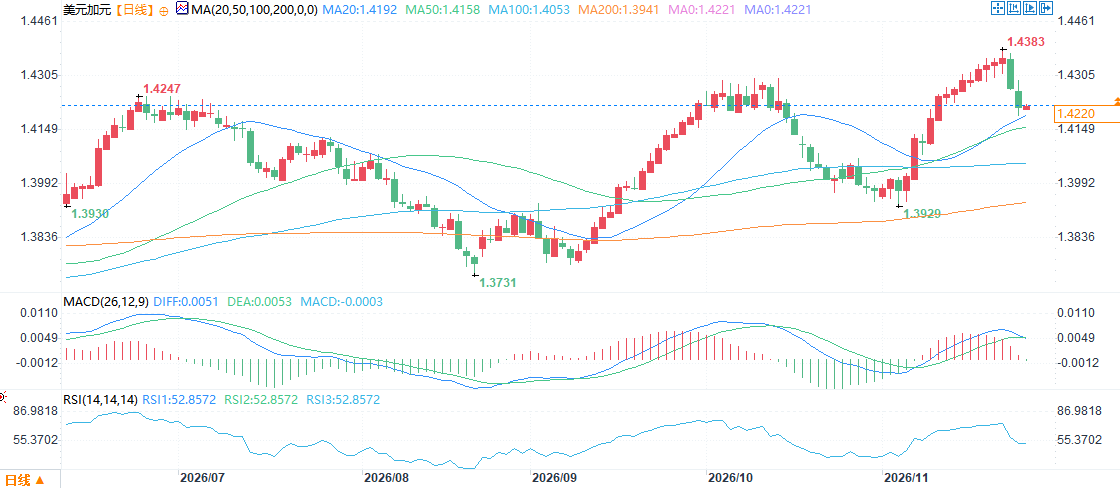 (USD/CAD daily chart, source: EasyForex) At 14:10 Beijing time, USD/CAD was trading at 1.4220/21.
US inflation data shows remarkable resilience, and expectations for interest rate hikes continue to rise.
On Wednesday, the US core PCE price index and Q3 GDP data were released simultaneously, once again confirming the coexistence of sticky inflation and economic resilience. Both the year-on-year and quarter-on-quarter core PCE figures were higher than market expectations, indicating that service prices and housing-related costs are still slowly declining. However, signs of rising goods inflation and the lagged effect of wage growth have made the overall inflation path smoother. Meanwhile, real GDP growth remained within a robust range, and private consumption and business investment did not show a significant decline, further weakening market illusions of a "rapid shift to easing after a soft landing." The CME FedWatch tool shows that traders, having fully priced in the 25 basis point rate hike at the December meeting, have begun pricing in two additional rate hikes that may occur in early 2027. This upward revision of interest rate expectations directly boosted short-term support for the US dollar index and also gave the USD/CAD pair some upward momentum during the Asian session. Historical experience shows that when inflation data consistently validates the "higher and longer" narrative, the US dollar often maintains relative strength against other currency pairs. The current market repricing of the Federal Reserve's policy path remains the core fundamental factor supporting the USD/CAD exchange rate. In the short term, any lower-than-expected inflation data could trigger a rapid correction in expectations. Therefore, investors need to closely monitor marginal changes in subsequent employment and price data.Resurgence of conflict in the Middle East is disrupting energy markets, becoming a dual variable.
Renewed geopolitical tensions in the Middle East have become a key variable influencing the USD/CAD exchange rate. The Houthi rebels claimed responsibility for attacks on Saudi Arabia's largest oil refinery, Rastanura, and the King Abdullah financial district. The Saudi-led coalition swiftly retaliated against Houthi targets in the port of Hodeidah, and attacks were also reported in Sana'a, the capital of Yemen. These events directly fueled market concerns about disruptions to Middle Eastern oil supplies, leading to a recovery in Brent and WTI crude oil prices during the Asian session. The rebound in oil prices provided significant support for the Canadian dollar, as Canada, as a major energy exporter, has a long-standing positive correlation between oil prices and the Canadian dollar. Simultaneously, the escalating geopolitical conflict also activated global risk aversion, with the US dollar, as a traditional safe-haven currency, once again attracting buying interest. These two forces offset each other, resulting in a tug-of-war between bulls and bears around 1.4220 for the USD/CAD pair. If the conflict escalates further and substantially impacts shipping in the Strait of Hormuz or the Red Sea, oil prices could accelerate their rise and strengthen support for the Canadian dollar; conversely, if the situation de-escalates quickly and safe-haven dollar buying subsides, the currency pair could come under renewed pressure. The market is currently closely watching subsequent statements from both Saudi Arabia and the Houthis, as well as signals of potential further US intervention.Thanksgiving will see low liquidity; be wary of distorted signals.
With the US Thanksgiving holiday approaching, liquidity has significantly decreased during major trading sessions in Europe and the US, and trading volume is even thinner during Asian sessions. This environment easily amplifies short-term price fluctuations, leading to temporary divergences between technical signals and fundamental logic. The USD/CAD pair has been correcting this week from its April high near 1.4385. While it has found some support below 1.4200 and rebounded slightly, there has been no clear confirmation of stabilization buying. In a liquidity-scarce environment, any single news event can trigger an overreaction, followed by a rapid pullback due to insufficient real demand. Historical data shows that USD-related currency pairs often experience "false breakouts" or "false breakdowns" around Thanksgiving, so investors should be extremely cautious when going long or short. It is recommended to prioritize whether trading volume is supportive, whether key support/resistance levels have been effectively broken, and whether Federal Reserve officials release new policy statements before or after the holiday. Before a clear trend signal emerges, a more prudent strategy is to control position size and shorten holding periods to avoid being misled by noise-driven market movements in a liquidity-scarce environment. (USD/CAD daily chart, source: EasyForex) At 14:10 Beijing time, USD/CAD was trading at 1.4220/21.
- Risk Warning and Disclaimer
- The market involves risk, and trading may not be suitable for all investors. This article is for reference only and does not constitute personal investment advice, nor does it take into account certain users’ specific investment objectives, financial situation, or other needs. Any investment decisions made based on this information are at your own risk.