Lagarde names three major forces; what kind of turning point is hidden in the outlook for the euro?
2026-11-26 21:04:34
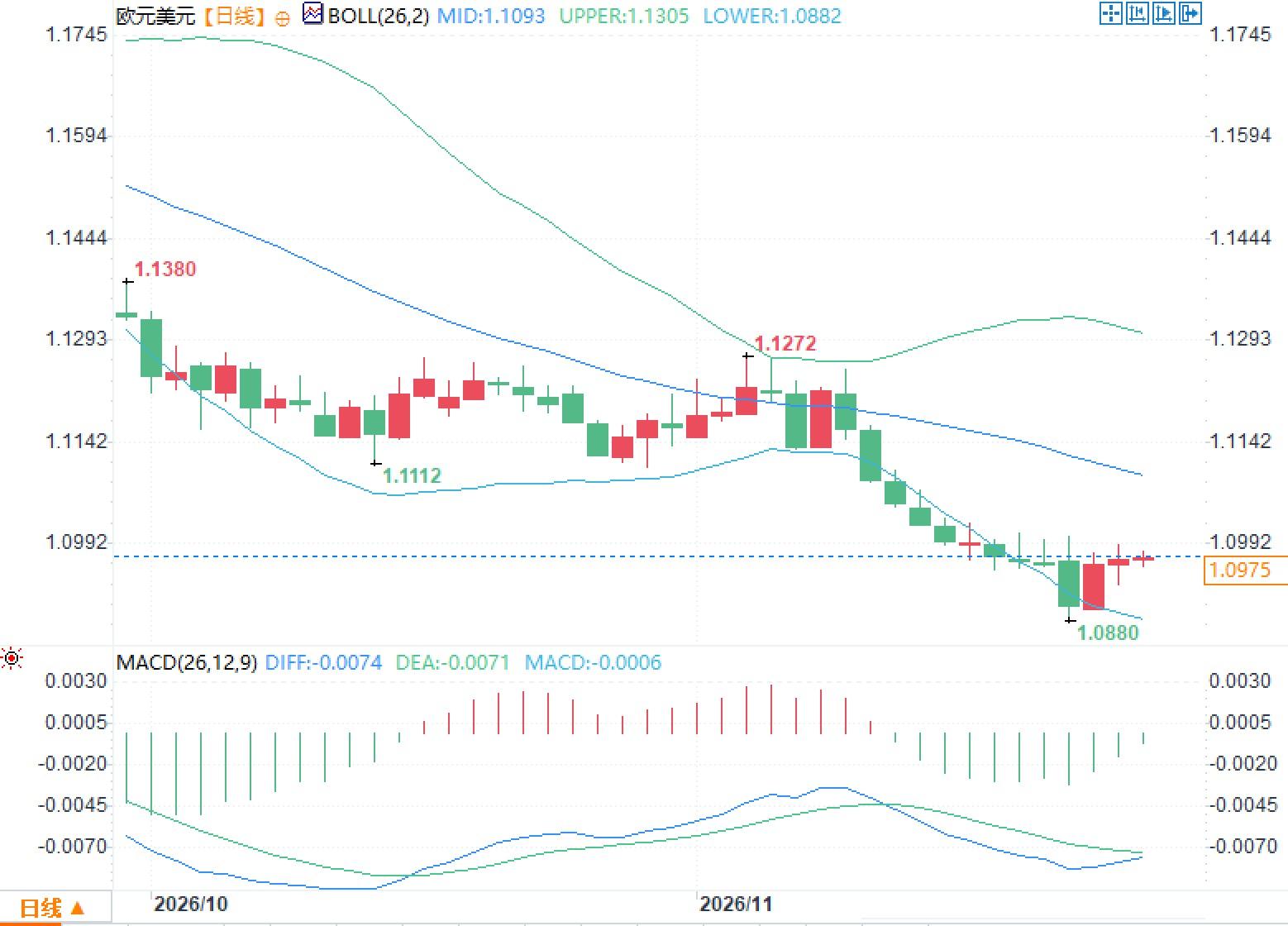
On Thursday, November 26, the euro traded in a narrow range against the US dollar around 1.097, down about 2% from the end of October, with limited intraday volatility. The European Central Bank (ECB) kept its deposit rate at 2.50%, its main refinancing rate at 2.65%, and its marginal lending rate at 2.90% on October 29. The Eurozone's harmonized index of consumer prices (HICP) rose to 4.0% year-on-year in October, up from 3.8% in September, with the energy component contributing the most, reaching around 21.0% year-on-year. ECB President Christine Lagarde told European leaders in Brussels this week that artificial intelligence is one of the factors helping the region cope with the energy crisis, and that the economy's resilience to the impact of related conflicts has exceeded expectations. She also specifically mentioned that rising global long-term interest rates are a third force shaping the outlook. 
Lagarde named three shaping forces
Lagarde explained to leaders that artificial intelligence, the energy situation, and rising global long-term interest rates constitute the three core forces driving the current outlook. Artificial intelligence plays a role by improving productivity and export structure, while energy shocks continue to push up costs. The rise in long-term interest rates reflects more the large-scale bond issuance by governments and corporations than simply expectations of central bank borrowing costs. This combination has allowed the Eurozone to continue expanding despite high energy prices, but tightening financing conditions have begun to affect investment decisions. Lagarde emphasized that the main reason for rising long-term interest rates is the large-scale bond issuance on the supply side. Currently, the yield on German 10-year government bonds is around 3.25% to 3.32%, and the yield on US 10-year bonds is around 4.86%, both significantly higher than at the beginning of the year.Sources of economic resilience under energy shocks
Energy prices have been rising steadily since spring, primarily driven by related conflicts. Crude oil and refined product prices briefly surpassed $100, leading to increased electricity costs. European Central Bank economists previously analyzed that the Eurozone's dependence on oil has fallen to about half of what it was in the early 1990s, and the increased share of renewable energy and nuclear power has weakened the transmission of natural gas prices to electricity prices. The investment cycle related to artificial intelligence has provided additional support, with Europe performing strongly in exports of cooling equipment and chip manufacturing. The European Commission has raised its 2026 Eurozone growth forecast to 1.2%. Lagarde noted that the economy's resilience has exceeded expectations, but the full effects of the energy shock are still unfolding. Underlying inflation is currently broadly stable, and wages have not yet shown a significant second-round effect. Core inflation was around 2.6% in October.The Mechanism and Market Impact of Rising Long-Term Interest Rates
Rising global long-term interest rates have become a significant variable across asset pricing. The European Central Bank's meeting minutes show that since September, forward rates adjusted for term premiums have already factored in a path for deposit rates to rise to 3.0% by mid-2027. Large-scale government and corporate bond issuance is the primary driver; fiscal expansion and corporate refinancing demands have increased supply, coupled with expectations of borrowing costs for some central banks, collectively pushing up term premiums. For the Eurozone, this reflects both tightening external financing conditions and the potential to impact internal financial conditions through exchange rates and capital flows. Currently, overall financing conditions in the Eurozone are tightening, further reinforced by stock price adjustments and widening sovereign debt spreads. Lagarde listed this as one of the three main forces, indicating that policymakers have incorporated it into their medium-term outlook assessment.Leadership change and policy continuity considerations
Christine Lagarde will step down on February 7, 2027, approximately nine months before the end of her term. Former Central Bank of Spain Governor Pablo Hernández de Cos has emerged as a clear frontrunner, with France and Germany having reached an agreement to support his appointment. This leadership change occurs against the backdrop of inflation remaining above target and the full effects of the energy shock not yet being realized. The market is focused on the new governor's continued reliance on a data-driven framework and a meeting-by-meeting decision-making approach. De Cos previously demonstrated experience in financial stability and policy communication during his tenure at the Bank of Spain, and his potential succession could help ensure a smooth transition to the existing policy path.Frequently Asked Questions
Question 1: How exactly do the three forces Lagarde mentioned affect the Eurozone's outlook? Answer: Artificial intelligence is supported by exports and investment; energy shocks push up costs, but declining dependence limits transmission; and rising long-term interest rates mainly come from large-scale bond issuance, collectively shaping the path of growth and inflation. Question 2: What is the current inflation and interest rate situation in the Eurozone? Answer: Inflation rose to 4.0% in October, dominated by the energy component. The ECB maintained its deposit rate at 2.50% in October, emphasizing data dependence and meeting-by-meeting decision-making. Question 3: What impact will the leadership change have on policy continuity? Answer: Lagarde will step down on February 7, 2027. Decos is currently a leading candidate, and the market is focused on whether he will continue the existing data-dependent framework.- Risk Warning and Disclaimer
- The market involves risk, and trading may not be suitable for all investors. This article is for reference only and does not constitute personal investment advice, nor does it take into account certain users’ specific investment objectives, financial situation, or other needs. Any investment decisions made based on this information are at your own risk.