













Crude oil price forecast: Gulf tensions push oil prices to find bottom.
2026-11-27 01:08:33
Despite rising crude oil inventories and record U.S. crude oil production, escalating tensions in the Gulf region have provided support for oil prices, with both West Texas Intermediate (WTI) and Brent crude showing signs of bottoming out.  West Texas Intermediate (WTI) crude oil prices continued Wednesday's upward trend during Thursday's (November 26) US trading session, amid a quiet holiday trading environment. The January WTI contract on the New York Mercantile Exchange settled at $84.61, up $0.34 from the previous trading range of $80.13–$84.27. No final settlement price was issued due to the holiday. Cushing crude oil inventories fell to 25.6 million barrels, still 1.3% above the five-year average of 25.3 million barrels. US commercial crude oil inventories rose by 1.1 million barrels to a total of 418.9 million barrels, less than analysts' previous expectations of a 1.5 million barrel increase. Data from the US Energy Information Administration (EIA) showed that Cushing inventories fell by 534,000 barrels to 25.6 million barrels, a level roughly in line with the weekly average for the same period in 2021–2025, but 3.9 million barrels higher than the same period last year. U.S. crude oil production hit a new record high of 14.065 million barrels per day (bpd) per week; refinery utilization surged to 97.5%. Import and Export Data: Crude oil exports decreased by 1.2 million barrels per day to 3.27 million bpd; crude oil imports rose to 6.25 million bpd per day. Gasoline inventories increased by 1.7 million barrels to 217.7 million barrels; distillate fuel inventories increased by 700,000 barrels to 105.6 million barrels; strategic petroleum reserves decreased by 2.9 million barrels to 273.5 million barrels. Near-record refining demand absorbed the record crude oil production, while declining crude oil exports were the main reason for this round of inventory increases. Forward curves show that the February contract settled at $82.35, the January-February contract spread widened to $1.33, and the January contract premium over the December 2027 contract was $11.62. Asset Management Funds: Thin Long Positions As of November 17th, asset management accounts held only 15,814 net long contracts, a very small long position. Intention to enter the market is weak. The rebound that began on Tuesday from the low of $79.08 was more likely short covering driven by news rather than new funds actively going long. This rebound in oil prices will be relatively fragile once the geopolitical risks in the Gulf subside. WTI Crude Oil Technical Analysis
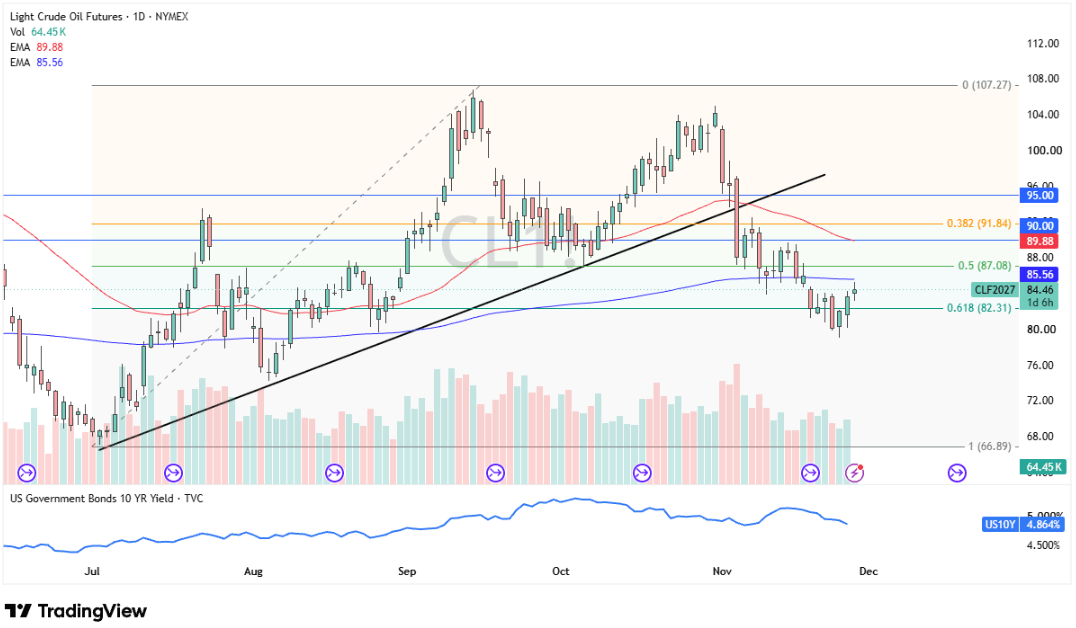 WTI crude oil rebounded to $84.61, stabilizing above the Fibonacci retracement level of $82.31, but still below the moving average of $85.56. From a technical perspective, Thursday's price action tested the 200-day exponential moving average (EMA), a key indicator for many traders to determine trend direction. A break above the 200-day EMA would be a positive sign. However, ultimately, current oil price movements remain highly dependent on breaking news. The market is currently in a phase of attempting to establish a support level. Brent Crude Oil As the conflict in the Gulf expands, the Brent crude oil spread between near and far months has widened sharply. The January-February spread reached $4.55, compared to just $2.62 the previous day. The January contract was quoted slightly below $96, while the February contract was quoted at $91.23. The Houthi rebels in Yemen claimed responsibility for an attack on the Rastanura oil refinery in Saudi Arabia, a key component of Saudi Arabia's crude oil export hub. The Saudi-led coalition stated that it shot down four drones over Rastanura, but did not confirm that any facilities were hit. Iran's Fars News Agency reported that an oil tanker struck a mine and caught fire in the Strait of Hormuz's controlled area. The Middle East conflict is escalating further. ANZ analysts stated that the continued expansion of the Middle East conflict could disrupt the recovery process of oil circulation. The International Energy Agency (IEA) reported on November 13 that Gulf region (excluding Oman) oil exports in October were 18.4 million barrels per day, 26% lower than pre-war levels; the IEA also predicted that oil supply will increase by 6.6 million barrels per day in 2027, but demand will only increase by 2 million barrels per day. OPEC's View OPEC's outlook is more optimistic: it believes that crude oil demand will still grow by 200,000 barrels per day in 2026, while the IEA predicts a decrease of 2.7 million barrels per day in demand in 2026; OPEC expects demand to increase by 2.6 million barrels per day in 2027, corresponding to a supply of 43.9 million barrels per day for OPEC crude oil. Bloomberg, citing sources, reported that OPEC representatives are discussing extending existing production quotas to January of next year; Iraq hopes to increase its officially approved production capacity to approximately 6 million barrels per day, up from the initial estimate of 4.9 million barrels per day. The OPEC+ ministerial meeting will be held on Sunday. Brent Crude Oil Technical Analysis
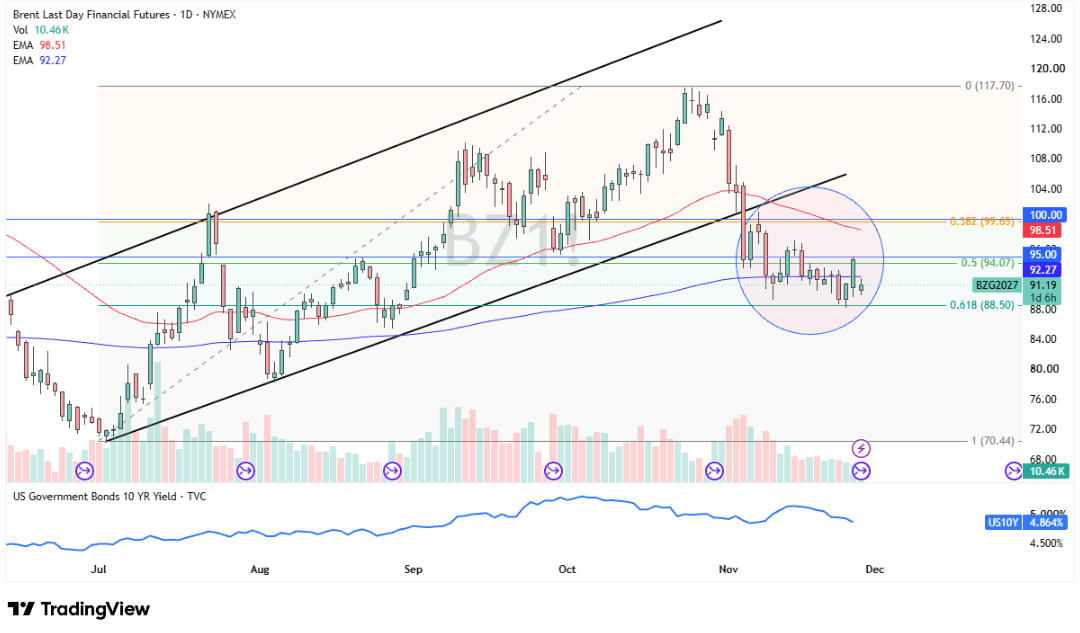 Brent crude is currently trading at $91.19, consolidating within a range of $88.50–$95.00. Chart patterns show Brent and WTI moving similarly, both in a bottoming phase. Oil prices previously experienced a rapid decline; notably, the 61.8% Fibonacci retracement level is just below the current price, and the 200-day EMA crosses this consolidation range. Given this situation, the market is likely to continue attracting value traders looking to buy on dips.
West Texas Intermediate (WTI) crude oil prices continued Wednesday's upward trend during Thursday's (November 26) US trading session, amid a quiet holiday trading environment. The January WTI contract on the New York Mercantile Exchange settled at $84.61, up $0.34 from the previous trading range of $80.13–$84.27. No final settlement price was issued due to the holiday. Cushing crude oil inventories fell to 25.6 million barrels, still 1.3% above the five-year average of 25.3 million barrels. US commercial crude oil inventories rose by 1.1 million barrels to a total of 418.9 million barrels, less than analysts' previous expectations of a 1.5 million barrel increase. Data from the US Energy Information Administration (EIA) showed that Cushing inventories fell by 534,000 barrels to 25.6 million barrels, a level roughly in line with the weekly average for the same period in 2021–2025, but 3.9 million barrels higher than the same period last year. U.S. crude oil production hit a new record high of 14.065 million barrels per day (bpd) per week; refinery utilization surged to 97.5%. Import and Export Data: Crude oil exports decreased by 1.2 million barrels per day to 3.27 million bpd; crude oil imports rose to 6.25 million bpd per day. Gasoline inventories increased by 1.7 million barrels to 217.7 million barrels; distillate fuel inventories increased by 700,000 barrels to 105.6 million barrels; strategic petroleum reserves decreased by 2.9 million barrels to 273.5 million barrels. Near-record refining demand absorbed the record crude oil production, while declining crude oil exports were the main reason for this round of inventory increases. Forward curves show that the February contract settled at $82.35, the January-February contract spread widened to $1.33, and the January contract premium over the December 2027 contract was $11.62. Asset Management Funds: Thin Long Positions As of November 17th, asset management accounts held only 15,814 net long contracts, a very small long position. Intention to enter the market is weak. The rebound that began on Tuesday from the low of $79.08 was more likely short covering driven by news rather than new funds actively going long. This rebound in oil prices will be relatively fragile once the geopolitical risks in the Gulf subside. WTI Crude Oil Technical Analysis WTI crude oil rebounded to $84.61, stabilizing above the Fibonacci retracement level of $82.31, but still below the moving average of $85.56. From a technical perspective, Thursday's price action tested the 200-day exponential moving average (EMA), a key indicator for many traders to determine trend direction. A break above the 200-day EMA would be a positive sign. However, ultimately, current oil price movements remain highly dependent on breaking news. The market is currently in a phase of attempting to establish a support level. Brent Crude Oil As the conflict in the Gulf expands, the Brent crude oil spread between near and far months has widened sharply. The January-February spread reached $4.55, compared to just $2.62 the previous day. The January contract was quoted slightly below $96, while the February contract was quoted at $91.23. The Houthi rebels in Yemen claimed responsibility for an attack on the Rastanura oil refinery in Saudi Arabia, a key component of Saudi Arabia's crude oil export hub. The Saudi-led coalition stated that it shot down four drones over Rastanura, but did not confirm that any facilities were hit. Iran's Fars News Agency reported that an oil tanker struck a mine and caught fire in the Strait of Hormuz's controlled area. The Middle East conflict is escalating further. ANZ analysts stated that the continued expansion of the Middle East conflict could disrupt the recovery process of oil circulation. The International Energy Agency (IEA) reported on November 13 that Gulf region (excluding Oman) oil exports in October were 18.4 million barrels per day, 26% lower than pre-war levels; the IEA also predicted that oil supply will increase by 6.6 million barrels per day in 2027, but demand will only increase by 2 million barrels per day. OPEC's View OPEC's outlook is more optimistic: it believes that crude oil demand will still grow by 200,000 barrels per day in 2026, while the IEA predicts a decrease of 2.7 million barrels per day in demand in 2026; OPEC expects demand to increase by 2.6 million barrels per day in 2027, corresponding to a supply of 43.9 million barrels per day for OPEC crude oil. Bloomberg, citing sources, reported that OPEC representatives are discussing extending existing production quotas to January of next year; Iraq hopes to increase its officially approved production capacity to approximately 6 million barrels per day, up from the initial estimate of 4.9 million barrels per day. The OPEC+ ministerial meeting will be held on Sunday. Brent Crude Oil Technical Analysis Brent crude is currently trading at $91.19, consolidating within a range of $88.50–$95.00. Chart patterns show Brent and WTI moving similarly, both in a bottoming phase. Oil prices previously experienced a rapid decline; notably, the 61.8% Fibonacci retracement level is just below the current price, and the 200-day EMA crosses this consolidation range. Given this situation, the market is likely to continue attracting value traders looking to buy on dips.
- Risk Warning and Disclaimer
- The market involves risk, and trading may not be suitable for all investors. This article is for reference only and does not constitute personal investment advice, nor does it take into account certain users’ specific investment objectives, financial situation, or other needs. Any investment decisions made based on this information are at your own risk.

