Gold Trading Alert: With interest rate hikes looming, gold prices remain under pressure. How long can the bulls hold on? Institutions warn of a risk of falling below 3400.
2026-11-27 07:10:33
On Thursday (November 26), the global gold market delivered a signal that unsettled bulls amid thin trading during the Thanksgiving holiday. Spot gold fell 0.6% on Thursday, closing at $3,588.40 per ounce. More alarming for the market was the brief dip below the key psychological level of $3,500 on Wednesday – the first time since September 2025. This move was not an isolated event, but rather a result of persistent inflation concerns and rising expectations of a Federal Reserve rate hike. Bybit's chief market analyst, Han Tan, noted, "Spot gold is testing support around $3,500. Unless the market senses that the Fed's rate hike cycle is about to end, a sustained rebound in gold is unlikely." He further pointed out that gold bulls will remain on the defensive, although new safe-haven events in global financial markets may support prices, coupled with continued central bank buying, but these factors are currently insufficient to reverse the overall downward pressure. On Friday (November 27) in early Asian trading, spot gold traded in a narrow range, currently hovering around $3,565 per ounce. 
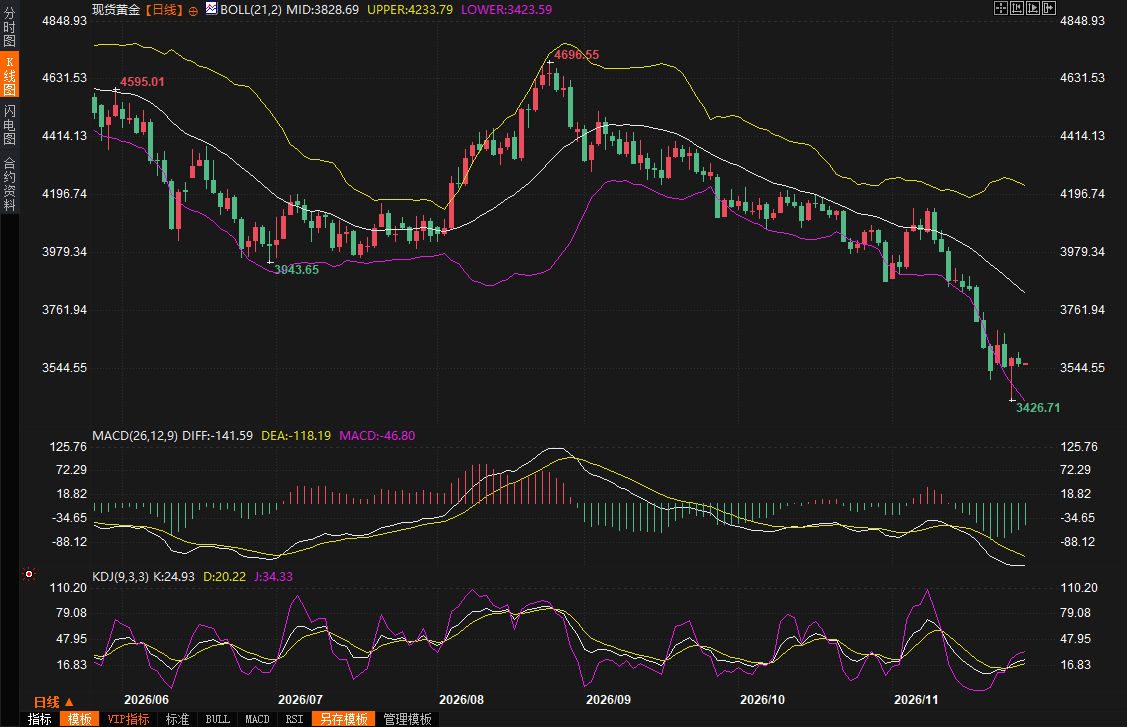 (Spot gold daily chart, source: FX678) At 07:06 Beijing time, spot gold is currently trading at $3565.18 per ounce.
Inflation data remains stubborn, and expectations of a Fed rate hike continue to grow.
The core logic behind the collapse in gold prices lies in the stubborn performance of US inflation. Data released on Wednesday showed that strong domestic demand is pushing up US inflation, with a measure of core inflation pressures rising year-on-year in October to its highest level since the end of 2023. This data further reinforced market expectations for a Federal Reserve rate hike next month and another in early 2027. Looking back to September, the Fed implemented its first rate hike in three years, and current market pricing suggests a 25 basis point rate hike in December is almost a certainty, with the probability of another rate hike in early 2027 also increasing. US core personal consumption expenditure (PCE) inflation in October was higher than expected, and third-quarter GDP growth was significantly revised upward to 4.3%. Coupled with a Fed survey showing continued economic growth and sticky inflation, these factors have reinforced the market's judgment of continued monetary policy tightening. For gold, rate hikes mean an increased opportunity cost of holding non-interest-bearing assets, which constitutes the most direct valuation pressure.The dollar's defensive strength limits gold's upside potential.
The relative strength of the US dollar echoed the pressure on gold prices. The dollar index closed up nearly 0.1% at 103.78 on Thursday, slightly below its highest level since March 2025. Sim Moh Siong, a foreign exchange strategist at OCBC Bank in Singapore, noted that the relationship between the dollar and the stock market is likely to continue to fluctuate, supported by safe-haven demand on one hand, and by market concerns that a further slowdown in the artificial intelligence industry could drag down US economic growth on the other. He also stated, "The risk-reward appeal of further chasing the dollar has diminished, but the risk of a hawkish Fed stance should continue to support the dollar." Analysts wrote more explicitly in a report that the core factors supporting the dollar's strength remain intact, including a strong US economy, inflation above target, and a hawkish Fed stance. Mizuho Bank economist Vishnu Varathan, in assessing the Trump administration's new round of tariffs, also believes that these proposed tariffs are not as impactful as those introduced in 2025, and therefore their impact on the dollar may be limited. This is more of a defensive strength for the dollar than a sharp decline in Asian currencies due to a significant weakening of trade-related support factors. This resilience of the US dollar undoubtedly creates additional obstacles for a rebound in gold priced in US dollars.A weak stock market coexists with geopolitical risks, creating a mixed picture for gold.
HSBC's comments on Thursday added another layer of concern to the outlook for gold prices, stating that continued weakness in the stock market risks gold falling below $3,400 per ounce. This assessment links gold to the performance of risk assets, suggesting that if the stock market continues to weaken, it could trigger broader asset sell-off pressure, and gold would not be immune. However, geopolitical uncertainties have not dissipated. On Wednesday, US President Trump launched a new round of tariffs on goods from 14 major trading partners, including Asian powers, Japan, and the EU, with the highest proposed tariffs on goods from Asian powers. Although Mizuho Bank believes that the impact of this round of tariffs will not be as strong as in 2025, the continued escalation of trade frictions still constitutes a potential safe-haven catalyst. At the same time, the situation in the Middle East has suddenly escalated—the Houthi rebels in Yemen claimed to have attacked Saudi Arabia's largest oil refinery, while Iran claimed that two oil tankers struck mines and exploded in the Strait of Hormuz, one of which was carrying more than 2 million barrels of crude oil. Phil Flynn, senior analyst at Price Futures Group, said this has kept the market highly vigilant as the Thanksgiving holiday approaches. Rory Johnston, founder of Commodity Context, pointed out that although data may show a slight oversupply of global oil in October, the outlook for crude oil prices is bullish. Oil shipments through the Strait of Hormuz are slowing, inventories are low, and about 15% of global supply faces "known and imminent risks." The combination of geopolitical risks has provided intermittent safe-haven buying support for gold, but this is insufficient to offset the systemic pressure from the shift in monetary policy.Political noise and data controversies test market confidence.
Worryingly, the impact of domestic politics on the credibility of economic data in the United States is intensifying. On Thursday, Trump demanded an immediate investigation, claiming that the economic growth data released before this month's midterm elections was deliberately fabricated. Previously, the Bureau of Economic Analysis (BEA) of the U.S. Department of Commerce revised its third-quarter GDP annualized growth rate upward from the initial 3.4% to 4.3%. Following his major defeat in the midterm elections, Trump posted on Truth Social that "just revealed information shows that the economic data released before the election was fake," but provided no evidence. The BEA had previously explained that the initial quarterly GDP forecast lacked complete raw data on inventories, trade, and service consumption expenditures, so discrepancies between the initial and final figures were normal. An article co-authored by the agency's director also pointed out that since the beginning of this century, revised GDP figures released 90 days after the initial estimate have differed from the initial estimate by an average of 0.52 percentage points. Nevertheless, Trump's questioning of data quality, coupled with his unsubstantiated accusations last year that a Labor Department official manipulated statistics and subsequently fired him, is eroding market confidence in the reliability of U.S. economic data. For gold, this crisis of confidence could turn into safe-haven demand in extreme circumstances, but at the current stage, the market is clearly more focused on the Fed's policy path than on the data controversy itself.Summary: Short-term downward pressure is unlikely to change, while long-term support remains.
In summary, the current gold market is caught in a tug-of-war between expectations of monetary policy tightening and geopolitical risk premiums, with the former clearly gaining the upper hand. The near certainty of a December rate hike by the Federal Reserve, rising expectations of another rate hike in early 2027, the defensive strength of the US dollar, and concerns about asset sell-offs triggered by a weak stock market—these factors collectively constitute the core logic behind the short-term downward pressure on gold prices. Han Tan's assessment is quite representative—unless the market perceives the rate hike cycle as nearing its end, gold is unlikely to experience a sustained rebound. HSBC's warning that gold prices could fall below $3,400 further outlines the downside risks. However, gold is not entirely without support. Continued buying by global central banks, escalating geopolitical conflicts in the Middle East, ongoing trade frictions, and the impact of US political factors on the credibility of economic data could all trigger a sudden surge in risk aversion at any time. As Han Tan stated, new risk-averse events in global financial markets could support gold prices. For investors, the $3,500 level will be a key indicator of short-term sentiment, while the fundamental variable determining whether gold can sustain a rally is the signal of a turning point in Federal Reserve policy—rather than a single economic data point. Until a clear signal emerges that the rate hike cycle has peaked, gold bulls will likely continue their defensive stance. (Spot gold daily chart, source: FX678) At 07:06 Beijing time, spot gold is currently trading at $3565.18 per ounce.- Risk Warning and Disclaimer
- The market involves risk, and trading may not be suitable for all investors. This article is for reference only and does not constitute personal investment advice, nor does it take into account certain users’ specific investment objectives, financial situation, or other needs. Any investment decisions made based on this information are at your own risk.