The Fed's hawkish expectations continue to suppress gold prices; how much longer will gold bulls have to hold on?
2026-11-27 08:26:36
On Friday (November 27) in early Asian trading, spot gold fluctuated slightly higher to around $3,570 per ounce. Previously, gold prices had dipped to their lowest level since August 2025, coinciding with the US Thanksgiving holiday, resulting in low overall market trading volume. The US October PCE price index data further solidified market expectations that the Federal Reserve will continue to tighten policy in December and early 2027. Gold is a non-interest-bearing asset, and higher borrowing costs directly increase the opportunity cost of holding gold, creating a sustained negative impact on gold prices. Market analysts commented that spot gold is testing the mid-range support level of $3,000. Only when the market perceives that the Fed's rate hike cycle is nearing its end can gold expect a sustained rebound; gold bulls will remain passive in the short term. However, unexpected global market risks and continued gold purchases by central banks will provide a potential buffer for gold prices. 
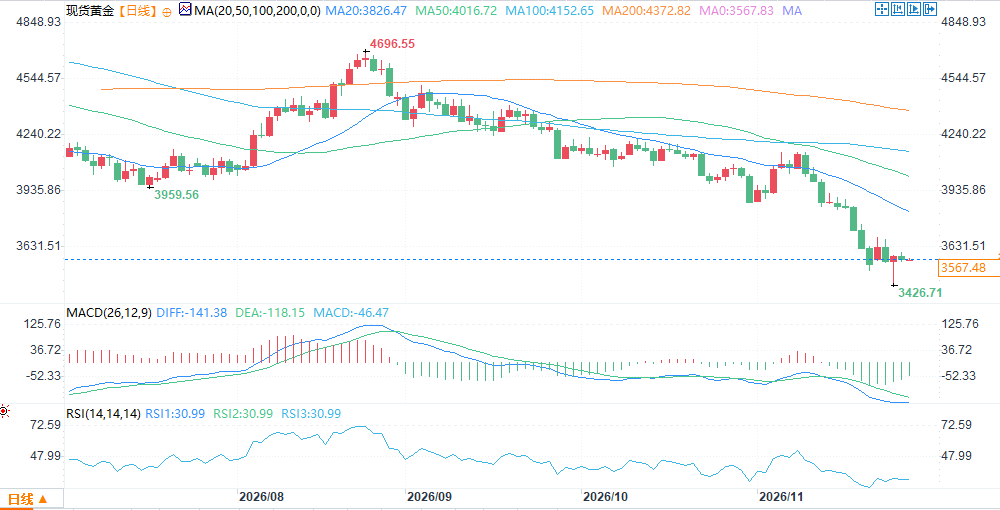 (Spot gold daily chart, source: EasyTrade) At 8:13 Beijing time, spot gold was trading at $3567.53 per ounce.
New trends in trade tariffs bring potential risk aversion variables.
According to the latest media reports, US President Trump plans to impose a new round of tariffs on 14 major trading partners, including the EU, Mexico, and Japan. Specific measures may cover key industrial products, semiconductors, new energy equipment, and some agricultural products. If implemented, this move will significantly increase the import costs of related goods, exacerbate global supply chain tensions, and may trigger retaliatory measures. Escalating trade frictions are often accompanied by increased risk aversion in financial markets. Gold, as a traditional safe-haven asset, will directly benefit from the shift of funds from risky assets to safe-haven assets. Historical experience shows that during the trade war of 2018-2019, gold prices experienced a period of increase. If this round of tariffs is implemented and triggers market panic, short-term buying is expected to emerge rapidly, partially offsetting the interest rate pressure brought by the Federal Reserve's continued hawkish stance. It is worth noting that tariffs themselves may also push up inflation expectations, further complicating the Fed's policy path and creating a two-way game of "high interest rate suppression + safe-haven support." Investors need to closely monitor the timetable for the subsequent release of policy details, the strength of retaliatory measures by trading partners, and the linkage between the US dollar index and real interest rates. These factors will jointly determine whether gold prices can rebound effectively driven by tariff news.Precious metals experienced sharp fluctuations, with industrial metal copper hitting a new low.
Deutsche Bank noted that the precious metals market experienced unusually sharp fluctuations over the past two trading days. Spot gold fell as much as 3.66% intraday, briefly approaching a new low, but subsequently rebounded strongly due to short covering and buying support, ultimately closing up 0.85% at $3,587 per ounce. Silver also staged a deep V-shaped reversal, plunging 6.51% intraday before closing up 0.91%. This "sharp drop followed by a significant recovery" reflects the market's susceptibility to emotional trading and technical corrections in a low-liquidity environment (coinciding with the US Thanksgiving holiday). In contrast, industrial metals performed significantly weaker, with copper prices falling 0.61%, hitting a new low since December 2025, indicating continued escalating concerns about global manufacturing demand and the economic outlook. The divergence between precious and industrial metals highlights the complexity of the current macroeconomic environment: on the one hand, high interest rates and a strong dollar are suppressing non-interest-bearing assets; on the other hand, geopolitical and trade uncertainties continue to provide potential support for gold. In the short term, precious metal volatility is expected to remain high. Investors should be wary of false breakouts and liquidity traps, manage their positions reasonably, and avoid chasing highs and lows in one-sided sentiment.Williams maintained his hawkish stance, stating that the Fed is not currently in a position to shift its policy.
New York Federal Reserve President Williams recently emphasized that the Fed "still has a lot of work to do" in bringing inflation back to its 2% target. Institutional forecasts indicate that inflation may still be around 3.5% by the end of 2026, and a true return to the 2% target is not expected until 2028. Even with the current resilience of the US economy and a stable job market, restrictive monetary policy needs to be maintained for a sufficient period. Williams specifically mentioned the upside risks to inflation from energy price volatility and the rapid development of artificial intelligence, coupled with an expected economic growth of approximately 2.75% in 2026-2027, further reinforcing the narrative of "high interest rates for longer." This statement solidified market pricing in continued policy tightening in December and early 2027, directly benefiting the US dollar and increasing the opportunity cost of holding gold. Until a clear shift signal emerges from the Fed, gold bulls will remain in a passive position, with limited upside potential, unless unexpected geopolitical or trade risks temporarily reverse market risk appetite. (Spot gold daily chart, source: EasyTrade) At 8:13 Beijing time, spot gold was trading at $3567.53 per ounce.
- Risk Warning and Disclaimer
- The market involves risk, and trading may not be suitable for all investors. This article is for reference only and does not constitute personal investment advice, nor does it take into account certain users’ specific investment objectives, financial situation, or other needs. Any investment decisions made based on this information are at your own risk.