Why are inflation and growth data diverging in the Eurozone?
2026-11-27 18:00:33
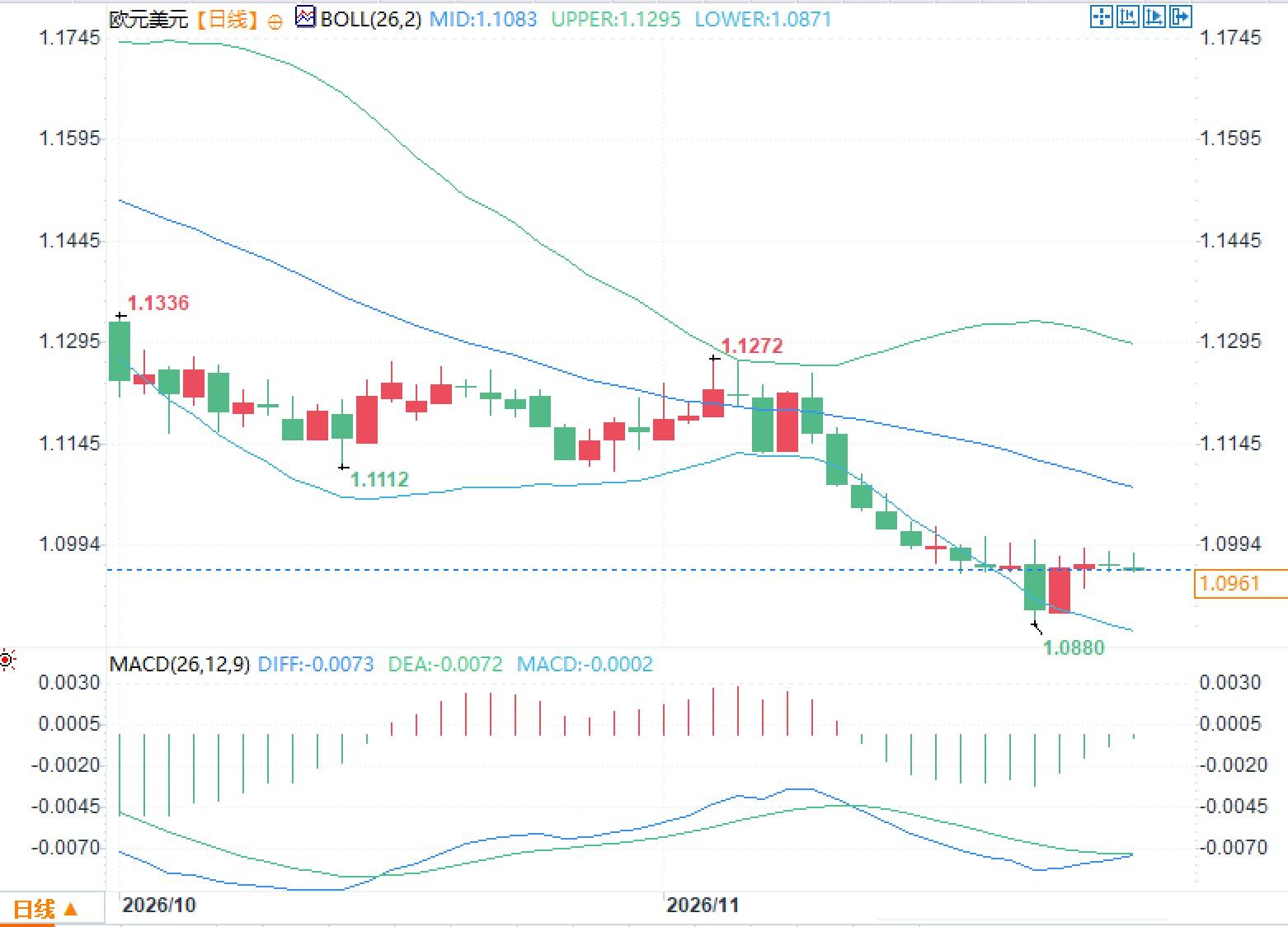
On Friday, November 27, the euro edged lower against the dollar, trading around 1.096 with little intraday volatility, though it has fallen approximately 1.7% this month. Trading was thin in the US market due to the Thanksgiving holiday, and the dollar index remained largely unchanged. Inflation in core Eurozone countries slowed more than expected, but growth and employment data remained weak. The market is focused on the relative shifts in the policy paths of the European Central Bank and the Federal Reserve. 
Inflation data from major Eurozone countries slowed more than expected.
Preliminary data released by France's National Institute of Statistics and Economic Studies (INSEE) on Friday showed that the year-on-year growth rate of the consumer price index (CPI) fell to 2.9% in November, lower than the market expectation of 3.2% and also lower than October's 3.4%. The harmonized index (HICP) slowed to 3.2% year-on-year from 3.7% in October, below the expected 3.6%. Energy price increases fell to 19.2% from 24.1%, being the main drag on overall inflation, although natural gas prices continued to accelerate. Services inflation fell to 2.3% from 2.6%, while food prices rose slightly to 1.3%. Preliminary data released by Spain's National Statistics Institute (INSEE) on the same day showed that the harmonized index of consumer prices (HICP) fell sharply to 4.1% year-on-year in November from 4.9% in October, lower than the market expectation of approximately 4.7%. Core inflation (excluding energy and unprocessed food) fell to 2.6% from 3.1%. Retail sales data were also weak, contracting for the fourth consecutive month in October, falling 1% year-on-year, compared to a 1.4% decline in the previous month. The simultaneous slowdown in inflation in both countries has alleviated some of the price pressures faced by the European Central Bank, but the overall level remains above the 2% policy target.Germany's labor market is stable but with limited improvement.
Data from the German Federal Employment Agency shows that the unemployment rate remained unchanged at 6.4% in October. After seasonal adjustment, the number of unemployed increased by approximately 4,000, less than the market's expected increase. In the unadjusted data, the number of unemployed decreased month-on-month but remained higher than the same period last year. The number of employed persons decreased by approximately 21,000 after seasonal adjustment, continuing the weak trend seen in most months of the year. While the labor market has not shown significant deterioration, insufficient job creation momentum limits its support for consumption and overall growth.French economic growth faces downward correction
The French National Institute of Statistics and Economic Studies (INSEE) revised its third-quarter GDP growth forecast downwards to a 0.2% contraction from the initial estimate of a 0.1% contraction. Exports fell by 1.6%, and investment contracted further to 0.9%. Household consumption rose slightly by 0.3%, failing to fully offset the drag from other components. By the end of the third quarter, the cumulative effect of full-year growth was only 0.1%. Continued contraction in Spanish retail sales also reflects persistent weakness in Southern European consumption. The divergence in growth within the Eurozone, coupled with declining inflation, has increased the complexity of policymaking.US Data and Holiday Trading Background
The U.S. Bureau of Economic Analysis revised its third-quarter annualized real GDP growth rate upward to 4.3% from the initial estimate of 3.4%. Personal consumption expenditure and private investment were the main contributors. Inflation indicators remained above the Federal Reserve's target level. Trading volume in the U.S. market was significantly lower during the Thanksgiving holiday, and the dollar remained largely flat. Market expectations for the December Federal Reserve policy meeting are divided, and uncertainty in the stock market is somewhat constraining the dollar's upward movement. The differences in growth and inflation rates between the Eurozone and the U.S. remain one of the core variables influencing the medium-term trend of the euro against the dollar.Frequently Asked Questions
Question 1: Does the simultaneous decline in inflation in France and Spain mean that the pressure on the ECB has significantly eased? Answer: Inflation data in both countries were lower than expected, mainly due to a decrease in the contribution of energy prices. Price pressures have eased somewhat in the short term, but core inflation remains above the 2% target, and policy space remains constrained by weak growth. Question 2: What impact does Germany's unemployment rate of 6.4% have on the euro? Answer: A stable unemployment rate but a continued decline in seasonally adjusted employment indicates limited improvement in the labor market, insufficient support for consumption, and unlikely to be a strong driver for the euro on its own. Question 3: How will the transatlantic policy divergence evolve after the US Q3 GDP was revised upward to 4.3%? Answer: Relatively strong US growth data and contraction in growth in core Eurozone countries mean that policy path differences remain an important background influencing the relative value of the euro against the dollar. Specific decisions will depend on subsequent data and meeting communications.- Risk Warning and Disclaimer
- The market involves risk, and trading may not be suitable for all investors. This article is for reference only and does not constitute personal investment advice, nor does it take into account certain users’ specific investment objectives, financial situation, or other needs. Any investment decisions made based on this information are at your own risk.