The market has already priced in further tightening in December. Will the dollar index rise or fall next?
2026-11-27 21:14:33
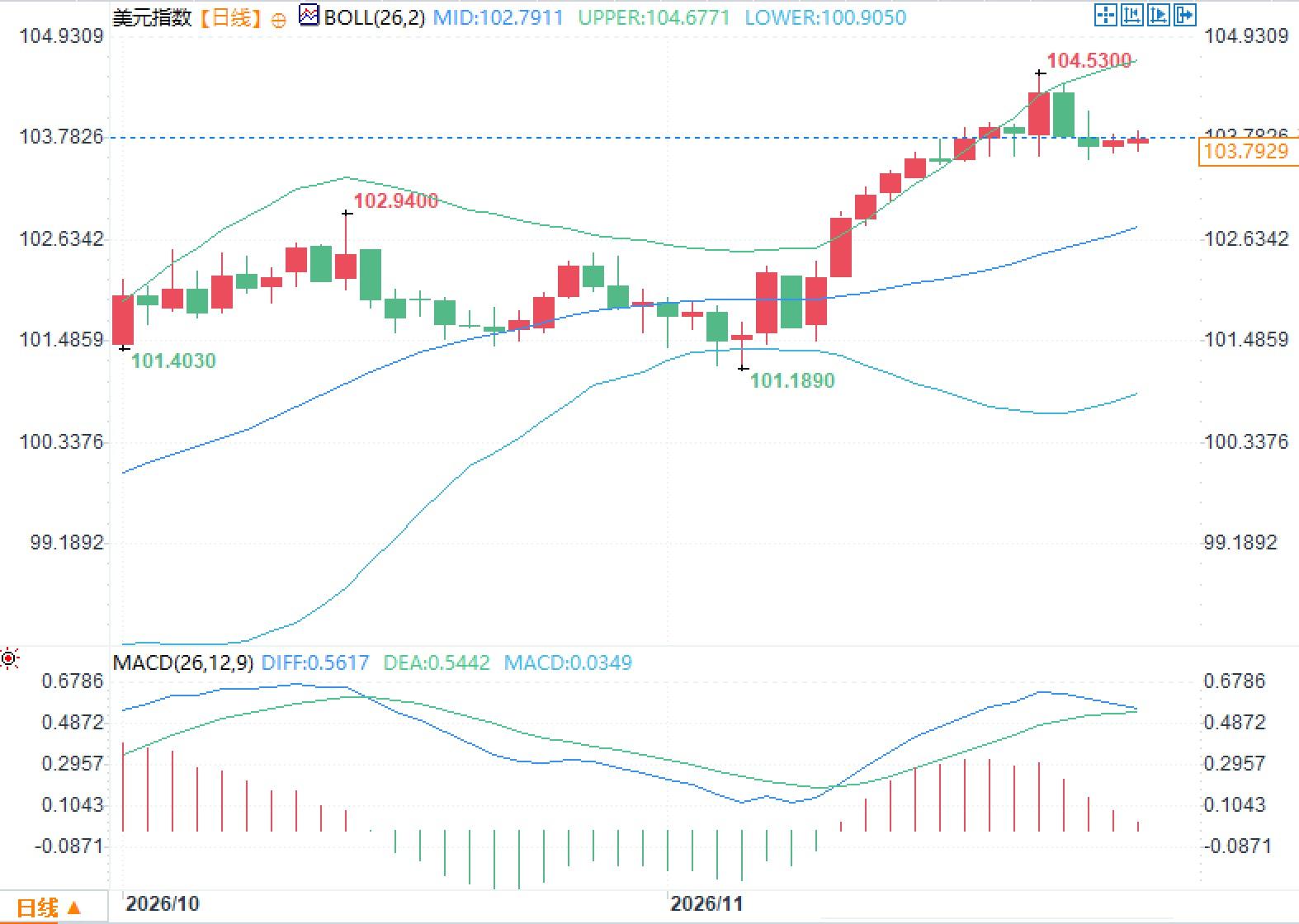
On Friday, November 27th, the first trading day after the Thanksgiving holiday, trading in the foreign exchange market was noticeably thin. The US dollar index fluctuated around 103.80, retreating from the high of 104.53 reached earlier this week. This adjustment was mainly related to the stabilization of the equity market and a moderate decline in demand for safe-haven assets, rather than a fundamental change in the economic fundamentals. In recent days, risk appetite in the stock market has recovered somewhat, with some funds flowing out of safe-haven assets, putting short-term pressure on the dollar. At the same time, recently released US economic data has continued to strengthen the basis for discussions on policy tightening. The second estimate of third-quarter GDP released by the US Bureau of Economic Analysis showed an annualized growth rate of 4.3%, revised upward by 0.9 percentage points from the initial estimate. The core PCE price index rose to 3.3% year-on-year in October, and the overall PCE reached 3.8% year-on-year. Initial jobless claims also fell to 189,000. These figures collectively point to continued economic expansion, with inflationary pressures not yet significantly eased and the labor market maintaining low application levels. In a thin trading environment, market participants are more focused on the implications of data for the medium-term interest rate path than on short-term fluctuations themselves. 
Details of the upward revision of third-quarter economic growth data
Estimates from the U.S. Bureau of Economic Analysis show that real GDP grew at an annualized rate of 4.3% in the third quarter, up from 2.2% in the second quarter. The upward revision mainly came from adjustments to investment and consumer spending. The annualized growth rate of private domestic final sales was revised upward to 5.8%, reflecting increased contributions from domestic demand-related projects. The revision on the investment side was more significant, with business fixed investment continuing to expand against the backdrop of ongoing AI-related capital expenditures. Exports declined, partially offsetting the pull from domestic demand. Structurally, the annualized growth rate of consumer spending was revised upward to 4.2%, with service consumption remaining the main driver. Government spending was also revised upward. This data combination indicates that the expansion in the third quarter was not driven by a single factor, but rather by the combined effect of investment and consumption. For the foreign exchange market, the higher growth reading means that the economic capacity to withstand further policy tightening is still under discussion, but the specific path still depends on the evolution of subsequent inflation and employment data. The market did not show a sustained one-sided reaction when digesting this upward revision, partly because the simultaneously released inflation data also showed that pressure had not eased.US inflation readings and labor market conditions
The October Personal Income and Spending Report showed that the core PCE price index rose to 3.3% year-on-year, a further increase from 3.1% in September, while the overall PCE was 3.8% year-on-year. The month-on-month change was 0.3%. This level is approaching a three-year high, and the continuous rise in the core indicator suggests that price pressures excluding food and energy are still accumulating. The Federal Reserve considers the core PCE a more stable inflation watchdog; the current reading is above the 2% target, and the short-term trend has not yet shown a significant decline. Regarding the labor market, initial jobless claims for the week ending November 21 fell to 189,000, a decrease of 13,000 from the previous week. Continuing claims also declined. This low level of claims indicates that companies have limited willingness to lay off workers, and the labor market remains relatively tight. The simultaneous strengthening of growth and inflation data has led to more focused discussions on further policy adjustments. The short-term pullback in the dollar is more due to a recovery in risk sentiment than changes in these fundamental data themselves.Market pricing logic of the Fed's policy path
The minutes of the October Federal Open Market Committee (FOMC) meeting showed that almost all participating officials believed that, based on the current inflation and labor market outlook, further adjustments to policy rates might be needed in the coming months to ensure inflation returns to the target. The minutes also mentioned that if subsequent data were unfavorable to a decline in inflation, there would be discussions at the December meeting regarding a larger adjustment. Governor Waller publicly stated that inflation was still moving in an unfavorable direction and its spread was widening, potentially requiring more forceful action, including considering a 50-basis-point adjustment in December. Philadelphia Fed President Paulson indicated a preference for a cautious pace but was willing to consider the possibility of successive actions. Current market pricing already fully reflects a higher probability of further adjustments in December. Discussions about the 2027 path focused more on the magnitude and pace of adjustments. The combination of strong growth and sticky inflation shifted the debate from "whether the economy can withstand further tightening" to "how long the adjustment will last." The dollar index retreated in thin trading after Thanksgiving, but fundamental factors still support a reassessment of the medium-term interest rate path. The fluctuations in the equity market related to AI sectors influence short-term capital flows through risk appetite channels, forming another pricing clue parallel to fundamental logic.Frequently Asked Questions
Question 1: What does the rise in core PCE to 3.3% mean for policy discussions? Answer: This reading is near a three-year high and has increased from the previous month, indicating that core price pressures are still accumulating. Combined with the statement in the Fed's October meeting minutes that almost all officials believed further policy adjustments might be needed in the coming months, market discussions on the adjustment path are more focused on the magnitude and pace, rather than whether adjustments are necessary. Question 2: How did the thin trading after Thanksgiving affect price performance? Answer: Thin trading amplified short-term volatility brought about by the recovery in risk sentiment, causing the dollar index to retreat from around 104.53 to around 103.80. However, the logic of fundamental data and policy discussions remains unchanged; market participants still primarily assess medium-term pricing based on growth, inflation, and official statements.- Risk Warning and Disclaimer
- The market involves risk, and trading may not be suitable for all investors. This article is for reference only and does not constitute personal investment advice, nor does it take into account certain users’ specific investment objectives, financial situation, or other needs. Any investment decisions made based on this information are at your own risk.