How will the rebound in copper prices and easing expectations for AI investment indirectly affect the Australian dollar against the US dollar?
2026-11-27 21:28:33
On Friday, November 27, the Australian dollar rebounded after hitting an annual low earlier in the week and is currently trading around 0.666 against the US dollar. Rising industrial metal prices and stabilizing market risk sentiment provided some support for the Australian dollar. Meanwhile, continued expectations of further monetary tightening by the Federal Reserve limited the upside potential for the Australian dollar. Monetary policy fundamentals continue to challenge the continuation of the trend, and oversold conditions only provide some flexibility for short-term fluctuations. 
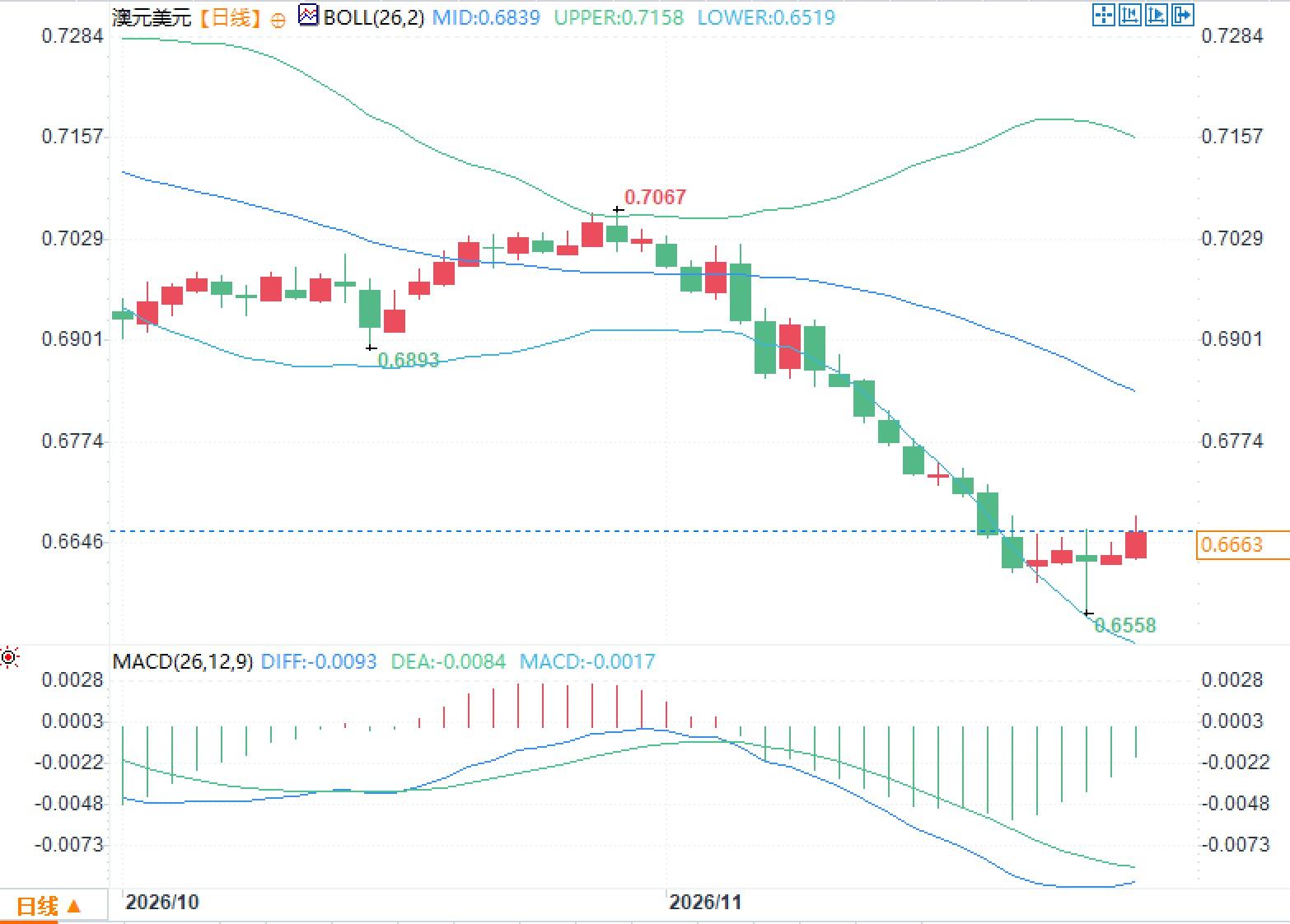
Industrial metal prices rebound and changes in risk sentiment
Copper prices rebounded significantly on Friday, partly due to easing concerns about a sell-off in AI-related assets. While iron ore is Australia's largest commodity export, copper, as a key indicator of the global industrial cycle, is highly sensitive to demand from data center construction and energy infrastructure development. Some economists point out that despite various risks, strong arguments suggest that AI companies will continue to significantly increase investment, at least next year, indirectly supporting demand for industrial metals. Continued investment could boost demand for industrial metals, thus impacting the Australian dollar. However, the resilience shown by US economic activity as a result could strengthen the Federal Reserve's case for maintaining restrictive policies, limiting the extent to which the Australian dollar can benefit from this.US inflation data and Federal Reserve policy expectations
The U.S. Personal Consumption Expenditures (PCE) price index rose 3.8% year-on-year in October. Initial jobless claims for the week ending November 21 fell to 189,000. Federal Reserve Governor Christopher Waller recently indicated he might support a larger rate hike to curb inflation. Market pricing suggests the probability of a 25-basis-point rate hike at the December meeting is nearly fully priced in. Against this backdrop, the dollar's reaction may depend more on the Fed's guidance on the 2027 interest rate trajectory than on the December decision itself. The prospect of further rate hikes could support U.S. Treasury yields, strengthening the dollar's attractiveness. Conversely, any signals indicating the tightening cycle is nearing its end could provide more room for a rebound in the Australian dollar against the U.S. dollar.Comparison of Australian Inflation and Employment Data
Australia's Consumer Price Index (CPI) accelerated to 4.9% year-on-year in October, up from 4.3% in September. Core inflation, measured by the truncated mean, rose to 3.8%, from 3.6% previously. However, the labor market showed signs of deterioration, with employment falling by 43,500 in October, marking the second consecutive month of decline, and the unemployment rate rising to 4.9%, a five-year high. The Reserve Bank of Australia (RBA) has raised its cash rate to 4.85%. Analysts point out that the RBA may be nearing the end of its rate hike cycle, while other central banks still have room to tighten, potentially eroding Australia's relative interest rate advantage. Some institutions expect interest rates to remain unchanged for an extended period, suggesting that speculation about rate cuts is premature.Monetary policy divergences and subsequent focus
Even without an interest rate cut in Australia, further tightening in the US could gradually narrow the Australian dollar's relative yield advantage, limiting the potential for a sustained recovery. Investors are focused on Reserve Bank of Australia Governor Michelle Bullock's speech on Tuesday, as well as the US November non-farm payroll data. A stronger-than-expected US jobs report could strengthen expectations of further rate hikes in 2027, while signs of weakness in the labor market could prompt a reassessment of future tightening levels, providing some breathing room for the Australian dollar. Policy path divergence and changes in relative yields remain the core factors influencing the Australian dollar's volatility against the US dollar.Frequently Asked Questions
Question 1: Why does the rebound in industrial metal prices support the Australian dollar? Answer: As indicators of the global industrial cycle, the price rebound of industrial metals such as copper reflects improved demand expectations. As a major commodity exporter, Australia's related income is closely linked to its exchange rate, thus indirectly supporting the Australian dollar. Question 2: What are the differences in policy paths between the Federal Reserve and the Reserve Bank of Australia? Answer: US inflation data and employment indicators support expectations of further tightening, while Australia faces the dual pressures of high inflation and deteriorating employment, potentially narrowing its interest rate advantage. Question 3: What events warrant close attention going forward? Answer: The RBA Governor's speech and the US non-farm payroll data will influence assessments of their respective policy paths, thereby affecting relative yields and exchange rate volatility.- Risk Warning and Disclaimer
- The market involves risk, and trading may not be suitable for all investors. This article is for reference only and does not constitute personal investment advice, nor does it take into account certain users’ specific investment objectives, financial situation, or other needs. Any investment decisions made based on this information are at your own risk.