Weekly Forex Market Review: Jensen Huang's Return to Office Ignites the Market! Dollar Surges and Retreats, But Strong Strength Remains, Five Consecutive Weekly Gains
2026-11-28 10:38:33
This week, the global foreign exchange market experienced a complex trend, driven by both sharp fluctuations in the artificial intelligence sector and rising expectations of a Federal Reserve rate hike. The market rallied and then retreated, but maintained overall strength. The US dollar index briefly touched a more than 19-month high before retreating, but still rose slightly by 0.19% for the week, marking its fifth consecutive weekly gain, demonstrating its relative advantage against the backdrop of a resilient US economy and a hawkish policy path. Meanwhile, the Australian dollar weakened due to fluctuating risk appetite and extreme accumulation of short positions, hitting a near one-year low on Wednesday before recovering its losses in the latter half of the week. The euro fell for the fifth consecutive week, while the pound sterling stabilized somewhat supported by data and policy comments. The yen continued to face pressure at high levels, triggering concerns about intervention. The Thanksgiving holiday shortened trading hours, further amplifying market volatility and making this week's forex market movements more dramatic. 
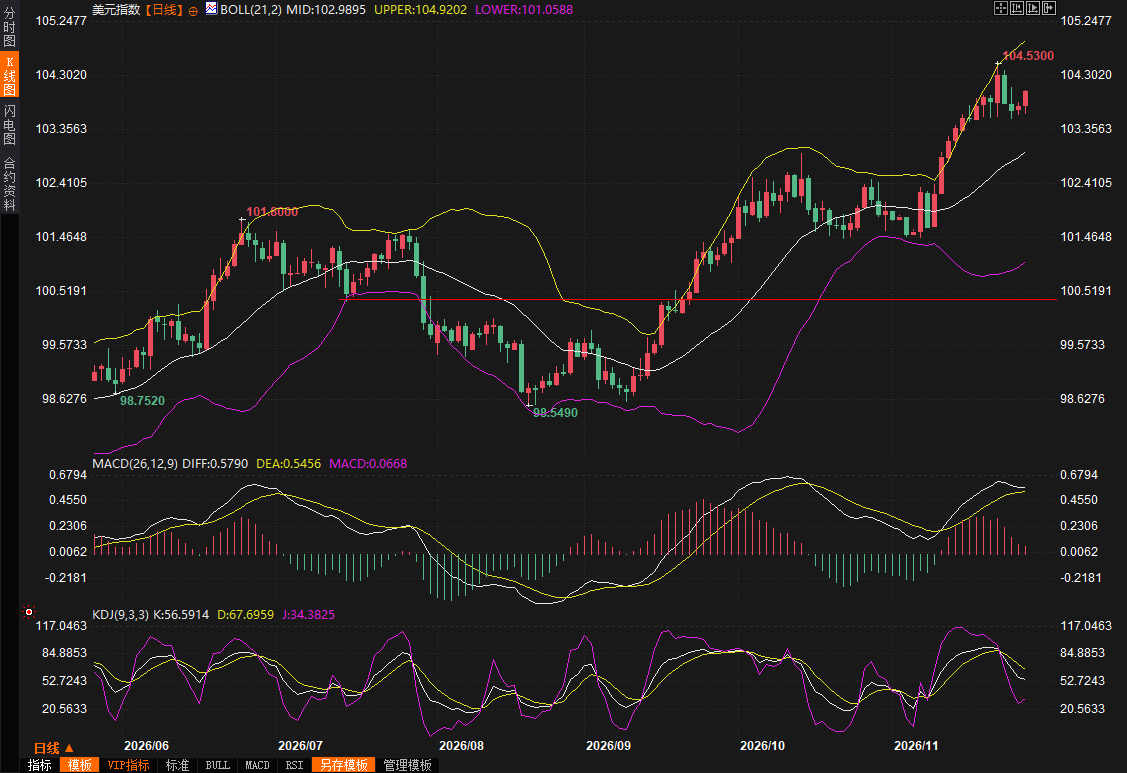 (US Dollar Index Daily Chart, Source: FX678)
AI market trends reversed dramatically, but the dollar's strong start proved unsustainable.
At the beginning of the week, Nvidia CEO Jensen Huang dramatically returned to his post following a public appeal from US President Trump, completely reversing his previous forced resignation due to an extramarital affair scandal. This news quickly ignited market optimism for the artificial intelligence sector, with Nvidia's stock price surging over 30% in a single day. The overall tech stock rebound reinforced traders' assessment of the potential for US economic growth and the Federal Reserve's greater room for interest rate hikes. The US dollar thus received a significant boost, rising to a more than 19-month high against the euro, with the dollar index reaching a high of around 104.53, a new high since March 2025. The continued inflow of technology capital into the US and the higher growth expectations brought by AI investment already constituted an important logic supporting the dollar in the medium to long term; Huang's return acted as a shot in the arm, briefly accelerating this process. However, the rebound momentum of the AI rally quickly weakened. In the following trading days, related stocks were sold off again, and although the Nasdaq index recovered somewhat after a sharp decline, market risk sentiment clearly fluctuated. The dollar was torn between safe-haven demand and AI-related capital flows, making its movement difficult to interpret in one direction. Some analysts point out that the relationship between the US dollar and the stock market is inherently complex—it can act as a safe-haven asset, yet also benefit from rising risk appetite due to its representation of "American exceptionalism." The same signal can often trigger drastically different foreign exchange reactions. This week, the US dollar index ultimately retreated and fluctuated at a high level around 103.8 to 104, closing at 104.04, with a weekly gain of only about 0.19%, indicating profit-taking pressure after the surge. (US Dollar Index Daily Chart, Source: FX678)Interest rate hike expectations continue to provide support, but the upside potential is beginning to be questioned.
The core support throughout the week remained the market's bet on continued tightening by the Federal Reserve. Federal funds futures indicated a 90%-100% probability of a 25 basis point rate hike in December, while the probability of a 50 basis point hike had diminished, and the likelihood of another rate hike in January remained above 60%. The stronger-than-expected rise in the US October core personal consumption expenditure price index, the significant upward revision of third-quarter GDP, and the overall resilience of business activity and consumer confidence data all reinforced the narrative that "inflation remains stubborn and the economy still has room to grow." Meanwhile, while the Trump administration's proposal to impose new tariffs on 14 major trading partners initially attracted attention, the market reaction was relatively limited, with most opinions suggesting its impact would be far less than previous measures. However, the dollar's rapid rise has also begun to face scrutiny. Some analysts point out that the US's growth advantage relative to the Eurozone, the UK, and Japan has recently narrowed, and relative data surprises often exhibit mean reversion characteristics, which may indicate that the dollar's rally is nearing a temporary peak. Other strategists believe that the current level of the US dollar index is significantly higher than the reasonable range corresponding to some fundamental models, and the room for further upside is relatively limited. The changes in the US Treasury yield curve this week are also noteworthy: the spread between the two-year and five-year yields narrowed significantly, reflecting the market's repricing of the longer-term interest rate path.Non-US currencies showed mixed performance, with short positions in the Australian dollar hitting a record high.
The euro briefly fell below $1.09 at the start of the week, hitting its lowest level since April 2025, but subsequently recovered somewhat due to a combination of factors, including a seventh consecutive month of rising German business confidence, hawkish comments from ECB officials, and a dollar pullback. However, it still fell 0.3% for the week, marking its fifth consecutive weekly decline. The pound, while briefly hitting a low, still recorded a slight weekly gain supported by improved fundamentals and valuation indicators. Market analysts believe that it will be difficult for the euro to return to the key $1.12 level in the short term, and a new trading range of 1.07 to 1.12 may be forming. The Australian dollar was one of the weakest major currencies this week. Under the dual pressure of fluctuating risk appetite and weak Australian employment data, the Australian dollar fell to a near one-year low against the US dollar, with a cumulative decline of over 5% this month. If the decline continues, it could mark its worst monthly performance since the end of 2022. More notably, speculators' short positions in the Australian dollar have reached a record high, worth approximately $12.25 billion. JPMorgan Chase and other institutions pointed out that put options continue to dominate the options market, with short positions reaching extreme levels on some indicators. On Friday, the Australian dollar rebounded from its lows as tech stocks rallied and Chinese measures to support the stock market boosted risk appetite, closing the week up 0.45%, ending a three-week losing streak. The New Zealand dollar followed a similar pattern, also dragged down by a global tech stock sell-off and a weakening yield advantage. It touched 0.5432 at the beginning of the week, a new low since March 2009, before rebounding and closing nearly flat for the week. Regarding the Japanese yen, the USD/JPY pair continued to rise this week, approaching the 160 level, closing at 159.65, a weekly gain of 0.63%. Market concerns about potential intervention by Japanese authorities persist. Domestic inflation data in Japan continued to rise, with core inflation in Tokyo reaching a 16-month high and the services producer price index hitting a 36-year high, providing more justification for the Bank of Japan to raise interest rates. However, against the backdrop of rising risk appetite and higher US Treasury yields, the yen remained weak. Analysts warn that if the Federal Reserve adopts a more hawkish stance at its December meeting, the market may quickly refocus on intervention issues.Next week's outlook
The most prominent feature of the currency market this week was the interplay between AI-related market fluctuations and interest rate hike expectations. The US dollar benefited from safe-haven demand but was also highly sensitive to AI-related capital flows, leading to frequent fluctuations. Institutions such as Mizuho pointed out that market attention is now highly focused on whether AI-related stocks can truly stabilize and rebound—if the rebound continues, high-yield currencies such as the Australian dollar are expected to recover; if they encounter another sell-off, these currencies may face additional pressure. Looking ahead to next week, the November jobs report will be a key focus, as its results will directly affect the market's pricing of the Fed's subsequent interest rate hike path. Meanwhile, Japanese inflation and policy expectations, changes in Australian dollar short positions, and further evolution of global risk appetite will all influence the performance of non-US dollar currencies. Overall, the US dollar still possesses a relative advantage supported by strong data and policy expectations, but the narrowing of its valuation and relative growth advantage after rapid gains means that its further unilateral upward potential is beginning to be constrained. Currency market participants need to find a new balance between "American exceptionalism," global growth divergence, and shifting AI sentiment.- Risk Warning and Disclaimer
- The market involves risk, and trading may not be suitable for all investors. This article is for reference only and does not constitute personal investment advice, nor does it take into account certain users’ specific investment objectives, financial situation, or other needs. Any investment decisions made based on this information are at your own risk.