Gold Weekly Review: From a 15-month low to its first gain in three weeks, gold prices have been on a rollercoaster ride. Is this a trap or a turning point under the shadow of the Federal Reserve?
2026-11-28 09:38:35
This week, the gold market experienced a highly dramatic price movement. Spot gold briefly fell below the key psychological level of $3,500 on Wednesday (November 25th), touching $3,426.64 per ounce, its lowest level since late August 2025 and the first time gold prices had fallen below $3,500 since September 2025. However, the market did not succumb, with bargain hunters quickly entering the market, pushing gold prices sharply back from their lows. On Friday (November 27th), spot gold rose 2.4% to $3,654.15 per ounce, having earlier risen by more than 3%, achieving a weekly gain of over 3%, marking its first weekly increase in three weeks. Looking at the overall weekly trend, gold exhibited a clear "decline followed by a rise" pattern. At the beginning of the week, gold prices were under downward pressure, hitting a weekly low on Wednesday due to strong inflation data, before rebounding driven by short covering, profit-taking, and bargain hunting. However, Friday's surge and subsequent pullback also indicates that the rebound is not without its challenges. A stronger dollar, rising US Treasury yields, and a hawkish outlook from the Federal Reserve continue to limit further upside potential for gold prices. Since hitting a record high earlier this year, spot gold prices have plummeted by approximately 37%, a massive drop that makes the current market rebound more of a technical correction after overselling than a trend reversal. 

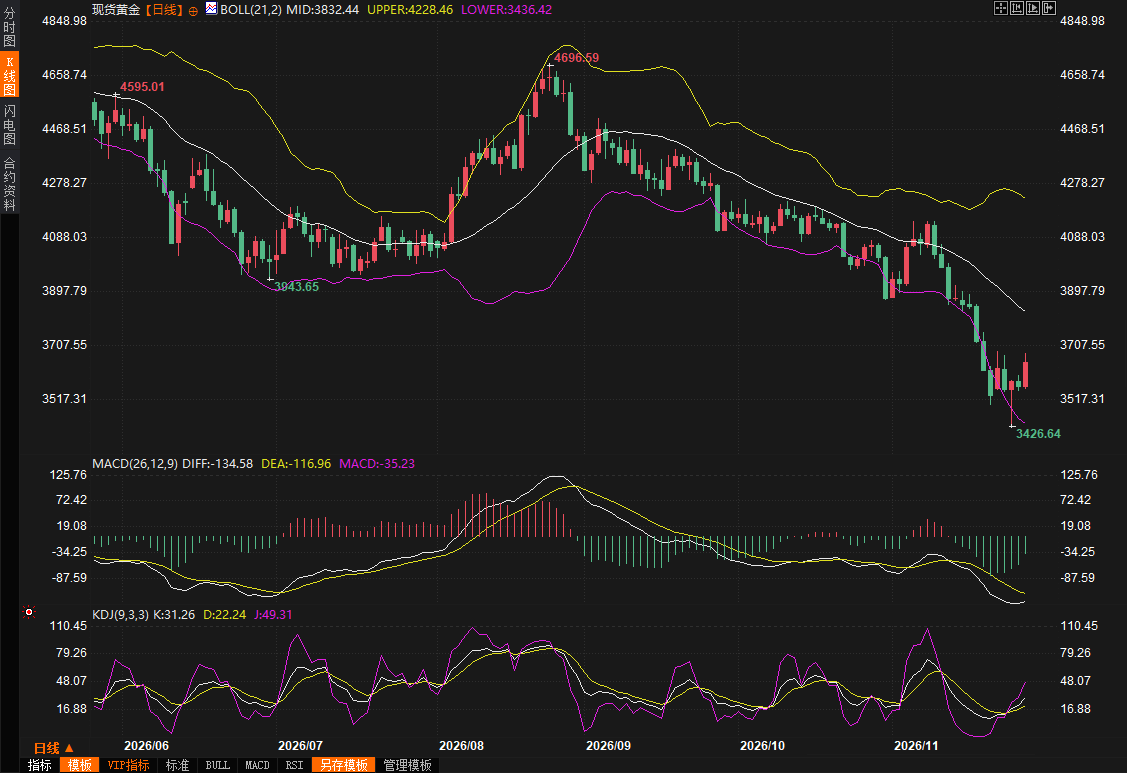 (Spot gold daily chart, source: FX678)
The triple shackles suppressing gold prices: the US dollar, yields, and hawkish expectations from the Federal Reserve.
This week, gold prices faced pressure from three interconnected factors, and understanding these three constraints is crucial for predicting the future direction of gold. First, the continued strength of the US dollar index. The dollar remains near its highest level in 22 months, making dollar-denominated gold more expensive for investors holding other currencies, thus suppressing physical demand in non-US markets. The strengthening dollar is inextricably linked to expectations of tightening by the Federal Reserve, forming a mutually reinforcing cycle—expectations of interest rate hikes push up the dollar, and a stronger dollar, in turn, suppresses dollar-denominated commodity prices. Second, the rise in US Treasury yields. The benchmark 10-year US Treasury yield rose this week and has moved away from recent lows. The persistently high real yields pose a fundamental pressure on gold because, as a non-interest-bearing asset, gold's attractiveness is inversely related to real interest rates. When investors can obtain substantial real returns from the bond market, the opportunity cost of holding gold increases significantly. Audacity Capital market analyst Zain Vawda clearly pointed out: "The Fed is still raising rates, real yields remain high, and the dollar is near multi-month highs. Unless one of these factors changes, a rebound in gold prices to the $3,750-$3,800 range could attract selling." The third constraint comes from the Fed's increasingly hawkish monetary policy stance. Data released Wednesday showed that US personal consumption expenditures (PCE) rose 0.3% month-over-month in October, with core inflation pressures showing the highest year-over-year increase since the end of 2023, indicating that strong domestic demand is continuing to push up inflation. David Meger, director of precious metals trading at High Ridge Futures, commented: "Given that inflationary pressures are still well above the Fed's target level, the possibility of further rate hikes by the Fed remains, putting pressure on the gold market. This has been one of the main headwinds facing the gold market, and today's PCE data did not alleviate these concerns." According to the CME Group's FedWatch tool, traders have fully priced in a 25-basis-point rate hike in December and believe there is a 2% probability of a 50-basis-point hike. The Federal Reserve raised interest rates for the first time in three years in September, and the market widely expects another rate hike in December, with further tightening of monetary policy in early 2027. New York Fed President Williams also stated on Monday that persistently high inflation continues to prompt the Fed to adopt a tighter monetary policy, although he emphasized that the pace of future rate hikes will depend on subsequent economic data.Institutional opinions are increasingly divided: some see $4,500, while others warn of $3,400.
Faced with the current complex and volatile market environment, significant differences have emerged in the views of various institutions and analysts, reflecting the high degree of uncertainty surrounding the market outlook. From the optimistic perspective, JPMorgan Chase predicts that gold prices will rebound to $4,500 per ounce by the end of 2027, while Commerzbank forecasts $4,100 per ounce during the same period. Jesse Colombo, an independent precious metals analyst and founder of the BubbleBubble Report, believes that the long-term downtrend in gold since its late January highs may have ended. He points out that the $3,200 to $3,500 range is a crucial support area, a consolidation zone for gold during the summer of 2025, within which prices fluctuated from mid-April to early September, before consolidating ahead of the autumn rally in 2025. “Sure enough, we bounced back from there. According to the RSI and other oscillators, it was oversold at the time,” Colombo said. “I think that was strong support, and I highly doubt it will break below that level.” He further pointed out that gold has fallen nearly 35%, comparable to or even exceeding the gold sell-off of 2008. Typically, such pullbacks are around this level, and unless extremely extreme circumstances occur, it won't fall lower. Colin Chesinski, chief market strategist at SIA Wealth Management, is bullish on gold for the coming week, believing that technically, gold is oversold in the short term, and a trading rebound appears to be underway. This seems to be a combination of forced liquidation of long positions, short squeezes, and bargain hunting. However, he also cautioned that gold may remain volatile during the December Fed meeting. However, there are also heavyweight voices in the bearish camp. HSBC said on Thursday that continued weakness in the stock market puts gold at risk of falling below $3,400 per ounce. FxPro senior market analyst Alex Kuptzkivic predicts gold prices will continue to fall next week, noting that financial markets' appetite for risk assets continues to weaken, with gold closely following the stock market's movements, while US Treasury yields remain at relatively high levels below recent standards. He warned, "Gold continues its downward trend, targeting 3300 points, which is the last long consolidation period we observed between April and August last year. It's also possible the bears will target even lower—3000 points, as the 200-week moving average is nearby." Barchart senior market analyst Darlin Newsom is more direct: "Is gold oversold? Yes. Is the path of least resistance still downward? Also yes. While I don't think there's a fundamental reason for gold to join crude oil's 'below-zero club,' the first rule of the market tells us not to go against the trend. Until further notice, the trend for gold remains downward." Kitco's weekly gold survey also confirms this divergence. Of the 15 analysts surveyed, 6 experts (40%) predicted gold prices would rise in the coming week, 5 experts (33%) predicted a fall, and the remaining 4 analysts (27%) had no clear opinion on gold's price movement or expected it to trade sideways. Meanwhile, in an online poll, 57 retail traders (36%) predicted gold prices would rise next week, indicating that the general public generally remains bearish.Technical and Fundamental Analysis: The Underlying Logic of Oversold Rebound
From a technical analysis perspective, this week's gold rebound was not accidental. When gold prices hit a low of $3,426 on Wednesday, oscillators such as the RSI indicated that the market was oversold, creating conditions for a technical rebound. Mark Chandler, Managing Director of Bannockburn Global Forex, pointed out that momentum indicators are rising, and according to the spot market, the nearest resistance level is in the $3,700 to $3,705 range. Gold prices stalled before reaching a weekly high of nearly $3,690 on Monday, a level that constitutes significant short-term resistance. Changes in liquidity are also worth noting. Razaqzada pointed out that "the wave of margin calls from the stock market has exacerbated the pressure on the precious metals market, forcing investors to release margin by closing out gold and silver positions." This week, major US stock indices all fell, with the tech-heavy Nasdaq index falling 4% due to continued selling of AI-related stocks. In this context, gold was sold off as a source of liquidity, significantly increasing its correlation with the stock market. Adam Barton, head of currency strategy at investingLive, told Kitco News, “The correlation between stocks and gold has reached 1 this week. Market sentiment experienced a sharp sell-off earlier this week, followed by a surprising reversal, which has really snowballed over the past three days.” Newsom, however, issued a warning from a positioning data perspective. He pointed out that implied market volatility has climbed to 28% (February futures), meaning that algorithms may continue to liquidate long futures positions. The previous trader positioning report showed that as of November 17, funds still held nearly five times more long futures contracts than short contracts (210,051 long contracts to 43,919 short contracts), meaning there is still room for further liquidation of long positions. Colombo offered his assessment from a more macro-cyclical perspective. He believes that after the market digested the 25 basis point rate hike following the Fed meeting, we could indeed see a “Santa Claus-style” stock market rally before Christmas. “They say ‘buy the rumor, sell the news,’ but in this case, it’s the opposite: ‘sell the rumor, buy the news.’ This risk aversion ahead of the Fed meeting may partly explain the sell-off of the past few weeks,” he further analyzed. “I think there’s a high probability of a safe-haven rally. The 25-basis-point rate hike at this meeting was priced in by the market at least a month in advance, so it won’t be a surprise. But I think the market would be more at ease if it weren’t for the unexpected 50-basis-point rate hike.”Risk aversion events and seasonal demand: potential bullish catalysts
Despite the current bearish market sentiment, several potential catalysts are brewing that could turn things around for gold. First, there's the renewed escalation of geopolitical and trade tensions. US President Trump launched a new round of tariffs on goods from 14 major trading partners, including China, Japan, and the EU, on Wednesday, reigniting global trade tensions. Bybit's chief market analyst, Han Tan, noted, "Gold bulls will remain on the defensive… but new safe-haven events in global financial markets could support gold prices, coupled with continued central bank buying." HSBC also acknowledged that continued weakness in the stock market poses downside risks to gold, but the outbreak of safe-haven events could alter this trajectory. Second, there's the arrival of seasonal demand. Barton points out that one of the most reliable seasonal trends is approaching: physical demand for gold will truly begin to rise as India's wedding and festival season, Christmas, Chinese New Year, and Valentine's Day approach. “From now on, seasonal demand for gold here will really start to rise, as will the stock market. If both strengthen simultaneously, it will be a double boost.” This seasonal factor has been repeatedly validated from the fourth quarter to the first quarter of the following year, and for the current low gold price, the influx of physical buying could provide significant support. A third potential catalyst comes from a potential shift in expectations regarding Federal Reserve policy. Barton specifically mentioned Williams' speech this week, noting that his discussion of a forward-looking perspective on inflation is noteworthy. “The Fed’s consistently hawkish stance is that we need to bring inflation down to 2%—and this week we’re seeing 3.8%, so we’re still a long way from the target—and everyone understands that. At the same time, you have to consider how to get there; you don’t just slam on the brakes. At some point, you need to turn around before reaching 2%.” Colombo expressed a similar view, believing that Fed Chairman Kevin Warsh’s tone will be very important. “He likes to put pressure on the market through rhetoric so he doesn’t have to actually raise rates that aggressively; he’s just doing it verbally. If market participants expect him to handle market volatility, and given the widespread sell-off, I wouldn’t be surprised if he softens his hawkish rhetoric.” Furthermore, Barton mentioned a noteworthy rumor—Middle Eastern sovereign wealth funds are selling off their gold reserves. "It could be Saudi Arabia, or it could be other countries... People are talking about countries like Qatar, Kuwait, and Turkey. I'm not sure exactly who, but there are reliable sources saying that these sovereign nations have been stockpiling gold." If this rumor is true, sovereign wealth fund selling could be one of the factors putting pressure on gold prices recently, but once the selling ends, the market will lose a significant selling force.Next Week's Outlook: Jobs Report Leads the Way, Waiting-and-See Period Ahead of the Fed Meeting
Looking ahead to next week, the highlight of the economic calendar is Friday's November jobs report. While jobs data will dominate, the schedule also includes some key indicators on industrial and consumer confidence. Tuesday will see the release of the November ISM Manufacturing Purchasing Managers' Index and JOLTS job openings data, followed by the ADP private non-farm payrolls data on Wednesday, weekly jobless claims and the ISM Services Purchasing Managers' Index on Thursday, and Friday concludes with the November non-farm payrolls report, followed by the University of Michigan preliminary consumer sentiment index for December. For gold, the importance of these data lies in their impact on market expectations for the Fed's December meeting and subsequent policy path. Strong jobs data will further reinforce the Fed's stance on interest rate hikes, putting pressure on gold prices; conversely, weak data could provide a respite for gold. Colombo stated that he is waiting to make a large gold purchase, but he believes many market participants will wait until after the December interest rate decision before acting. “I don’t know if he wants to do this before the Fed meeting, because I’m worried he might take a very hawkish tone again and lash out at the market. I wouldn’t be surprised to see the market, including gold, in a wait-and-see mode before the Fed meeting, just stabilizing around these levels. Sometimes traders and investors don’t want to make big moves before important meetings.” He expects gold prices to stabilize slightly above the $3,500 to $3,200 support zone, and then ideally break out once this type of stabilization is seen. “I would see this as a trend-following buy.” Han Tan’s summary perhaps best represents the current market sentiment: “Spot gold is testing support around $3,500. Unless the market senses that the Fed’s rate hike cycle is about to end, gold is unlikely to see a sustained rally.” This means that before a clear signal of a shift in Fed policy emerges, gold’s rebound is more likely to be technical and temporary rather than trend-driven. The $3,750 to $3,800 range will be a key resistance area to test the strength of the rebound. If gold prices rebound to this range and encounter selling pressure, the continuation of the downtrend will be confirmed; if it can effectively break through and hold above this area, a shift in market sentiment may be underway.Summary: An oversold rebound has occurred, but a trend reversal still needs to be awaited.
In summary, after a sharp drop to a 15-month low this week, the gold market achieved its first weekly gain in three weeks, driven by oversold technical signals, short covering, and bargain hunting, showing signs of strong support in the $3,400 to $3,500 range. However, this rebound is more of a technical correction than a trend reversal. The dollar near a 22-month high, the 10-year Treasury yield moving away from its lows, and the near certainty of a December rate hike by the Federal Reserve with further tightening possible in early 2027—these three pressures constitute a solid ceiling for gold's upward movement. The divergence in institutional opinions reflects that the market is currently at a critical crossroads. JPMorgan Chase and Commerzbank's forecasts of $4,500 and $4,100 gold prices by the end of 2027 are based on the long-term assumption that the Federal Reserve will eventually shift to easing; while HSBC and FxPro's warnings of $3,400 or even $3,000 are based on the short-term reality that the tightening cycle has not yet ended and the stock market sell-off may continue to trigger margin calls. The Kitco survey's findings of a recovering Wall Street sentiment and persistently bearish retail investor sentiment highlight a discrepancy between professional investors' and the general public's assessment of the market outlook. For investors, the key at this stage is identifying signals of a trend reversal. As Vawda stated, unless there is a shift in at least one of the following: the dollar, real yields, or expectations of Fed policy, the upside potential for gold prices will be limited. Next week's jobs report and the December Fed meeting will be crucial observation windows. Colombo's advice may be worth considering—remain on the sidelines before the Fed meeting, waiting for gold prices to stabilize above the $3200-$3500 support zone. Once stabilization signals and breakout signs appear, consider buying in. Until then, the gold market will likely maintain a consolidation pattern, with alternating rebounds and pullbacks. A true trend opportunity still requires patiently awaiting confirmation of a turning point in Fed policy. (Spot gold daily chart, source: FX678)
- Risk Warning and Disclaimer
- The market involves risk, and trading may not be suitable for all investors. This article is for reference only and does not constitute personal investment advice, nor does it take into account certain users’ specific investment objectives, financial situation, or other needs. Any investment decisions made based on this information are at your own risk.