EUR/USD exchange rate forecast: Technical outlook leans bullish after breakout from wedge pattern.
2025-12-03 02:39:02
On Tuesday (December 2), the euro/dollar exchange rate remained flat during the US session, pressured by a steadily strengthening US dollar in a generally calm market environment. The euro/dollar traded around 1.1608 during the session, ending a six-day winning streak after briefly hitting a more than two-week high on Monday.
No major U.S. economic data was released on Tuesday, resulting in thin trading activity. Traders reacted modestly to preliminary Eurozone inflation data. The latest data showed that the Eurozone's Harmonized Index of Consumer Prices (HICP) rose 2.2% year-on-year in November, up from 2.1% in October; the core HICP rose 2.4% year-on-year, unchanged from the previous month. ING economist Bert Colijn noted in a report that this slight rebound in inflation was mainly due to a narrowing decline in energy prices and does not necessarily indicate a rate cut by the European Central Bank in December. He stated, "Currently, deflation and inflation factors appear to be balancing each other, and price levels remain high, insufficient to support further rate cuts." Looking ahead, businesses expect prices to rise more rapidly, particularly in the services sector, but deflationary pressures should keep prices near current levels for the foreseeable future, with inflation likely to remain below target in the coming months.
The divergence in monetary policy continues to shape the overall market outlook, with relatively little upward resistance for the exchange rate. The market widely expects the European Central Bank (ECB) to keep interest rates unchanged at its December 18th monetary policy meeting, while the US market firmly believes the Federal Reserve will initiate a rate cut at its meeting next week. From a macroeconomic perspective, this CPI data is unlikely to have a significant impact on the ECB's interest rate expectations. Francesco Pesole of ING also agrees with this view. As for the euro, there are slight downside risks, but the exchange rate is likely to remain neutral; if the dollar weakens as expected, the euro/dollar exchange rate could approach the 1.1700 level again.
Looking ahead, key economic data to be released this week from both the US and Europe could provide new impetus for the euro/dollar exchange rate. In the Eurozone, traders will focus on Wednesday's Producer Price Index (PPI) and HCOB Composite Purchasing Managers' Index (PMI), followed by Thursday's retail sales data, and Friday's quarterly employment change data and final Q3 GDP figures. In the US, Wednesday's ADP employment change data and ISM non-manufacturing PMI will be key, while Friday's personal consumption expenditures (PCE) data will provide further clues about the Federal Reserve's monetary policy outlook. Furthermore, the progress of the Russia-Ukraine peace talks remains the most closely watched topic in the euro-related field this week. With US Special Envoy Steve Vitkov meeting with President Putin today, the market will gain a clearer understanding of the progress towards an agreement.
Technical Analysis
(EUR/USD daily chart source: FX678)
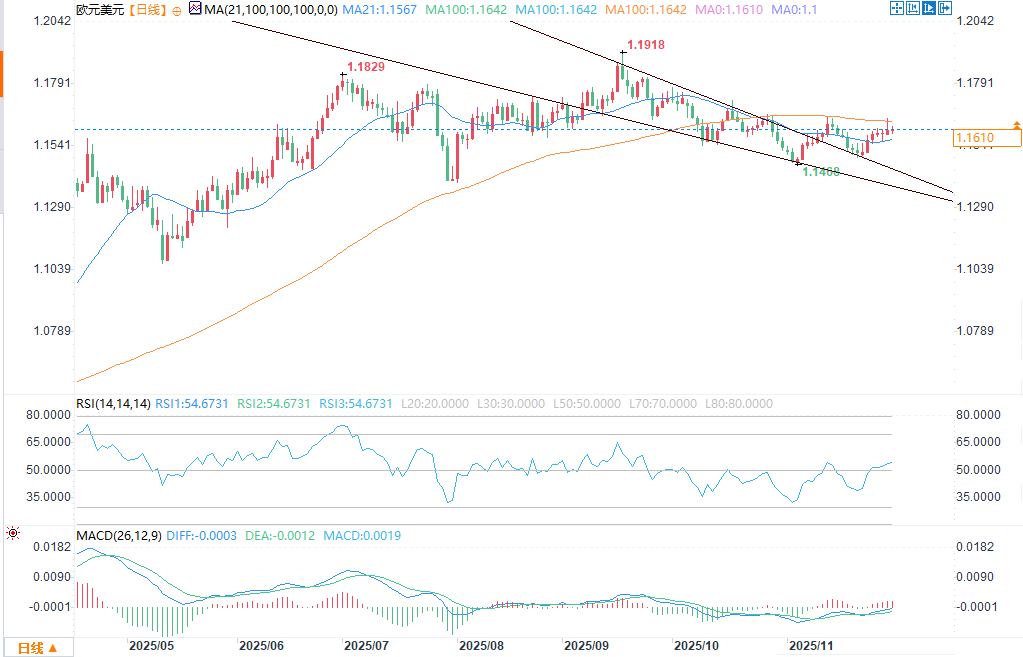
From a technical perspective, EUR/USD has maintained a constructive trend after breaking out of and retesting the descending wedge pattern, and is currently consolidating before a potential new round of upward movement. The 100-day simple moving average continues to limit recent upside, while the 21-day simple moving average is acting as dynamic support. A clear break above the 100-day simple moving average is needed to confirm a continuation of the bullish trend, with the next resistance level around 1.1700.
On the downside, a break below the 21-day simple moving average would lead to a flat or even slightly bearish short-term outlook. Momentum indicators support the current consolidation phase, but show that the bulls are gradually taking control: the Relative Strength Index (RSI) has risen above 50, and the Moving Average Convergence Divergence (MACD) has turned positive near the zero line, indicating an initial recovery in momentum.
No major U.S. economic data was released on Tuesday, resulting in thin trading activity. Traders reacted modestly to preliminary Eurozone inflation data. The latest data showed that the Eurozone's Harmonized Index of Consumer Prices (HICP) rose 2.2% year-on-year in November, up from 2.1% in October; the core HICP rose 2.4% year-on-year, unchanged from the previous month. ING economist Bert Colijn noted in a report that this slight rebound in inflation was mainly due to a narrowing decline in energy prices and does not necessarily indicate a rate cut by the European Central Bank in December. He stated, "Currently, deflation and inflation factors appear to be balancing each other, and price levels remain high, insufficient to support further rate cuts." Looking ahead, businesses expect prices to rise more rapidly, particularly in the services sector, but deflationary pressures should keep prices near current levels for the foreseeable future, with inflation likely to remain below target in the coming months.
The divergence in monetary policy continues to shape the overall market outlook, with relatively little upward resistance for the exchange rate. The market widely expects the European Central Bank (ECB) to keep interest rates unchanged at its December 18th monetary policy meeting, while the US market firmly believes the Federal Reserve will initiate a rate cut at its meeting next week. From a macroeconomic perspective, this CPI data is unlikely to have a significant impact on the ECB's interest rate expectations. Francesco Pesole of ING also agrees with this view. As for the euro, there are slight downside risks, but the exchange rate is likely to remain neutral; if the dollar weakens as expected, the euro/dollar exchange rate could approach the 1.1700 level again.
Looking ahead, key economic data to be released this week from both the US and Europe could provide new impetus for the euro/dollar exchange rate. In the Eurozone, traders will focus on Wednesday's Producer Price Index (PPI) and HCOB Composite Purchasing Managers' Index (PMI), followed by Thursday's retail sales data, and Friday's quarterly employment change data and final Q3 GDP figures. In the US, Wednesday's ADP employment change data and ISM non-manufacturing PMI will be key, while Friday's personal consumption expenditures (PCE) data will provide further clues about the Federal Reserve's monetary policy outlook. Furthermore, the progress of the Russia-Ukraine peace talks remains the most closely watched topic in the euro-related field this week. With US Special Envoy Steve Vitkov meeting with President Putin today, the market will gain a clearer understanding of the progress towards an agreement.
Technical Analysis
(EUR/USD daily chart source: FX678)
From a technical perspective, EUR/USD has maintained a constructive trend after breaking out of and retesting the descending wedge pattern, and is currently consolidating before a potential new round of upward movement. The 100-day simple moving average continues to limit recent upside, while the 21-day simple moving average is acting as dynamic support. A clear break above the 100-day simple moving average is needed to confirm a continuation of the bullish trend, with the next resistance level around 1.1700.
On the downside, a break below the 21-day simple moving average would lead to a flat or even slightly bearish short-term outlook. Momentum indicators support the current consolidation phase, but show that the bulls are gradually taking control: the Relative Strength Index (RSI) has risen above 50, and the Moving Average Convergence Divergence (MACD) has turned positive near the zero line, indicating an initial recovery in momentum.
- Risk Warning and Disclaimer
- The market involves risk, and trading may not be suitable for all investors. This article is for reference only and does not constitute personal investment advice, nor does it take into account certain users’ specific investment objectives, financial situation, or other needs. Any investment decisions made based on this information are at your own risk.