A weaker dollar and expectations of weaker Canadian employment data kept the USD/CAD pair trading at low levels.
2025-12-03 14:32:07
The USD/CAD pair remained cautiously volatile during Wednesday's European trading session, hovering around 1.3960. The US dollar was generally weak, mainly influenced by hints from within the US government regarding future personnel arrangements at the Federal Reserve.
The US president recently stated that he has narrowed down the candidates for the next Federal Reserve chairman to one person and directly mentioned his economic advisor Kevin Hassett in his speech, leading the market to believe that the future direction of monetary policy may be more dovish.
 According to market research, one institution commented: "Hassett is seen as a more accommodative candidate. If he takes office, it may lead to a further decline in the future path of dollar interest rates, which will put medium-term pressure on the dollar."
Meanwhile, the US dollar index (DXY) continued to decline slightly in early European trading, remaining around 99.10, reflecting the market's cautious attitude towards the outlook for the Federal Reserve's monetary policy.
Investors are focused on the US ADP employment data and the November ISM services PMI, both of which will provide key signals on the resilience of the labor market and the economy, thereby influencing market judgments on the Fed's rate cut path throughout the year.
Economists point out that "Federal Reserve officials have repeatedly emphasized the downside risks to the labor market recently, therefore the importance of ADP and other employment-related data during the week is constantly increasing."
Regarding the Canadian dollar, the market is focused on the Canadian November employment data to be released on Friday. The market expects the Canadian unemployment rate to rise from 6.9% to 7%, while the overall labor force is expected to remain flat. This expectation has resulted in a lack of active buying momentum for the Canadian dollar in the short term, but stabilizing oil prices have provided some support, keeping the USD/CAD pair trading within a range.
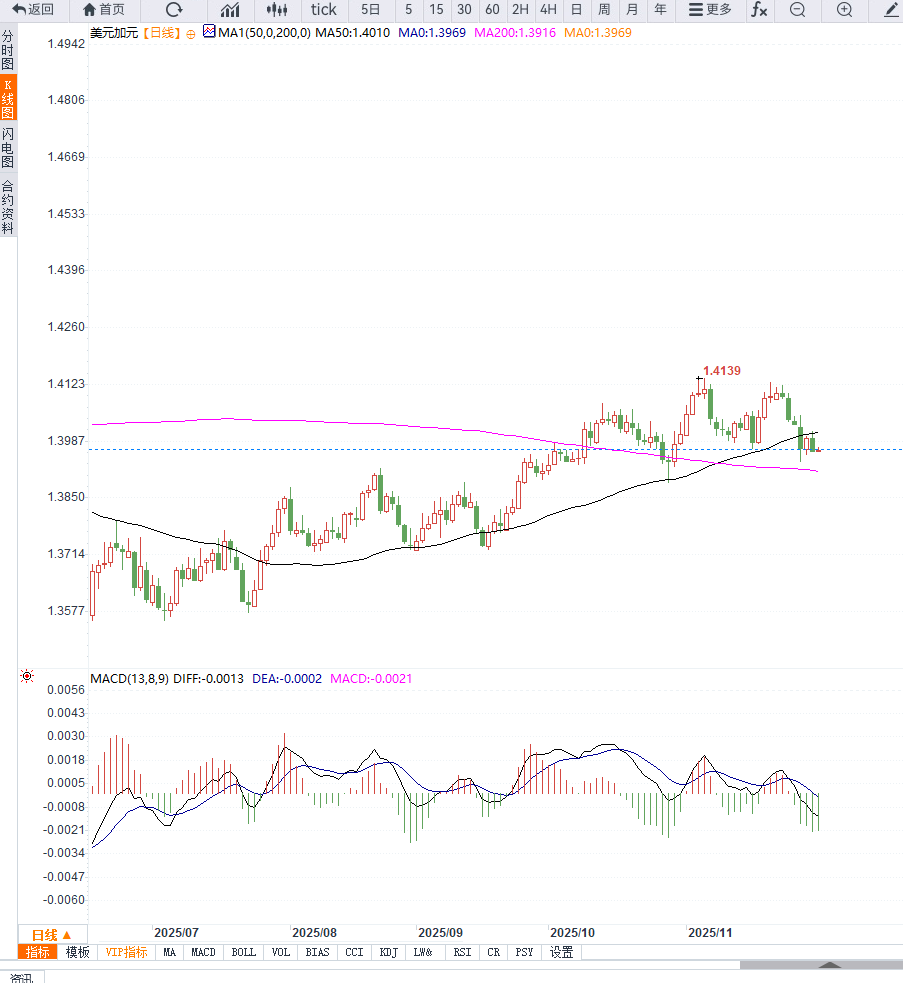
On the daily chart, USD/CAD remains within its medium-term upward channel, and the bullish structure remains intact. Key technical indicators are as follows: The price has held the 1.3920 support level, providing a bottom buffer for short-term bulls; the initial resistance level is at the 1.4000 psychological level, and a break above this level would target the 1.4070 resistance zone.
The RSI remains around 57, indicating that bullish momentum still exists but needs data to drive it. The MACD histogram is above the zero line, but the growth is slowing, indicating short-term volatility. If it breaks below 1.3920, it may retrace to the lower support level of 1.3870 or even 1.3830. Overall, the exchange rate is still in a range-bound trading pattern, but the direction will become clear after the release of US and Canadian employment data.
Editor's Note:
Currently, the USD/CAD pair lacks a clear direction, with both the US dollar and the Canadian dollar constrained by their respective countries' employment data. Potential personnel changes at the Federal Reserve are exacerbating dollar volatility, while expectations of weaker Canadian employment are limiting the Canadian dollar's rebound.
Technical analysis suggests that the bulls still hold a certain advantage, but the 1.4000 level is a key point for short-term breakthroughs. It's advisable to wait for the release of the US ADP, ISM, and Canadian employment reports before making directional moves to avoid the risk of pre-data volatility.
The US president recently stated that he has narrowed down the candidates for the next Federal Reserve chairman to one person and directly mentioned his economic advisor Kevin Hassett in his speech, leading the market to believe that the future direction of monetary policy may be more dovish.
According to market research, one institution commented: "Hassett is seen as a more accommodative candidate. If he takes office, it may lead to a further decline in the future path of dollar interest rates, which will put medium-term pressure on the dollar."Meanwhile, the US dollar index (DXY) continued to decline slightly in early European trading, remaining around 99.10, reflecting the market's cautious attitude towards the outlook for the Federal Reserve's monetary policy.
Investors are focused on the US ADP employment data and the November ISM services PMI, both of which will provide key signals on the resilience of the labor market and the economy, thereby influencing market judgments on the Fed's rate cut path throughout the year.
Economists point out that "Federal Reserve officials have repeatedly emphasized the downside risks to the labor market recently, therefore the importance of ADP and other employment-related data during the week is constantly increasing."
Regarding the Canadian dollar, the market is focused on the Canadian November employment data to be released on Friday. The market expects the Canadian unemployment rate to rise from 6.9% to 7%, while the overall labor force is expected to remain flat. This expectation has resulted in a lack of active buying momentum for the Canadian dollar in the short term, but stabilizing oil prices have provided some support, keeping the USD/CAD pair trading within a range.
On the daily chart, USD/CAD remains within its medium-term upward channel, and the bullish structure remains intact. Key technical indicators are as follows: The price has held the 1.3920 support level, providing a bottom buffer for short-term bulls; the initial resistance level is at the 1.4000 psychological level, and a break above this level would target the 1.4070 resistance zone.
The RSI remains around 57, indicating that bullish momentum still exists but needs data to drive it. The MACD histogram is above the zero line, but the growth is slowing, indicating short-term volatility. If it breaks below 1.3920, it may retrace to the lower support level of 1.3870 or even 1.3830. Overall, the exchange rate is still in a range-bound trading pattern, but the direction will become clear after the release of US and Canadian employment data.
Editor's Note:
Currently, the USD/CAD pair lacks a clear direction, with both the US dollar and the Canadian dollar constrained by their respective countries' employment data. Potential personnel changes at the Federal Reserve are exacerbating dollar volatility, while expectations of weaker Canadian employment are limiting the Canadian dollar's rebound.
Technical analysis suggests that the bulls still hold a certain advantage, but the 1.4000 level is a key point for short-term breakthroughs. It's advisable to wait for the release of the US ADP, ISM, and Canadian employment reports before making directional moves to avoid the risk of pre-data volatility.
- Risk Warning and Disclaimer
- The market involves risk, and trading may not be suitable for all investors. This article is for reference only and does not constitute personal investment advice, nor does it take into account certain users’ specific investment objectives, financial situation, or other needs. Any investment decisions made based on this information are at your own risk.