Putin's surprise visit to India strikes at a US weakness! Tariffs unlikely to halt Russian oil-rupee trade.
2025-12-03 15:27:06
Russian President Vladimir Putin will visit India this week to attend a summit aimed at deepening cooperation in the economic, defense, and energy sectors. With the ongoing conflict between Russia and Ukraine, the trip will also test New Delhi's efforts to balance its relations with both Moscow and Washington.
Vladimir Putin is scheduled to meet with Indian Prime Minister Narendra Modi on Thursday (December 4). Both governments stated that they will review the progress of bilateral relations, discuss issues of common concern, and sign inter-ministerial and commercial agreements.
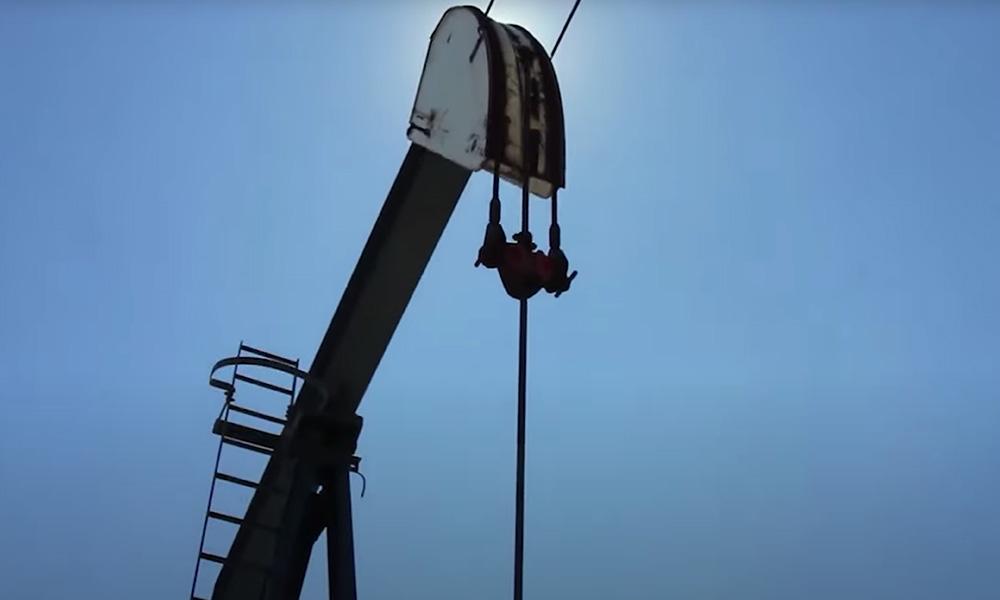
India retains the right to continue purchasing Russian oil, and despite warnings from Washington that the move partially sustains Moscow's revenue used to finance the conflict between Russia and Ukraine, India continues to buy Russian oil at discounted prices. In retaliation, US President Donald Trump has imposed a 25% tariff on Indian imports, bringing the total tariff rate to 50%.
India argues that its imports are necessary to meet the growing energy needs of its 1.4 billion citizens. Putin last visited India in 2021. Modi visited Moscow last year, and the two leaders also met briefly in China this September while attending the Shanghai Cooperation Organisation summit.
As the India-Russia summit convenes, the United States restarts its efforts to promote peace between Russia and Ukraine and seeks broader cooperation with key partners.
US President Donald Trump's peace plan has raised concerns that it is too biased towards Moscow. The proposal was revised more than a week after US and Ukrainian officials met in Geneva.
Modi avoided condemning Russia's actions in Ukraine, while emphasizing the need to resolve the dispute peacefully.
Sriram Sundar Jolyah, an international affairs expert at the Jindal Institute of International Studies near New Delhi, said that India avoids taking on a public mediating role because it could complicate its relations with Russia and the United States.
Jolia said, "But it is feasible for Modi to engage in behind-the-scenes diplomacy, and to some extent it has already happened." He added that Modi might try to get Putin to "take some of the concerns of Ukraine and Europe into account in order to achieve a cessation of hostilities."
Indian officials involved in the summit's preparations said India and Russia will focus on strengthening bilateral relations and are expected to sign a package of documents centered on economic cooperation, trade facilitation, maritime affairs, healthcare, and media exchanges. These officials requested anonymity as details have not yet been released.
India is eager to increase its exports of pharmaceuticals, agricultural products, and textiles to Russia and is seeking to eliminate non-tariff barriers. New Delhi is also looking for long-term fertilizer supplies from Moscow.
Another key area the two countries are working to finalize is facilitating the safe and regulated migration of Indian skilled workers to Russia.
The United States has pressured India to stop buying discounted Russian oil, accusing New Delhi of funding Moscow's conflict operations. In August, Trump imposed a 50% tariff on Indian imports to escalate the pressure.
India has rejected the accusation, stating that it complies with international sanctions and prioritizes national interests and energy security. However, India's position may become more complicated following the imposition of new US sanctions on Russian oil giants Rosneft and Lukoil. Indian officials have indicated they will avoid purchasing oil from sanctioned producers while maintaining options for cooperation with companies not subject to sanctions.
“India will undoubtedly emphasize that it has no intention of completely cutting off its energy supply from Russia,” said Harsh Pant, vice president of foreign policy at the Observer Research Foundation, a New Delhi-based think tank. Pant said future imports will depend on “market forces and the extent to which sanctions can free Indian private or state-owned enterprises from dependence on Russian energy.”
Energy cooperation is expected to be a key topic at the summit, including Indian investment in the Russian Far East and expanding cooperation in civilian nuclear energy. The Kudankulam nuclear power plant, built in Tamil Nadu with Russian assistance, remains central to the partnership, and officials stated that both sides will continue discussions on the localization of equipment manufacturing and potential cooperative projects in third countries.
India is expected to urge Russia to expedite the delivery of two additional squadrons of S-400 air defense missile systems. India had previously received three squadrons under a 2018 agreement worth approximately $5.4 billion. The delivery delays are linked to supply chain disruptions caused by the Russia-Ukraine conflict.
Indian authorities may also explore the possibility of purchasing more S-400 systems or upgraded versions thereof, but no contracts or announcements are expected. Indian defense planners have stated that the S-400 proved effective during the brief military standoff with Pakistan in May.
Indian Defence Secretary Rajesh Kumar Singh said at a security conference in New Delhi last week: "This meeting will focus on the broader elements of institutional cooperation between the two sides in the defense sector and work to ensure that delivery delays are resolved. The possibility of adding S-400s cannot be ruled out, but do not expect any announcements during the visit."
The two sides are also expected to discuss issues such as upgrading India's Russian-made Su-30MKI fighter jets, accelerating the delivery of key military hardware, and improving joint exercises and disaster relief coordination.
Despite India's diversification of military hardware procurement over the past few years, Russia remains its largest supplier. Moscow is eager to sell its Su-57 stealth fighter jets to India, but New Delhi also retains the option of other foreign suppliers.
This summit will most likely continue the Russia-India "discounted crude oil cooperation model," providing a stable incremental supply to the global market. However, the risk of escalating US sanctions could trigger partial disruptions to trade flows. In the short term, the expansion of Russian oil discounts may slightly suppress international oil prices, but geopolitical tensions will limit the downside.
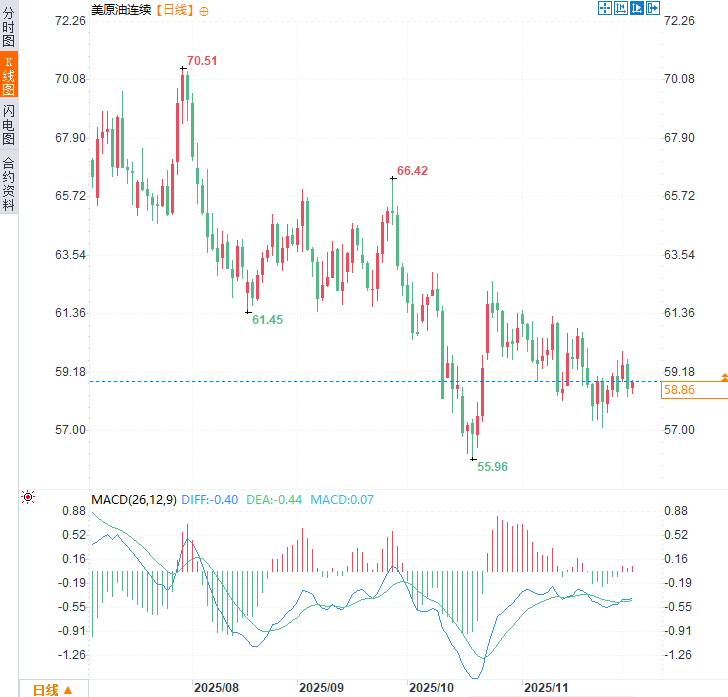
(US crude oil daily chart, source: FX678)
At 15:26 Beijing time, US crude oil futures were trading at $58.93 per barrel.
Vladimir Putin is scheduled to meet with Indian Prime Minister Narendra Modi on Thursday (December 4). Both governments stated that they will review the progress of bilateral relations, discuss issues of common concern, and sign inter-ministerial and commercial agreements.
India retains the right to continue purchasing Russian oil, and despite warnings from Washington that the move partially sustains Moscow's revenue used to finance the conflict between Russia and Ukraine, India continues to buy Russian oil at discounted prices. In retaliation, US President Donald Trump has imposed a 25% tariff on Indian imports, bringing the total tariff rate to 50%.
India argues that its imports are necessary to meet the growing energy needs of its 1.4 billion citizens. Putin last visited India in 2021. Modi visited Moscow last year, and the two leaders also met briefly in China this September while attending the Shanghai Cooperation Organisation summit.
This crucial diplomatic moment
As the India-Russia summit convenes, the United States restarts its efforts to promote peace between Russia and Ukraine and seeks broader cooperation with key partners.
US President Donald Trump's peace plan has raised concerns that it is too biased towards Moscow. The proposal was revised more than a week after US and Ukrainian officials met in Geneva.
Modi avoided condemning Russia's actions in Ukraine, while emphasizing the need to resolve the dispute peacefully.
Sriram Sundar Jolyah, an international affairs expert at the Jindal Institute of International Studies near New Delhi, said that India avoids taking on a public mediating role because it could complicate its relations with Russia and the United States.
Jolia said, "But it is feasible for Modi to engage in behind-the-scenes diplomacy, and to some extent it has already happened." He added that Modi might try to get Putin to "take some of the concerns of Ukraine and Europe into account in order to achieve a cessation of hostilities."
Economic cooperation is a key focus of Putin's visit.
Indian officials involved in the summit's preparations said India and Russia will focus on strengthening bilateral relations and are expected to sign a package of documents centered on economic cooperation, trade facilitation, maritime affairs, healthcare, and media exchanges. These officials requested anonymity as details have not yet been released.
India is eager to increase its exports of pharmaceuticals, agricultural products, and textiles to Russia and is seeking to eliminate non-tariff barriers. New Delhi is also looking for long-term fertilizer supplies from Moscow.
Another key area the two countries are working to finalize is facilitating the safe and regulated migration of Indian skilled workers to Russia.
The United States is pressuring India to boycott Russian oil.
The United States has pressured India to stop buying discounted Russian oil, accusing New Delhi of funding Moscow's conflict operations. In August, Trump imposed a 50% tariff on Indian imports to escalate the pressure.
India has rejected the accusation, stating that it complies with international sanctions and prioritizes national interests and energy security. However, India's position may become more complicated following the imposition of new US sanctions on Russian oil giants Rosneft and Lukoil. Indian officials have indicated they will avoid purchasing oil from sanctioned producers while maintaining options for cooperation with companies not subject to sanctions.
“India will undoubtedly emphasize that it has no intention of completely cutting off its energy supply from Russia,” said Harsh Pant, vice president of foreign policy at the Observer Research Foundation, a New Delhi-based think tank. Pant said future imports will depend on “market forces and the extent to which sanctions can free Indian private or state-owned enterprises from dependence on Russian energy.”
Energy cooperation is expected to be a key topic at the summit, including Indian investment in the Russian Far East and expanding cooperation in civilian nuclear energy. The Kudankulam nuclear power plant, built in Tamil Nadu with Russian assistance, remains central to the partnership, and officials stated that both sides will continue discussions on the localization of equipment manufacturing and potential cooperative projects in third countries.
With defensive cooperation as the core
India is expected to urge Russia to expedite the delivery of two additional squadrons of S-400 air defense missile systems. India had previously received three squadrons under a 2018 agreement worth approximately $5.4 billion. The delivery delays are linked to supply chain disruptions caused by the Russia-Ukraine conflict.
Indian authorities may also explore the possibility of purchasing more S-400 systems or upgraded versions thereof, but no contracts or announcements are expected. Indian defense planners have stated that the S-400 proved effective during the brief military standoff with Pakistan in May.
Indian Defence Secretary Rajesh Kumar Singh said at a security conference in New Delhi last week: "This meeting will focus on the broader elements of institutional cooperation between the two sides in the defense sector and work to ensure that delivery delays are resolved. The possibility of adding S-400s cannot be ruled out, but do not expect any announcements during the visit."
The two sides are also expected to discuss issues such as upgrading India's Russian-made Su-30MKI fighter jets, accelerating the delivery of key military hardware, and improving joint exercises and disaster relief coordination.
Despite India's diversification of military hardware procurement over the past few years, Russia remains its largest supplier. Moscow is eager to sell its Su-57 stealth fighter jets to India, but New Delhi also retains the option of other foreign suppliers.
This summit will most likely continue the Russia-India "discounted crude oil cooperation model," providing a stable incremental supply to the global market. However, the risk of escalating US sanctions could trigger partial disruptions to trade flows. In the short term, the expansion of Russian oil discounts may slightly suppress international oil prices, but geopolitical tensions will limit the downside.
(US crude oil daily chart, source: FX678)
At 15:26 Beijing time, US crude oil futures were trading at $58.93 per barrel.
- Risk Warning and Disclaimer
- The market involves risk, and trading may not be suitable for all investors. This article is for reference only and does not constitute personal investment advice, nor does it take into account certain users’ specific investment objectives, financial situation, or other needs. Any investment decisions made based on this information are at your own risk.