The pound was pressured by rising expectations of a Bank of England rate cut in December, with EUR/GBP falling to 0.8795, but downside was limited.
2025-12-03 14:53:24
The EUR/GBP cross rate saw a modest decline in early European trading on Wednesday, fluctuating around 0.8795. However, continued strengthening of market bets on a possible interest rate cut by the Bank of England in December kept the pound relatively weak, thus limiting the downside potential of the cross rate.
Following the release of the UK's autumn budget, the market is generally concerned that overall tax levels will rise further. Meanwhile, the weakening labor market and low inflation have reinforced the likelihood that the Bank of England will adopt a more accommodative stance in future policy.
 According to market research, an economist from a certain institution stated: "The momentum of demand in the UK is slowing down, and the structural decline in inflation makes a rate cut by the Bank of England in December highly probable, which will put short-term pressure on the pound."
The British Prime Minister emphasized that it is necessary to push inflation and interest rates further down in order to promote business investment and economic growth. The market has already fully priced in the Bank of England's expectation of a 25 basis point rate cut to 3.75% in December, with a probability as high as 90%, leaving the pound lacking support.
In contrast, the situation is different in the Eurozone. November's unexpected rise in inflation has led the market to believe that the European Central Bank (ECB) is unlikely to cut interest rates further in the near term. Previously, the ECB had kept interest rates unchanged at two consecutive meetings, including maintaining the deposit rate at 2.00%.
A European policy analyst pointed out, "The European Central Bank has entered a policy observation phase. The rebound in inflation gives it a reason to hold rates steady, which provides relatively stable support for the euro in the foreign exchange market." The ECB president recently stated that current interest rates are at an "appropriate level," reinforcing the market's judgment that the downward cycle may be coming to a temporary end.
This has increased the relative advantage of the euro in cross-currency pairs, offsetting some of the short-term downward pressure on EUR/GBP.
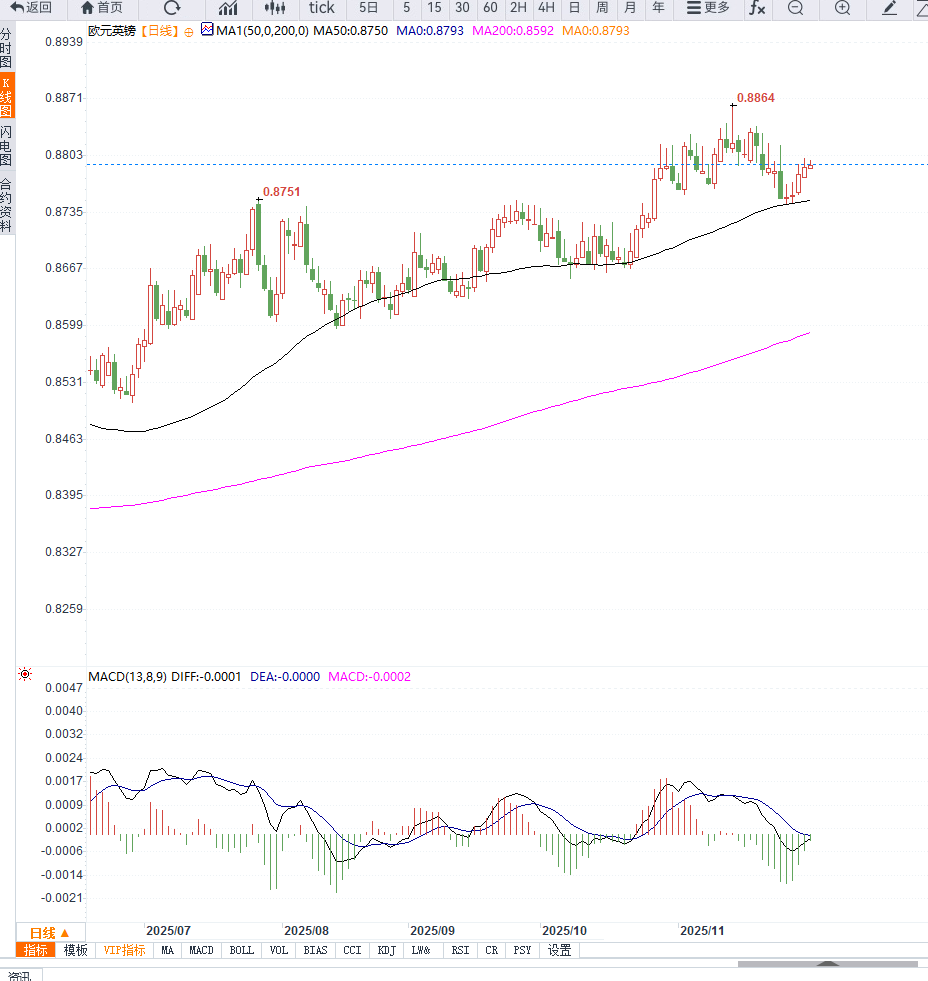
The daily chart shows that EUR/GBP maintains a moderate upward trend, but there are signs of profit-taking in the short term: the exchange rate encountered resistance below 0.8800, putting downward pressure on short-term bulls; initial support is at 0.8770, and a break below this level could lead to a retest of the 0.8745 area.
The RSI is around 56, indicating that bullish momentum has not completely weakened; the MACD fast line is still above the zero line, but the momentum bars are shortening, reflecting a slowdown in the short-term upward trend; if it regains a foothold above 0.8820, cross-currency pairs are expected to further test the 0.8850 resistance zone. Overall, the technical outlook leans towards a fluctuating upward trend, but further clarity on the Bank of England's policy expectations is needed.
Editor's Note:
The current EUR/GBP exchange rate is driven by the policy expectations gap between the Bank of England and the European Central Bank. The pound remains under pressure due to persistently high expectations of interest rate cuts, while the rebound in Eurozone inflation makes the ECB more likely to maintain current interest rates, thus providing relatively stable buying support for the euro.
In the short term, the decline in cross-currency pairs is limited. If UK employment or inflation weakens further, EUR/GBP may still attempt to retest the 0.8820 level. Closely monitor key data releases ahead of the Bank of England's December meeting to mitigate the risk of rapid price movements due to increased volatility.
Following the release of the UK's autumn budget, the market is generally concerned that overall tax levels will rise further. Meanwhile, the weakening labor market and low inflation have reinforced the likelihood that the Bank of England will adopt a more accommodative stance in future policy.
According to market research, an economist from a certain institution stated: "The momentum of demand in the UK is slowing down, and the structural decline in inflation makes a rate cut by the Bank of England in December highly probable, which will put short-term pressure on the pound."The British Prime Minister emphasized that it is necessary to push inflation and interest rates further down in order to promote business investment and economic growth. The market has already fully priced in the Bank of England's expectation of a 25 basis point rate cut to 3.75% in December, with a probability as high as 90%, leaving the pound lacking support.
In contrast, the situation is different in the Eurozone. November's unexpected rise in inflation has led the market to believe that the European Central Bank (ECB) is unlikely to cut interest rates further in the near term. Previously, the ECB had kept interest rates unchanged at two consecutive meetings, including maintaining the deposit rate at 2.00%.
A European policy analyst pointed out, "The European Central Bank has entered a policy observation phase. The rebound in inflation gives it a reason to hold rates steady, which provides relatively stable support for the euro in the foreign exchange market." The ECB president recently stated that current interest rates are at an "appropriate level," reinforcing the market's judgment that the downward cycle may be coming to a temporary end.
This has increased the relative advantage of the euro in cross-currency pairs, offsetting some of the short-term downward pressure on EUR/GBP.
The daily chart shows that EUR/GBP maintains a moderate upward trend, but there are signs of profit-taking in the short term: the exchange rate encountered resistance below 0.8800, putting downward pressure on short-term bulls; initial support is at 0.8770, and a break below this level could lead to a retest of the 0.8745 area.
The RSI is around 56, indicating that bullish momentum has not completely weakened; the MACD fast line is still above the zero line, but the momentum bars are shortening, reflecting a slowdown in the short-term upward trend; if it regains a foothold above 0.8820, cross-currency pairs are expected to further test the 0.8850 resistance zone. Overall, the technical outlook leans towards a fluctuating upward trend, but further clarity on the Bank of England's policy expectations is needed.
Editor's Note:
The current EUR/GBP exchange rate is driven by the policy expectations gap between the Bank of England and the European Central Bank. The pound remains under pressure due to persistently high expectations of interest rate cuts, while the rebound in Eurozone inflation makes the ECB more likely to maintain current interest rates, thus providing relatively stable buying support for the euro.
In the short term, the decline in cross-currency pairs is limited. If UK employment or inflation weakens further, EUR/GBP may still attempt to retest the 0.8820 level. Closely monitor key data releases ahead of the Bank of England's December meeting to mitigate the risk of rapid price movements due to increased volatility.
- Risk Warning and Disclaimer
- The market involves risk, and trading may not be suitable for all investors. This article is for reference only and does not constitute personal investment advice, nor does it take into account certain users’ specific investment objectives, financial situation, or other needs. Any investment decisions made based on this information are at your own risk.