Putin makes a surprise visit to India amidst US tariffs! A multi-billion dollar trade imbalance foreshadows potential oil price shifts.
2025-12-05 09:07:31
As the United States imposes punitive tariffs on India for purchasing Russian oil, India will host a two-day visit by Russian President Vladimir Putin, demonstrating India's determination to deepen its relationship with Russia. The Kremlin stated that the visit is of "great significance," and that President Putin and Prime Minister Modi will discuss the "special and privileged strategic partnership between Russia and India."
Ian Bremer, president and founder of the Eurasia Group political risk consultancy, said the visit demonstrates India's desire to "maintain relations with Russia." Putin visited India from December 4th to 5th to attend the 23rd annual India-Russia summit. Experts say the two countries will expand their strategic and trade ties.
British think tank researcher Zitaji Bajape said that although the visit was scheduled before the deterioration of US-India relations, it demonstrates that "New Delhi is unaffected by the Trump administration's erratic policies and adheres to an independent foreign policy." Expanding trade will be a major focus of the summit, which will help India achieve more balanced bilateral trade with Russia.
As the United States imposes punitive tariffs on India for its purchases of Russian oil, India will host a two-day visit by Russian President Vladimir Putin, demonstrating India's determination to deepen its relationship with Russia. Alexei Zakharov, a visiting scholar at the Observer Research Foundation, an Indian think tank, stated that expanding trade will be a major focus of the summit, helping India achieve a more balanced bilateral trade relationship with Russia . The two leaders are likely to discuss India's procurement of Russia's new generation Su-57 fighter jets and advanced S-500 missile defense system during their talks.
The trade deficit between Russia and India is enormous. According to data from the government-backed Indian Brand Assets Foundation, trade between India and Russia totaled $68.72 billion in the fiscal year ending March 2025, with the trade balance heavily tilted towards Russia. Data shows that India's exports to Russia amounted to only $4.88 billion, while imports reached a staggering $63.84 billion. The two countries plan to expand bilateral trade to $100 billion by 2030. Zakharov stated that India could increase its exports of machinery, chemicals, food, and pharmaceuticals to Russia, while Moscow would focus on promoting its civilian nuclear energy technology solutions, including the construction of small modular reactors in India.
"New Delhi and Moscow are seeking to diversify their trade relationship into other areas, including defense and civilian nuclear cooperation, to offset the impact of India's reduced imports of Russian oil," said Chithaiji Bajape, a senior fellow for South Asia at the Asia-Pacific program at the Chatham House, a British think tank. Ian Bremer, president and founder of the Eurasia Group's political risk consultancy, said that India and Russia will discuss weapons supplies, but Russia is unable to deliver India's ordered S-400 missile systems due to chip shortages, and India is not interested in the Su-57 fighter jet.
Data from the Stockholm International Peace Research Institute (SIPRI) shows that Russia will be India's largest arms supplier from 2020 to 2024, accounting for 36%, followed by France at 33% and Israel at 13%. However, Russia's share has been declining, from 55% in 2015-2019 and 72% in 2010-2014 to 36% this year. A report by SIPRI in March of this year indicated that India is shifting its arms procurement towards suppliers such as France, Israel, and the United States.
The trade deficit between Russia and India is enormous. India is forced to maintain a balance between the United States and Russia. The United States has been pressuring India to reduce its imports of Russian oil. Washington claims that these imports allow Russia to withstand Western economic sanctions and continue to fund the Russia-Ukraine conflict.
As "punishment" for its purchases of Russian energy, New Delhi was not only required to pay a 25% tariff on exports to the US, but also faced an additional 25% tariff. The US imposed a 50% tariff on Indian goods, which took effect on August 27th; this is one of the highest tariffs the US has imposed on any country. The US accused India of importing Russian oil and reselling it on the open market for "huge profits," enabling Moscow to fund the Russia-Ukraine conflict. New Delhi stated that its oil imports were based on "the goal of ensuring the energy security of India's 1.4 billion people."
In an effort to repair relations with the United States, New Delhi has increased its energy purchases from Washington. India's state-owned oil company signed a one-year agreement to import approximately 2.2 million tons of liquefied petroleum gas (LPG) annually from the US. India has also been reducing its purchases of Russian oil following US sanctions against Russia's two largest oil companies, Rosneft and Lukoil.
However, Sumit Ritolia, chief research analyst at energy intelligence firm Kpler, told CNBC that Russian oil exports to India will decline in the short term but will recover through new intermediaries that can circumvent sanctions. Alpit Chatuvedi, an advisor to the geopolitical risk consulting team at Teneo, said that if a US-India trade agreement is not reached, India will lose a $20 billion trade surplus, while the cost advantage gained from discounted Russian oil will only be $8 billion. Chatuvedi said, "From a purely monetary perspective, trade with the US is far more important to India."
Putin's visit to India comes at a time when the United States is working to broker a peace agreement between Ukraine and Russia. On Tuesday (December 2), Putin, U.S. Special Envoy Steve Vitkov, and Trump's son-in-law Jared Kushner met for five hours in Moscow to discuss ending the Russia-Ukraine conflict. The Kremlin stated that the talks were constructive but failed to achieve a breakthrough. Chithai Bajape, a senior fellow for South Asia at the Chatham House Asia-Pacific Program, said India will hope for an eventual peace agreement, as this would help reduce scrutiny of Indo-Russian relations.
These developments may provide slight support for oil prices in the short term, but their medium- to long-term impact is neutral and could exacerbate market volatility. On Friday (December 5), US crude oil prices fluctuated around $59.65 per barrel.
The aforementioned India-Russia-US triangular relationship is not a single driving factor that can determine the direction of oil prices, but rather an important "volatility amplifier" and "structural variable." It ensures that Russian oil does not completely withdraw from the market, but also limits its large-scale expansion, while continuously injecting geopolitical uncertainty into the market.
Traders need to pay closer attention to specific signals such as the effectiveness of sanctions circumvention routes, subsequent US policies, and progress in the Russia-Ukraine peace talks.
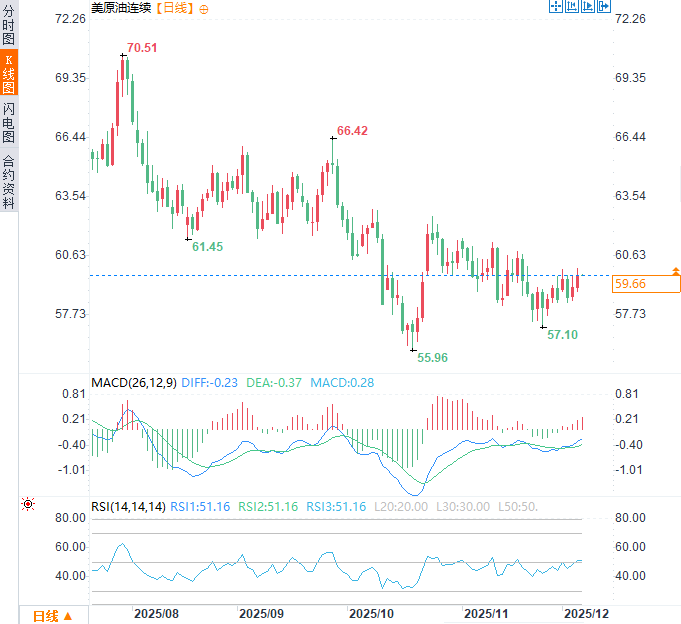
(US crude oil daily chart, source: FX678)
At 9:07 AM Beijing time, US crude oil futures were trading at $59.66 per barrel.
Ian Bremer, president and founder of the Eurasia Group political risk consultancy, said the visit demonstrates India's desire to "maintain relations with Russia." Putin visited India from December 4th to 5th to attend the 23rd annual India-Russia summit. Experts say the two countries will expand their strategic and trade ties.
British think tank researcher Zitaji Bajape said that although the visit was scheduled before the deterioration of US-India relations, it demonstrates that "New Delhi is unaffected by the Trump administration's erratic policies and adheres to an independent foreign policy." Expanding trade will be a major focus of the summit, which will help India achieve more balanced bilateral trade with Russia.
trade deficit
As the United States imposes punitive tariffs on India for its purchases of Russian oil, India will host a two-day visit by Russian President Vladimir Putin, demonstrating India's determination to deepen its relationship with Russia. Alexei Zakharov, a visiting scholar at the Observer Research Foundation, an Indian think tank, stated that expanding trade will be a major focus of the summit, helping India achieve a more balanced bilateral trade relationship with Russia . The two leaders are likely to discuss India's procurement of Russia's new generation Su-57 fighter jets and advanced S-500 missile defense system during their talks.
The trade deficit between Russia and India is enormous. According to data from the government-backed Indian Brand Assets Foundation, trade between India and Russia totaled $68.72 billion in the fiscal year ending March 2025, with the trade balance heavily tilted towards Russia. Data shows that India's exports to Russia amounted to only $4.88 billion, while imports reached a staggering $63.84 billion. The two countries plan to expand bilateral trade to $100 billion by 2030. Zakharov stated that India could increase its exports of machinery, chemicals, food, and pharmaceuticals to Russia, while Moscow would focus on promoting its civilian nuclear energy technology solutions, including the construction of small modular reactors in India.
"New Delhi and Moscow are seeking to diversify their trade relationship into other areas, including defense and civilian nuclear cooperation, to offset the impact of India's reduced imports of Russian oil," said Chithaiji Bajape, a senior fellow for South Asia at the Asia-Pacific program at the Chatham House, a British think tank. Ian Bremer, president and founder of the Eurasia Group's political risk consultancy, said that India and Russia will discuss weapons supplies, but Russia is unable to deliver India's ordered S-400 missile systems due to chip shortages, and India is not interested in the Su-57 fighter jet.
Data from the Stockholm International Peace Research Institute (SIPRI) shows that Russia will be India's largest arms supplier from 2020 to 2024, accounting for 36%, followed by France at 33% and Israel at 13%. However, Russia's share has been declining, from 55% in 2015-2019 and 72% in 2010-2014 to 36% this year. A report by SIPRI in March of this year indicated that India is shifting its arms procurement towards suppliers such as France, Israel, and the United States.
The Way of Balance
The trade deficit between Russia and India is enormous. India is forced to maintain a balance between the United States and Russia. The United States has been pressuring India to reduce its imports of Russian oil. Washington claims that these imports allow Russia to withstand Western economic sanctions and continue to fund the Russia-Ukraine conflict.
As "punishment" for its purchases of Russian energy, New Delhi was not only required to pay a 25% tariff on exports to the US, but also faced an additional 25% tariff. The US imposed a 50% tariff on Indian goods, which took effect on August 27th; this is one of the highest tariffs the US has imposed on any country. The US accused India of importing Russian oil and reselling it on the open market for "huge profits," enabling Moscow to fund the Russia-Ukraine conflict. New Delhi stated that its oil imports were based on "the goal of ensuring the energy security of India's 1.4 billion people."
In an effort to repair relations with the United States, New Delhi has increased its energy purchases from Washington. India's state-owned oil company signed a one-year agreement to import approximately 2.2 million tons of liquefied petroleum gas (LPG) annually from the US. India has also been reducing its purchases of Russian oil following US sanctions against Russia's two largest oil companies, Rosneft and Lukoil.
However, Sumit Ritolia, chief research analyst at energy intelligence firm Kpler, told CNBC that Russian oil exports to India will decline in the short term but will recover through new intermediaries that can circumvent sanctions. Alpit Chatuvedi, an advisor to the geopolitical risk consulting team at Teneo, said that if a US-India trade agreement is not reached, India will lose a $20 billion trade surplus, while the cost advantage gained from discounted Russian oil will only be $8 billion. Chatuvedi said, "From a purely monetary perspective, trade with the US is far more important to India."
Putin's visit to India comes at a time when the United States is working to broker a peace agreement between Ukraine and Russia. On Tuesday (December 2), Putin, U.S. Special Envoy Steve Vitkov, and Trump's son-in-law Jared Kushner met for five hours in Moscow to discuss ending the Russia-Ukraine conflict. The Kremlin stated that the talks were constructive but failed to achieve a breakthrough. Chithai Bajape, a senior fellow for South Asia at the Chatham House Asia-Pacific Program, said India will hope for an eventual peace agreement, as this would help reduce scrutiny of Indo-Russian relations.
Comprehensive assessment of crude oil price trends
These developments may provide slight support for oil prices in the short term, but their medium- to long-term impact is neutral and could exacerbate market volatility. On Friday (December 5), US crude oil prices fluctuated around $59.65 per barrel.
The aforementioned India-Russia-US triangular relationship is not a single driving factor that can determine the direction of oil prices, but rather an important "volatility amplifier" and "structural variable." It ensures that Russian oil does not completely withdraw from the market, but also limits its large-scale expansion, while continuously injecting geopolitical uncertainty into the market.
Traders need to pay closer attention to specific signals such as the effectiveness of sanctions circumvention routes, subsequent US policies, and progress in the Russia-Ukraine peace talks.
(US crude oil daily chart, source: FX678)
At 9:07 AM Beijing time, US crude oil futures were trading at $59.66 per barrel.
- Risk Warning and Disclaimer
- The market involves risk, and trading may not be suitable for all investors. This article is for reference only and does not constitute personal investment advice, nor does it take into account certain users’ specific investment objectives, financial situation, or other needs. Any investment decisions made based on this information are at your own risk.