Geopolitical risk premiums rise again! Public rifts between the US and Europe, and dashed hopes for Russia-Ukraine peace talks, support oil prices.
2025-12-12 13:20:39
Last week, the White House released a new version of its national security strategy, causing concern in Europe. The document warned of the risk of "civilizational annihilation" and questioned its ability to continue serving as a geopolitical partner of the United States.
The document harshly criticizes the “weakness” of European leadership, attacks the region’s stance on issues such as immigration, democracy, and freedom of speech, and points out that its economic and military strength is declining, which has deeply shocked its European allies.
The document states that "it is far from clear whether certain European countries possess sufficient economic and military strength to remain reliable allies," and points to a "lack of confidence" in the region. It also advocates that the United States should rebuild a "strategic stability" relationship with Russia—despite the ongoing conflict between Russia and Ukraine.
However, former CIA Director and four-star general David Petraeus said that it is not a bad thing for European countries to receive such a wake-up call, as it can prompt them to focus on their own defense and security.
He said on Thursday (December 11): "This strategy is, to some extent, a wake-up call for Europeans, but frankly, some Europeans do need to be woken up. I have witnessed four US presidents trying to urge Europeans to contribute more to their own defense, and now it's finally paying off."
Petraeus believes that President Trump played an "extremely significant" role in pushing Europe to increase defense spending. "He got Europeans to commit to things they should have done years ago," Petraeus noted. Under continued pressure from the Trump administration, NATO's European members agreed earlier this year to increase defense spending to 5% of their GDP.
Petraeus made these remarks as diplomatic efforts to end the Russia-Ukraine conflict continued, with U.S. officials holding talks with representatives of Russia and Ukraine in recent weeks regarding peace proposals.
Russia, Ukraine, and their European allies have all put forward conflicting peace proposals with differing "red lines." The biggest obstacle to the peace process remains the disagreement between the two sides on subsequent security guarantees for Ukraine, and Russia's demand that the Kyiv authorities cede the Donbas region in the east.
Washington is reportedly urging both sides to reach an agreement before Christmas, but doubts remain about this possibility. Meanwhile, Russia seems pleased that Europe and Ukraine are facing increasing pressure from Washington.
Petraeus stated that he is not confident that Russia might compromise on its peace plan, as Putin has shown no signs of compromising on goals such as territorial control, regime change, and creating a "demilitarized" Ukraine without NATO prospects.
He said, "What encourages me is that, with the support of the United States and President Trump himself on many fronts, his direct negotiators are working to end this conflict. But Moscow's response makes me less optimistic."
He added, "Putin has only repeatedly reiterated that his goal is to maximize his demands, which essentially negates Ukraine's independence. He wants a pro-Russian president to replace Zelensky... He intends to demilitarize Ukraine... and demands land in Ukraine's most heavily fortified regions."
Petraeus concluded, "Putin will not back down."
With the United Nations estimating that postwar reconstruction and Russian reparations could exceed $500 billion, Ukraine's European allies are exploring ways to continue funding Ukraine and considering a final postwar reconstruction plan.
The EU is believed to be close to reaching an agreement to use a significant portion of the approximately €210 billion (about $244 billion) of Russian sovereign assets currently frozen in European financial institutions.
However, concerns have been raised about the legal consequences of using these assets and the potential for retaliatory action from Moscow. The chairman of the Russian Security Council warned last week that using Russian assets would be tantamount to a declaration of war.
Petraeus stated that if the EU does indeed begin using the frozen Russian assets, it will bring about "disruptive changes."
He said, "We've heard a lot about so-called disruptive changes, and I've never agreed with that notion. But... providing Ukraine with $200 billion or even €100 billion would indeed bring about disruptive changes. That would be enough to solve their financial and economic difficulties for years to come."
Despite the theoretically negative factor for oil prices—a potential shift in the US stance towards Russia—the current signals of a stalemate in the conflict and the possibility of retaliation for aggressive EU actions (such as the use of Russian assets) are stronger. Therefore, the support (risk premium) for oil prices outweighs the pressure. On Friday, US crude oil prices fluctuated higher, rising approximately 0.76%.
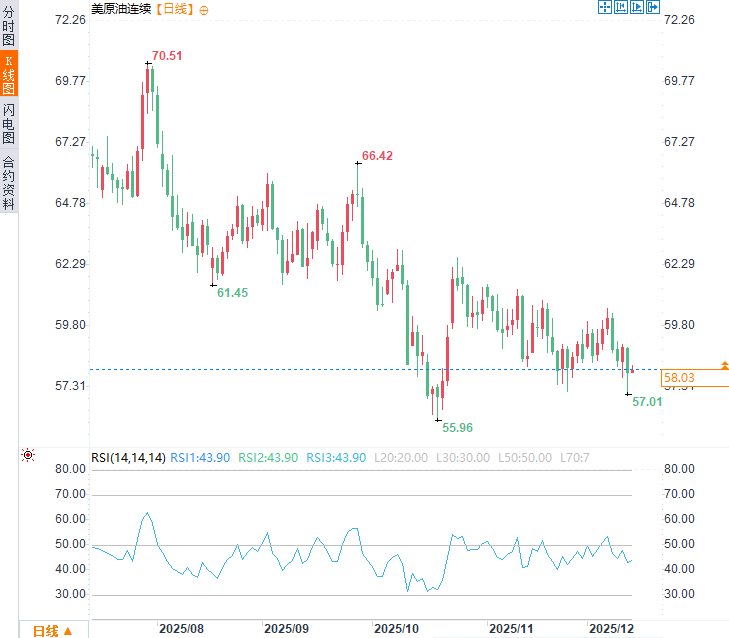
(US crude oil daily chart, source: FX678)
At 13:20 Beijing time, US crude oil futures were trading at $58.10 per barrel.
The document harshly criticizes the “weakness” of European leadership, attacks the region’s stance on issues such as immigration, democracy, and freedom of speech, and points out that its economic and military strength is declining, which has deeply shocked its European allies.
The document states that "it is far from clear whether certain European countries possess sufficient economic and military strength to remain reliable allies," and points to a "lack of confidence" in the region. It also advocates that the United States should rebuild a "strategic stability" relationship with Russia—despite the ongoing conflict between Russia and Ukraine.
However, former CIA Director and four-star general David Petraeus said that it is not a bad thing for European countries to receive such a wake-up call, as it can prompt them to focus on their own defense and security.
He said on Thursday (December 11): "This strategy is, to some extent, a wake-up call for Europeans, but frankly, some Europeans do need to be woken up. I have witnessed four US presidents trying to urge Europeans to contribute more to their own defense, and now it's finally paying off."
Petraeus believes that President Trump played an "extremely significant" role in pushing Europe to increase defense spending. "He got Europeans to commit to things they should have done years ago," Petraeus noted. Under continued pressure from the Trump administration, NATO's European members agreed earlier this year to increase defense spending to 5% of their GDP.
Putin will not back down
Petraeus made these remarks as diplomatic efforts to end the Russia-Ukraine conflict continued, with U.S. officials holding talks with representatives of Russia and Ukraine in recent weeks regarding peace proposals.
Russia, Ukraine, and their European allies have all put forward conflicting peace proposals with differing "red lines." The biggest obstacle to the peace process remains the disagreement between the two sides on subsequent security guarantees for Ukraine, and Russia's demand that the Kyiv authorities cede the Donbas region in the east.
Washington is reportedly urging both sides to reach an agreement before Christmas, but doubts remain about this possibility. Meanwhile, Russia seems pleased that Europe and Ukraine are facing increasing pressure from Washington.
Petraeus stated that he is not confident that Russia might compromise on its peace plan, as Putin has shown no signs of compromising on goals such as territorial control, regime change, and creating a "demilitarized" Ukraine without NATO prospects.
He said, "What encourages me is that, with the support of the United States and President Trump himself on many fronts, his direct negotiators are working to end this conflict. But Moscow's response makes me less optimistic."
He added, "Putin has only repeatedly reiterated that his goal is to maximize his demands, which essentially negates Ukraine's independence. He wants a pro-Russian president to replace Zelensky... He intends to demilitarize Ukraine... and demands land in Ukraine's most heavily fortified regions."
Petraeus concluded, "Putin will not back down."
Purpose of frozen assets
With the United Nations estimating that postwar reconstruction and Russian reparations could exceed $500 billion, Ukraine's European allies are exploring ways to continue funding Ukraine and considering a final postwar reconstruction plan.
The EU is believed to be close to reaching an agreement to use a significant portion of the approximately €210 billion (about $244 billion) of Russian sovereign assets currently frozen in European financial institutions.
However, concerns have been raised about the legal consequences of using these assets and the potential for retaliatory action from Moscow. The chairman of the Russian Security Council warned last week that using Russian assets would be tantamount to a declaration of war.
Petraeus stated that if the EU does indeed begin using the frozen Russian assets, it will bring about "disruptive changes."
He said, "We've heard a lot about so-called disruptive changes, and I've never agreed with that notion. But... providing Ukraine with $200 billion or even €100 billion would indeed bring about disruptive changes. That would be enough to solve their financial and economic difficulties for years to come."
Despite the theoretically negative factor for oil prices—a potential shift in the US stance towards Russia—the current signals of a stalemate in the conflict and the possibility of retaliation for aggressive EU actions (such as the use of Russian assets) are stronger. Therefore, the support (risk premium) for oil prices outweighs the pressure. On Friday, US crude oil prices fluctuated higher, rising approximately 0.76%.
(US crude oil daily chart, source: FX678)
At 13:20 Beijing time, US crude oil futures were trading at $58.10 per barrel.
- Risk Warning and Disclaimer
- The market involves risk, and trading may not be suitable for all investors. This article is for reference only and does not constitute personal investment advice, nor does it take into account certain users’ specific investment objectives, financial situation, or other needs. Any investment decisions made based on this information are at your own risk.