Zelensky's sudden withdrawal from NATO: Has Putin finally gotten what he was waiting for? Global oil market awaits today's negotiations.
2025-12-15 08:57:04
Ukrainian President Volodymyr Zelenskyy proposed abandoning Ukraine's desire to join NATO after a five-hour meeting with a U.S. envoy in Berlin on Sunday (December 14) to end the Russia-Ukraine conflict. The talks are scheduled to continue later on Monday.
Trump’s special envoy Steve Vitkov said “great progress has been made”. He and President Trump’s son-in-law Jared Kushner met with Zelensky on Sunday in the latest effort to end the Russia-Ukraine conflict, but full details have not yet been disclosed.
Zelensky's advisor, Dmitro Litvin, said the president would comment on the talks after they concluded on Monday. Litvin said officials were reviewing draft documents. "The talks lasted more than five hours and have ended today. Both sides agreed to resume negotiations tomorrow morning," Litvin said on Sunday.
Before the talks began, Zelensky proposed abandoning Ukraine's goal of joining NATO in exchange for security guarantees from the West. This move marks a significant shift for Ukraine, which had been fighting for NATO membership as a safeguard against Russian attacks and had enshrined it in its constitution. This also fulfilled one of Russia's objectives, although Kyiv has so far remained firmly opposed to ceding territory to Moscow.
Trump's special envoy Steve Witkov said on Sunday, "The two sides had in-depth discussions on issues such as the 20-point peace plan and the economic agenda. Significant progress was made in the talks, and the meeting will continue tomorrow morning." According to sources, the meeting was chaired by German Chancellor Friedrich Merz, who left after a brief opening address, leaving the two sides to negotiate on their own. Other European leaders are also scheduled to arrive in Germany later on Monday to participate in the talks.
Zelensky stated, "Ukraine has always desired to join NATO, as this is the true guarantee of security. However, some of our US and European partners do not support this direction. Therefore, the current bilateral security agreements with the US, security commitments similar to NATO Article 5, and guarantees provided by our European partners, Canada, Japan, and other countries will be key to deterring Russia. This in itself is a compromise we have made." He emphasized that these security agreements must be legally binding.
Russian President Vladimir Putin has repeatedly demanded that Ukraine formally abandon its bid for NATO membership and withdraw its troops from the 10% of Ukrainian-controlled territory in the Donbas region. Moscow has also demanded that Ukraine maintain neutrality and prohibit NATO troops from stationing there. Earlier this year, Russian sources revealed that Putin hoped to obtain a written commitment from major Western powers guaranteeing that NATO would not expand eastward—which would essentially mean formally excluding Ukraine, Georgia, Moldova, and other former Soviet republics from the possibility of joining the alliance.
With the Russia-Ukraine conflict nearing its fourth anniversary, Vitkov, who spearheaded the US peace negotiations, is visiting Germany as a special envoy, seemingly indicating that Washington sees an opportunity to advance peace talks. Zelensky, under pressure from Trump to accept a peace agreement initially biased towards Russia, has accused Russia of prolonging the conflict through deadly bombings of cities and hydroelectric infrastructure. He stated that a ceasefire along the current front would be a fair choice.
In an interview, German Defense Minister Boris Pistorius was asked whether businessman-turned-negotiators Vitkov and Kushner were suitable to serve as negotiators. He stated that Trump sending special envoys was a "good sign," but admitted, "It's clear that such a negotiating lineup is far from ideal. However, as the saying goes, you can only dance with those you're with on the dance floor."
Regarding Ukraine's proposal to relinquish its NATO aspirations in exchange for security guarantees, Pistorius pointed out Ukraine's painful history of security commitments—in 1994, Kyiv relinquished its Soviet-era nuclear arsenal in exchange for territorial guarantees from the US, Russia, and the UK. He emphasized, "To what extent Zelensky's current statements can be implemented, and what preconditions need to be met, remains to be seen. This involves territorial issues, commitments from Russia and other parties." He added that without substantial US involvement, "the value of mere security guarantees is limited."
Britain, France, and Germany are working to refine the US proposal. The draft, revealed last month, demands that Kyiv cede more territory, abandon NATO ambitions, and accept limitations on its armed forces. European allies are calling this a "critical juncture that will determine Ukraine's future" and are attempting to use frozen Russian central bank assets to support Kyiv's military and civilian budgets.
Ukraine's abandonment of its NATO goals and the progress of peace talks are clear signals of easing geopolitical risks, which are expected to weaken the geopolitical premium supporting oil prices.
However, the core contradiction in the negotiations (the territorial issue) is extremely thorny, and questions remain about the security guarantee mechanism, which could still prompt a rebound in oil prices.
US crude oil prices rebounded slightly on Monday, rising by about 0.44%.
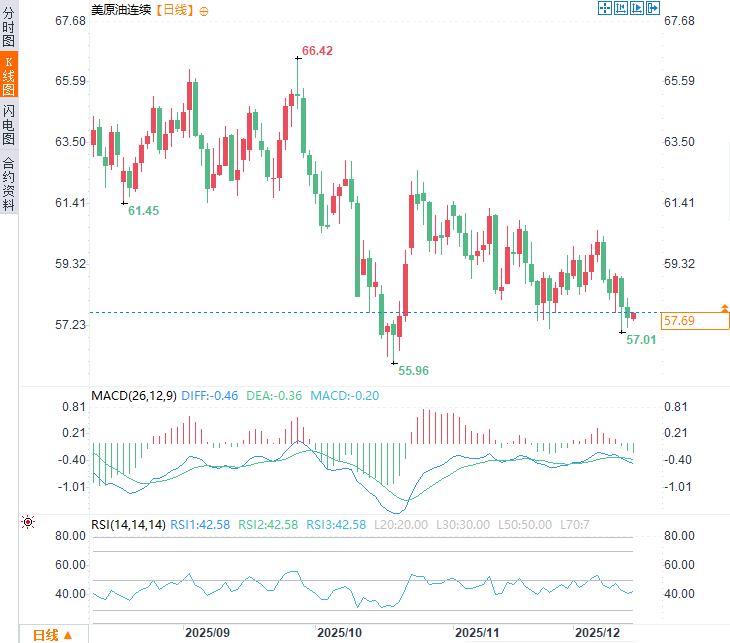
(US crude oil daily chart, source: FX678)
At 8:56 AM Beijing time, US crude oil futures were trading at $57.67 per barrel.
Multilateral mediation in progress
Trump’s special envoy Steve Vitkov said “great progress has been made”. He and President Trump’s son-in-law Jared Kushner met with Zelensky on Sunday in the latest effort to end the Russia-Ukraine conflict, but full details have not yet been disclosed.
Zelensky's advisor, Dmitro Litvin, said the president would comment on the talks after they concluded on Monday. Litvin said officials were reviewing draft documents. "The talks lasted more than five hours and have ended today. Both sides agreed to resume negotiations tomorrow morning," Litvin said on Sunday.
Before the talks began, Zelensky proposed abandoning Ukraine's goal of joining NATO in exchange for security guarantees from the West. This move marks a significant shift for Ukraine, which had been fighting for NATO membership as a safeguard against Russian attacks and had enshrined it in its constitution. This also fulfilled one of Russia's objectives, although Kyiv has so far remained firmly opposed to ceding territory to Moscow.
Trump's special envoy Steve Witkov said on Sunday, "The two sides had in-depth discussions on issues such as the 20-point peace plan and the economic agenda. Significant progress was made in the talks, and the meeting will continue tomorrow morning." According to sources, the meeting was chaired by German Chancellor Friedrich Merz, who left after a brief opening address, leaving the two sides to negotiate on their own. Other European leaders are also scheduled to arrive in Germany later on Monday to participate in the talks.
Security Architecture Game
Zelensky stated, "Ukraine has always desired to join NATO, as this is the true guarantee of security. However, some of our US and European partners do not support this direction. Therefore, the current bilateral security agreements with the US, security commitments similar to NATO Article 5, and guarantees provided by our European partners, Canada, Japan, and other countries will be key to deterring Russia. This in itself is a compromise we have made." He emphasized that these security agreements must be legally binding.
Russian President Vladimir Putin has repeatedly demanded that Ukraine formally abandon its bid for NATO membership and withdraw its troops from the 10% of Ukrainian-controlled territory in the Donbas region. Moscow has also demanded that Ukraine maintain neutrality and prohibit NATO troops from stationing there. Earlier this year, Russian sources revealed that Putin hoped to obtain a written commitment from major Western powers guaranteeing that NATO would not expand eastward—which would essentially mean formally excluding Ukraine, Georgia, Moldova, and other former Soviet republics from the possibility of joining the alliance.
With the Russia-Ukraine conflict nearing its fourth anniversary, Vitkov, who spearheaded the US peace negotiations, is visiting Germany as a special envoy, seemingly indicating that Washington sees an opportunity to advance peace talks. Zelensky, under pressure from Trump to accept a peace agreement initially biased towards Russia, has accused Russia of prolonging the conflict through deadly bombings of cities and hydroelectric infrastructure. He stated that a ceasefire along the current front would be a fair choice.
critical moment
In an interview, German Defense Minister Boris Pistorius was asked whether businessman-turned-negotiators Vitkov and Kushner were suitable to serve as negotiators. He stated that Trump sending special envoys was a "good sign," but admitted, "It's clear that such a negotiating lineup is far from ideal. However, as the saying goes, you can only dance with those you're with on the dance floor."
Regarding Ukraine's proposal to relinquish its NATO aspirations in exchange for security guarantees, Pistorius pointed out Ukraine's painful history of security commitments—in 1994, Kyiv relinquished its Soviet-era nuclear arsenal in exchange for territorial guarantees from the US, Russia, and the UK. He emphasized, "To what extent Zelensky's current statements can be implemented, and what preconditions need to be met, remains to be seen. This involves territorial issues, commitments from Russia and other parties." He added that without substantial US involvement, "the value of mere security guarantees is limited."
Britain, France, and Germany are working to refine the US proposal. The draft, revealed last month, demands that Kyiv cede more territory, abandon NATO ambitions, and accept limitations on its armed forces. European allies are calling this a "critical juncture that will determine Ukraine's future" and are attempting to use frozen Russian central bank assets to support Kyiv's military and civilian budgets.
Assessment of the overall impact on the crude oil market
Ukraine's abandonment of its NATO goals and the progress of peace talks are clear signals of easing geopolitical risks, which are expected to weaken the geopolitical premium supporting oil prices.
However, the core contradiction in the negotiations (the territorial issue) is extremely thorny, and questions remain about the security guarantee mechanism, which could still prompt a rebound in oil prices.
US crude oil prices rebounded slightly on Monday, rising by about 0.44%.
(US crude oil daily chart, source: FX678)
At 8:56 AM Beijing time, US crude oil futures were trading at $57.67 per barrel.
- Risk Warning and Disclaimer
- The market involves risk, and trading may not be suitable for all investors. This article is for reference only and does not constitute personal investment advice, nor does it take into account certain users’ specific investment objectives, financial situation, or other needs. Any investment decisions made based on this information are at your own risk.