The pound's employment data briefly boosted the exchange rate, but expectations of an interest rate cut suppressed the rebound, causing the euro/pound pair to retreat from its highs.
2025-12-16 15:42:14
On Tuesday during the European session, the euro/pound pair retreated from its high near 0.8800, with the trading focus shifting downwards to around 0.8785. The pair faced short-term pressure, primarily due to a temporary recovery in the pound following the release of the latest UK employment data.
Data from the UK Office for National Statistics shows that the ILO unemployment rate rose to 5.1% in the three months to October, a slight increase from the previous reading of 5.0%, which is in line with market expectations.
Meanwhile, the number of people applying for unemployment benefits increased by 201,000 in November, significantly higher than the previous decline. Despite the rising unemployment rate, employment-related sub-items did not show significant deterioration, and the market interpretation was neutral to stable, providing some buying support for the pound after the data release.
 However, from a policy expectation perspective, the foundation for a pound rebound remains limited. The market widely expects the Bank of England to cut its benchmark interest rate from 4.0% to 3.75% at its meeting this week, marking the first rate cut since August and implying that borrowing costs will fall to their lowest level in nearly three years.
The prospect of interest rate cuts continues to weigh on the pound's medium-term performance. In contrast, policy expectations in the Eurozone are more stable. The market consensus is that the European Central Bank will keep interest rates unchanged at its meeting this week, maintaining its current wait-and-see stance.
Statements from some officials have further reinforced this assessment. European Central Bank Governing Council member Isabel Schnabel said she was “quite reassured” that the market was beginning to price in future interest rate hikes, while another policymaker, Nagel, also pointed out that current interest rates are “in an appropriate range.”
Amid expectations of diverging monetary policies between the UK and the EU, the euro has experienced a short-term pullback, but its medium-term relative advantage remains intact, and the euro/pound pair continues to fluctuate within a relatively high range.
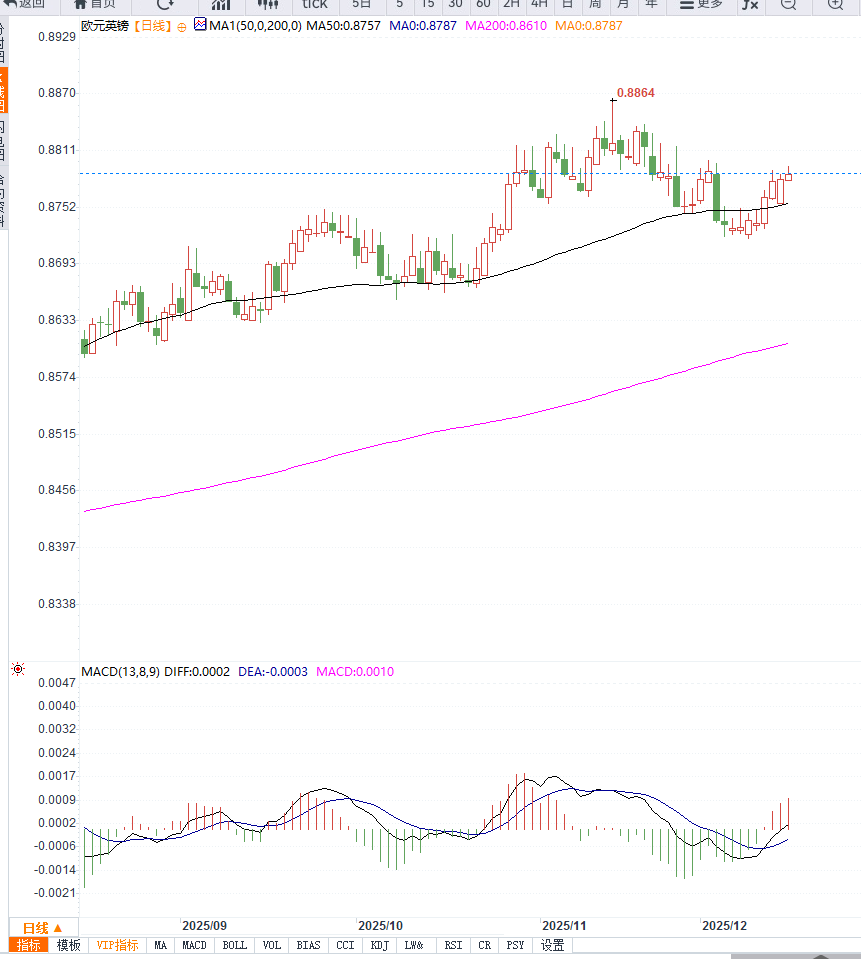
From a technical perspective, EUR/GBP remains within a high-level consolidation range, and the trend has not yet shown a clear reversal. On the downside, the first support level is around 0.8750, which corresponds to the recent consolidation platform. A hold above this level would help limit short-term pullback.
Further support lies at the psychological level of 0.8700; a decisive break below this level could trigger a deeper technical correction. On the upside, the 0.8800 level is the primary resistance, having repeatedly limited the price's upward movement. A breakout and sustained hold above this level could open up further upside potential, targeting the 0.8850 and even the 0.8900 area.
Overall, as long as the exchange rate remains above 0.8700, the euro/pound pair will remain in a relatively strong oscillating pattern, with pullbacks primarily reflecting short-term adjustments.
Editor's Note:
The core logic behind the current EUR/GBP exchange rate lies in the difference in policy pace, rather than any single economic data point. Although UK employment data has improved sentiment in the short term, a Bank of England rate cut is almost a consensus, making a sustained pound rebound unlikely.
In contrast, the Eurozone's policy stance has stabilized, and the market is even discussing the possibility of further tightening in the future. Against this backdrop, even if the euro/pound experiences a temporary pullback, its downside is relatively limited, and it is more likely to remain in a high-level range, awaiting new directional guidance from central bank decisions.
Data from the UK Office for National Statistics shows that the ILO unemployment rate rose to 5.1% in the three months to October, a slight increase from the previous reading of 5.0%, which is in line with market expectations.
Meanwhile, the number of people applying for unemployment benefits increased by 201,000 in November, significantly higher than the previous decline. Despite the rising unemployment rate, employment-related sub-items did not show significant deterioration, and the market interpretation was neutral to stable, providing some buying support for the pound after the data release.
However, from a policy expectation perspective, the foundation for a pound rebound remains limited. The market widely expects the Bank of England to cut its benchmark interest rate from 4.0% to 3.75% at its meeting this week, marking the first rate cut since August and implying that borrowing costs will fall to their lowest level in nearly three years.The prospect of interest rate cuts continues to weigh on the pound's medium-term performance. In contrast, policy expectations in the Eurozone are more stable. The market consensus is that the European Central Bank will keep interest rates unchanged at its meeting this week, maintaining its current wait-and-see stance.
Statements from some officials have further reinforced this assessment. European Central Bank Governing Council member Isabel Schnabel said she was “quite reassured” that the market was beginning to price in future interest rate hikes, while another policymaker, Nagel, also pointed out that current interest rates are “in an appropriate range.”
Amid expectations of diverging monetary policies between the UK and the EU, the euro has experienced a short-term pullback, but its medium-term relative advantage remains intact, and the euro/pound pair continues to fluctuate within a relatively high range.
From a technical perspective, EUR/GBP remains within a high-level consolidation range, and the trend has not yet shown a clear reversal. On the downside, the first support level is around 0.8750, which corresponds to the recent consolidation platform. A hold above this level would help limit short-term pullback.
Further support lies at the psychological level of 0.8700; a decisive break below this level could trigger a deeper technical correction. On the upside, the 0.8800 level is the primary resistance, having repeatedly limited the price's upward movement. A breakout and sustained hold above this level could open up further upside potential, targeting the 0.8850 and even the 0.8900 area.
Overall, as long as the exchange rate remains above 0.8700, the euro/pound pair will remain in a relatively strong oscillating pattern, with pullbacks primarily reflecting short-term adjustments.
Editor's Note:
The core logic behind the current EUR/GBP exchange rate lies in the difference in policy pace, rather than any single economic data point. Although UK employment data has improved sentiment in the short term, a Bank of England rate cut is almost a consensus, making a sustained pound rebound unlikely.
In contrast, the Eurozone's policy stance has stabilized, and the market is even discussing the possibility of further tightening in the future. Against this backdrop, even if the euro/pound experiences a temporary pullback, its downside is relatively limited, and it is more likely to remain in a high-level range, awaiting new directional guidance from central bank decisions.
- Risk Warning and Disclaimer
- The market involves risk, and trading may not be suitable for all investors. This article is for reference only and does not constitute personal investment advice, nor does it take into account certain users’ specific investment objectives, financial situation, or other needs. Any investment decisions made based on this information are at your own risk.