Crude oil trading alert: Increased US pressure on energy prices triggered a short-term rebound, but oil prices remain under pressure due to oversupply.
2025-12-18 09:15:06
During Thursday's Asian trading session, international crude oil prices continued their strong rebound from the previous day, trading around $56.70 per barrel. Technically, it remains within the oversold rebound range and has not yet shown a clear trend reversal.
Despite the price stabilization and rebound, overall market trading remained thin due to North American holidays and year-end factors, with limited willingness to enter the market. The main driver of this rebound came from the tough stance taken by the United States on geopolitical fronts.

Multiple sources familiar with the matter revealed that if Russian President Vladimir Putin refuses to advance the Russia-Ukraine peace agreement, the United States is preparing to impose a new round of sanctions on Russia's energy sector. The proposed sanctions include targeting the "shadow tanker fleet" that transports Russian crude oil, as well as traders who facilitate such transactions.
This statement reignited market concerns about potential supply disruptions in the short term. Meanwhile, US President Trump announced a complete blockade of all sanctioned oil tankers entering or leaving Venezuela, stating that Venezuela was now surrounded by the largest fleet in South American history.
The Venezuelan navy escorted several ships carrying oil products overnight, indicating a potential for further escalation. However, from a fundamental perspective, the market reacted relatively restrainedly to this news.
Although Venezuelan oil production has rebounded from its 2020 lows, it is still significantly lower than its peak decades ago. Its current production accounts for less than 1% of global crude oil supply, making it difficult to have a substantial impact on the overall supply and demand structure.
Senior energy trader Rebecca Babin pointed out that the market generally believes the potential impact is around 500,000 barrels per day, which is insufficient to change the overall narrative of the current global supply glut. Therefore, oil prices have only seen a mild rebound, rather than a trend reversal.
From an industry perspective, policy uncertainty and low oil prices have also limited capital appetite. The Trump administration is inquiring of U.S. oil companies about their willingness to re-enter the Venezuelan energy market should the current regime change occur. However, multiple sources familiar with the matter indicate that industry feedback has been generally lukewarm.
With current oil prices at a near five-year low and the availability of more attractive, less politically risky oil fields globally, companies are finding it difficult to invest in Venezuela’s dilapidated infrastructure.
Industry insiders bluntly stated that persuading companies to invest large amounts of capital is unrealistic given the highly uncertain political environment and unclear return prospects. Currently, Chevron remains the only major international oil company continuing to operate in Venezuela and export crude oil to the United States under special permission, which to some extent highlights the cautious attitude of the industry as a whole.
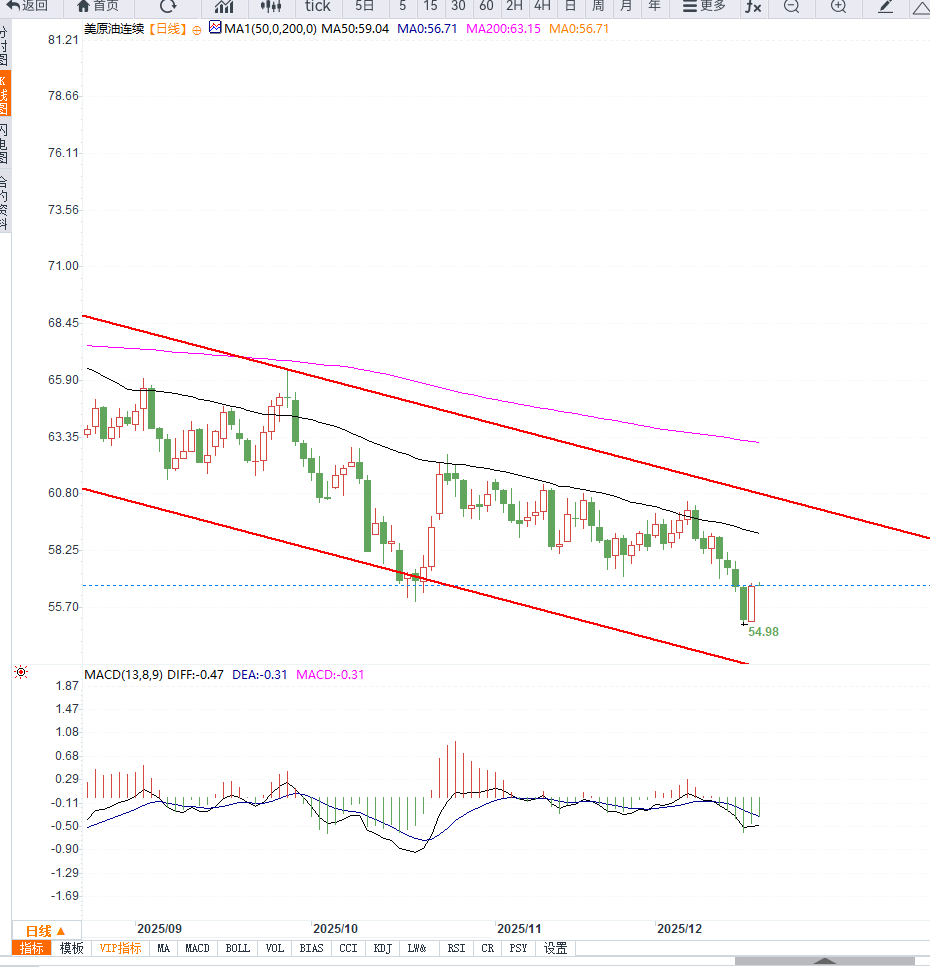
From the daily chart, WTI crude oil experienced a technical rebound after falling to a four-and-a-half-year low, but the overall trend remains weak. Prices had previously broken below several medium- and long-term moving averages and are currently trading below the 20-day, 50-day, and 100-day moving averages, with the moving averages showing a bearish alignment, indicating that the medium-term downtrend has not yet reversed.
The Relative Strength Index (RSI) briefly entered oversold territory before rebounding slightly to around 30, indicating some easing of short-term selling pressure. However, this rebound is more of a corrective move. The area around $55 provides temporary support; a decisive break below this level could open up further downside potential.
On the upside, the $58-$59 range needs to be monitored. This area is close to both the short-term moving average and a previous area of dense trading volume. If prices cannot hold above this level, the upside potential of oil prices will be significantly limited. Overall, the daily chart structure indicates that oil prices remain in a weak, oscillating pattern, and a trend reversal signal has not yet appeared.
Editor's Note:
This rebound in oil prices is more of an emotional response to geopolitical risks than a substantial improvement in supply and demand fundamentals. Until the expectation of high global inventories and oversupply is resolved, policy escalations by a single country or region are unlikely to provide long-term support for oil prices.
If there is a lack of clear production cuts or signs of demand recovery, oil prices may continue to fluctuate in a low range with limited upside potential.
Despite the price stabilization and rebound, overall market trading remained thin due to North American holidays and year-end factors, with limited willingness to enter the market. The main driver of this rebound came from the tough stance taken by the United States on geopolitical fronts.
Multiple sources familiar with the matter revealed that if Russian President Vladimir Putin refuses to advance the Russia-Ukraine peace agreement, the United States is preparing to impose a new round of sanctions on Russia's energy sector. The proposed sanctions include targeting the "shadow tanker fleet" that transports Russian crude oil, as well as traders who facilitate such transactions.
This statement reignited market concerns about potential supply disruptions in the short term. Meanwhile, US President Trump announced a complete blockade of all sanctioned oil tankers entering or leaving Venezuela, stating that Venezuela was now surrounded by the largest fleet in South American history.
The Venezuelan navy escorted several ships carrying oil products overnight, indicating a potential for further escalation. However, from a fundamental perspective, the market reacted relatively restrainedly to this news.
Although Venezuelan oil production has rebounded from its 2020 lows, it is still significantly lower than its peak decades ago. Its current production accounts for less than 1% of global crude oil supply, making it difficult to have a substantial impact on the overall supply and demand structure.
Senior energy trader Rebecca Babin pointed out that the market generally believes the potential impact is around 500,000 barrels per day, which is insufficient to change the overall narrative of the current global supply glut. Therefore, oil prices have only seen a mild rebound, rather than a trend reversal.
From an industry perspective, policy uncertainty and low oil prices have also limited capital appetite. The Trump administration is inquiring of U.S. oil companies about their willingness to re-enter the Venezuelan energy market should the current regime change occur. However, multiple sources familiar with the matter indicate that industry feedback has been generally lukewarm.
With current oil prices at a near five-year low and the availability of more attractive, less politically risky oil fields globally, companies are finding it difficult to invest in Venezuela’s dilapidated infrastructure.
Industry insiders bluntly stated that persuading companies to invest large amounts of capital is unrealistic given the highly uncertain political environment and unclear return prospects. Currently, Chevron remains the only major international oil company continuing to operate in Venezuela and export crude oil to the United States under special permission, which to some extent highlights the cautious attitude of the industry as a whole.
From the daily chart, WTI crude oil experienced a technical rebound after falling to a four-and-a-half-year low, but the overall trend remains weak. Prices had previously broken below several medium- and long-term moving averages and are currently trading below the 20-day, 50-day, and 100-day moving averages, with the moving averages showing a bearish alignment, indicating that the medium-term downtrend has not yet reversed.
The Relative Strength Index (RSI) briefly entered oversold territory before rebounding slightly to around 30, indicating some easing of short-term selling pressure. However, this rebound is more of a corrective move. The area around $55 provides temporary support; a decisive break below this level could open up further downside potential.
On the upside, the $58-$59 range needs to be monitored. This area is close to both the short-term moving average and a previous area of dense trading volume. If prices cannot hold above this level, the upside potential of oil prices will be significantly limited. Overall, the daily chart structure indicates that oil prices remain in a weak, oscillating pattern, and a trend reversal signal has not yet appeared.
Editor's Note:
This rebound in oil prices is more of an emotional response to geopolitical risks than a substantial improvement in supply and demand fundamentals. Until the expectation of high global inventories and oversupply is resolved, policy escalations by a single country or region are unlikely to provide long-term support for oil prices.
If there is a lack of clear production cuts or signs of demand recovery, oil prices may continue to fluctuate in a low range with limited upside potential.
- Risk Warning and Disclaimer
- The market involves risk, and trading may not be suitable for all investors. This article is for reference only and does not constitute personal investment advice, nor does it take into account certain users’ specific investment objectives, financial situation, or other needs. Any investment decisions made based on this information are at your own risk.