Trump issues "blockade order" against Venezuela, Maduro responds strongly, will oil prices take off?
2025-12-18 14:25:09
Venezuelan President Nicolas Maduro said on Wednesday (December 17) that the country would continue its oil trade. This came a day after US President Donald Trump threatened to impose a blockade on all sanctioned oil tankers entering or leaving the country.
Maduro stated in Spanish: "The trade will continue—our oil and all natural resources, according to the Constitution and the legacy of Bolivar, these riches, lands and oils belong to their only legitimate owners, who for thousands of years have been the absolute owners of this territory, its underground resources and all its wealth, to us, the Venezuelan people."
Maduro claimed that Trump's "intention" was to overthrow the Venezuelan regime. He stated, "This will never happen, never, never—Venezuela will never be a colony of any country or power, never."
Maduro made these remarks after Trump announced on Tuesday so-called "block" measures on sanctioned oil tankers entering and leaving Venezuela, further increasing pressure on the Maduro regime.
In a lengthy post on his social media platform, Trump wrote: “Venezuela is now completely surrounded by the largest fleet in South American history. This fleet will only continue to grow, and the impact it will have on them will be unprecedented—until they return all the oil, land and other assets they have stolen from us to the United States of America.”
It remains unclear what specific oil and land Trump is referring to as being stolen. However, during the presidency of Hugo Chávez, the Venezuelan government confiscated some assets of US oil companies after nationalizing oil fields in 2007.
In this post, Trump announced a “complete and total blockade of all sanctioned oil tankers entering and leaving Venezuela” and demanded the return of the oil and assets.
The Venezuelan government responded to Trump's statement, calling it a "reckless and serious threat" to the country and saying it violated international law, free trade, and freedom of navigation.
The Venezuelan government said in a statement: "The US president intends to impose a so-called naval military blockade on Venezuela in a completely irrational manner, with the aim of stealing the wealth that belongs to our motherland."
The Venezuelan government stated that its ambassador to the United Nations will "set out a condemnation of this serious violation of international law against Venezuela" and called on "people around the world to boycott" Trump's statement.
According to Politico, the Trump administration's recent blockade of oil tankers off the Venezuelan coast is the latest manifestation of its "gradual pressure" strategy against Venezuelan President Maduro. This strategy aims to ultimately oust Maduro from power through sustained isolation and pressure, rather than immediate large-scale domestic action.
Sources familiar with the matter revealed that the US believes the Maduro regime's survival depends on oil and illicit gold smuggling, and the current US actions are simultaneously exerting pressure on these areas. However, analysts also acknowledge that Maduro will not easily yield, and his stubborn stance, coupled with the increased expectations of US action, leaves little room for compromise on either side. The report points out that "Maduro is buying time, while Trump is buying victory," leaving few options for de-escalation.
Venezuela possesses the world's largest known oil reserves, and oil exports are a major source of government revenue.
According to Xinhua News Agency, Venezuelan Defense Minister López Obrador said on Wednesday that US President Trump's remarks about blocking the Caribbean Sea were "delusional." López Obrador stated that the Caribbean Sea is a space for cooperation, free trade, and freedom of navigation, not a closed sea area serving US interests.
The United States currently has 11 warships deployed in the Caribbean—the most in decades—but even with an increased military presence, a traditional blockade remains difficult to achieve. A traditional blockade requires completely sealing off a country's coastline, which is essentially equivalent to using force.
Trump's statement could be a prelude to the seizure of more oil tankers, following the U.S. seizure last week of a sanctioned tanker off the coast of Venezuela. Officials said the tanker was involved in an illicit oil transport network supporting foreign terrorist organizations and was being used to transport oil between the South American country and Iran. The tanker was en route to Cuba. Maduro called the seizure an act of "international piracy."
Last Thursday, the U.S. Treasury Department announced sanctions against six newly added oil tankers—the White Crane, Chiara M, H Constance, Latafa, Tamia, and Monique—and six affiliated companies and other entities, accusing them of transporting Venezuelan crude oil in recent months.
The U.S. Treasury Department stated that these sanctions are aimed at Venezuela's oil industry, which the U.S. claims "continues to fund the illegitimate Maduro regime." The measures are part of a broader package of sanctions that also targets three relatives of Maduro and a business partner of the Venezuelan president.
It is possible that the United States will impose restrictions on more ships in the coming days.
Overall, the United States has imposed transaction restrictions on hundreds of vessels. The most recent instance was in January 2025, when the U.S. imposed restrictions on 183 Russian oil tankers; and in November 2025, the U.S. imposed transaction restrictions on 170 oil tankers involved in Iranian oil transactions.
It has been reported that approximately 30 sanctioned vessels are assisting in the transport of Venezuelan oil. According to Tanker Trackers data, there are currently more than 12 sanctioned oil tankers in Venezuelan waters.
In addition, since September, the U.S. military has launched dozens of strikes against ships allegedly carrying illicit goods—a move the Trump administration says is aimed at stopping illegal smuggling into the United States. These strikes have resulted in at least 95 deaths.
Before Trump's post on Tuesday evening, White House Chief of Staff Susie Wells was quoted in Vanity Fair as saying that Trump "want to keep bombing ships until Maduro gives in."
In a post on Tuesday, Trump condemned the Maduro government as a "hostile regime."
The United States has long regarded Maduro as the head of a corrupt and authoritarian regime, but last month Trump made an unprecedented announcement that he was the head of a foreign terrorist organization.
In a post on Tuesday, Trump wrote: “The illegitimate Maduro regime is using the oil from these stolen oil fields to fund itself, finance terrorism, human trafficking, murder and kidnapping. The Venezuelan regime has been designated a foreign terrorist organization for stealing our assets and for a number of reasons, including terrorism, smuggling and human trafficking.”
The current impact of the US-Venezuela dispute on the crude oil market is primarily driven by sentiment and risk premiums, rather than a large-scale actual supply gap. This crisis has installed a "geopolitical accelerator" for oil prices, but how far it can ultimately push prices depends on whether the conflict will slide from "threats and sanctions" to a genuine "physical supply disruption." US crude oil rose approximately 0.93% on Thursday.
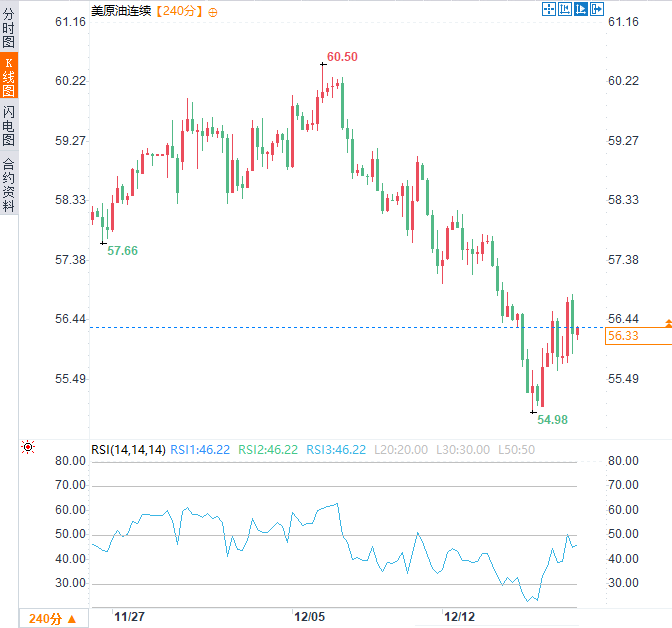
(US crude oil 4-hour chart, source: FX678)
At 14:24 Beijing time, US crude oil futures were trading at $56.34 per barrel.
Maduro responds strongly: Oil trade will not stop.
Maduro stated in Spanish: "The trade will continue—our oil and all natural resources, according to the Constitution and the legacy of Bolivar, these riches, lands and oils belong to their only legitimate owners, who for thousands of years have been the absolute owners of this territory, its underground resources and all its wealth, to us, the Venezuelan people."
Maduro claimed that Trump's "intention" was to overthrow the Venezuelan regime. He stated, "This will never happen, never, never—Venezuela will never be a colony of any country or power, never."
Trump escalates pressure: announces full lockdown
Maduro made these remarks after Trump announced on Tuesday so-called "block" measures on sanctioned oil tankers entering and leaving Venezuela, further increasing pressure on the Maduro regime.
In a lengthy post on his social media platform, Trump wrote: “Venezuela is now completely surrounded by the largest fleet in South American history. This fleet will only continue to grow, and the impact it will have on them will be unprecedented—until they return all the oil, land and other assets they have stolen from us to the United States of America.”
It remains unclear what specific oil and land Trump is referring to as being stolen. However, during the presidency of Hugo Chávez, the Venezuelan government confiscated some assets of US oil companies after nationalizing oil fields in 2007.
In this post, Trump announced a “complete and total blockade of all sanctioned oil tankers entering and leaving Venezuela” and demanded the return of the oil and assets.
The Venezuelan government condemns accusations of international piracy by the United States.
The Venezuelan government responded to Trump's statement, calling it a "reckless and serious threat" to the country and saying it violated international law, free trade, and freedom of navigation.
The Venezuelan government said in a statement: "The US president intends to impose a so-called naval military blockade on Venezuela in a completely irrational manner, with the aim of stealing the wealth that belongs to our motherland."
The Venezuelan government stated that its ambassador to the United Nations will "set out a condemnation of this serious violation of international law against Venezuela" and called on "people around the world to boycott" Trump's statement.
Trump shifts to a gradual approach to pressure, with the ultimate goal of ousting Maduro.
According to Politico, the Trump administration's recent blockade of oil tankers off the Venezuelan coast is the latest manifestation of its "gradual pressure" strategy against Venezuelan President Maduro. This strategy aims to ultimately oust Maduro from power through sustained isolation and pressure, rather than immediate large-scale domestic action.
Sources familiar with the matter revealed that the US believes the Maduro regime's survival depends on oil and illicit gold smuggling, and the current US actions are simultaneously exerting pressure on these areas. However, analysts also acknowledge that Maduro will not easily yield, and his stubborn stance, coupled with the increased expectations of US action, leaves little room for compromise on either side. The report points out that "Maduro is buying time, while Trump is buying victory," leaving few options for de-escalation.
Oil lifeline and blockade dilemma
Venezuela possesses the world's largest known oil reserves, and oil exports are a major source of government revenue.
According to Xinhua News Agency, Venezuelan Defense Minister López Obrador said on Wednesday that US President Trump's remarks about blocking the Caribbean Sea were "delusional." López Obrador stated that the Caribbean Sea is a space for cooperation, free trade, and freedom of navigation, not a closed sea area serving US interests.
The United States currently has 11 warships deployed in the Caribbean—the most in decades—but even with an increased military presence, a traditional blockade remains difficult to achieve. A traditional blockade requires completely sealing off a country's coastline, which is essentially equivalent to using force.
Sanctions continue to escalate: from seizing oil tankers to expanding restrictions
Trump's statement could be a prelude to the seizure of more oil tankers, following the U.S. seizure last week of a sanctioned tanker off the coast of Venezuela. Officials said the tanker was involved in an illicit oil transport network supporting foreign terrorist organizations and was being used to transport oil between the South American country and Iran. The tanker was en route to Cuba. Maduro called the seizure an act of "international piracy."
Last Thursday, the U.S. Treasury Department announced sanctions against six newly added oil tankers—the White Crane, Chiara M, H Constance, Latafa, Tamia, and Monique—and six affiliated companies and other entities, accusing them of transporting Venezuelan crude oil in recent months.
The U.S. Treasury Department stated that these sanctions are aimed at Venezuela's oil industry, which the U.S. claims "continues to fund the illegitimate Maduro regime." The measures are part of a broader package of sanctions that also targets three relatives of Maduro and a business partner of the Venezuelan president.
It is possible that the United States will impose restrictions on more ships in the coming days.
Overall, the United States has imposed transaction restrictions on hundreds of vessels. The most recent instance was in January 2025, when the U.S. imposed restrictions on 183 Russian oil tankers; and in November 2025, the U.S. imposed transaction restrictions on 170 oil tankers involved in Iranian oil transactions.
It has been reported that approximately 30 sanctioned vessels are assisting in the transport of Venezuelan oil. According to Tanker Trackers data, there are currently more than 12 sanctioned oil tankers in Venezuelan waters.
Military operations and humanitarian concerns
In addition, since September, the U.S. military has launched dozens of strikes against ships allegedly carrying illicit goods—a move the Trump administration says is aimed at stopping illegal smuggling into the United States. These strikes have resulted in at least 95 deaths.
Before Trump's post on Tuesday evening, White House Chief of Staff Susie Wells was quoted in Vanity Fair as saying that Trump "want to keep bombing ships until Maduro gives in."
In a post on Tuesday, Trump condemned the Maduro government as a "hostile regime."
The United States has long regarded Maduro as the head of a corrupt and authoritarian regime, but last month Trump made an unprecedented announcement that he was the head of a foreign terrorist organization.
In a post on Tuesday, Trump wrote: “The illegitimate Maduro regime is using the oil from these stolen oil fields to fund itself, finance terrorism, human trafficking, murder and kidnapping. The Venezuelan regime has been designated a foreign terrorist organization for stealing our assets and for a number of reasons, including terrorism, smuggling and human trafficking.”
The current impact of the US-Venezuela dispute on the crude oil market is primarily driven by sentiment and risk premiums, rather than a large-scale actual supply gap. This crisis has installed a "geopolitical accelerator" for oil prices, but how far it can ultimately push prices depends on whether the conflict will slide from "threats and sanctions" to a genuine "physical supply disruption." US crude oil rose approximately 0.93% on Thursday.
(US crude oil 4-hour chart, source: FX678)
At 14:24 Beijing time, US crude oil futures were trading at $56.34 per barrel.
- Risk Warning and Disclaimer
- The market involves risk, and trading may not be suitable for all investors. This article is for reference only and does not constitute personal investment advice, nor does it take into account certain users’ specific investment objectives, financial situation, or other needs. Any investment decisions made based on this information are at your own risk.