It's not just about buying islands: America's century-old ambition and triple calculations regarding Greenland.
2026-01-07 19:45:21
On Sunday aboard Air Force One, Trump made it clear to reporters that "from a national security perspective, we must take control of Greenland."
According to the White House, the US president, who has long advocated for bringing Greenland under his control, has not ruled out using military means to complete the annexation.
US President Donald Trump is determined to gain control of Greenland. This island, straddling the Arctic and North Atlantic Oceans, is not only vast and sparsely populated, but also possesses astonishing reserves of mineral resources.
On Air Force One last Sunday, Trump emphasized that "its strategic position is irreplaceable. The waters around Greenland are currently a densely populated area for ships from Russia and other countries. From a national security perspective, taking over Greenland is imperative."
This statement, following the US's aggressive military action in Venezuela, quickly caused a huge uproar in Europe. The Danish government went so far as to warn that if the US forcibly seizes Greenland, the NATO military alliance will face a crisis of disintegration.
But Trump's stance has not wavered in the slightest.
Moreover, the White House further escalated transatlantic tensions on Tuesday, stating that the Trump team was developing a "package" to push for the island's annexation by the United States, with "using the U.S. military" prominently featured in it.

Greenland is situated between the two superpowers, the United States and Russia, and its strategic value is self-evident, especially in the Arctic security landscape where it occupies a pivotal position.
This territory, with a population of only about 57,000, is adjacent to the emerging Arctic shipping route. As the Arctic ice cap melts at an accelerated pace, this route will significantly shorten the sea route between Eurasia, and its commercial value is significantly superior to the traditional Suez Canal route.
Meanwhile, Greenland guards a crucial maritime chokepoint – the GIUK Gap.
This waterway, located between Greenland, Iceland, and the United Kingdom, is a vital link between the Arctic Ocean and the Atlantic Ocean, making it a strategically vital location.
In addition to its unique geographical advantages, Greenland also possesses a wealth of untapped natural resources, ranging from oil and gas to key minerals and strategically important rare earth elements, with considerable reserves. The island has proven reserves of approximately 30 million tons of rare earth elements, as well as abundant oil, gas, and mineral resources.
These minerals and rare earth elements are core raw materials for emerging industries such as wind power equipment, electric vehicles, and energy storage technology, as well as for the defense and military industries. Just last year, China repeatedly used its near-monopoly position in the rare earth sector to exert trade pressure on the United States.
In a video interview with CNBC, Clayton Allen, business director of the political risk consultancy Eurasia Group, bluntly stated that "Trump's businessman mindset is deeply ingrained, and Greenland is undoubtedly the most valuable strategic location in the world, with an eye on economic dividends and strategic defenses over the next three to fifty years."
It is worth mentioning that the United States has already completed its strategic deployment in Greenland. The Pitufik Space Base, located in northwestern Greenland, was formerly the Thule Air Force Base and faces Nunavut, Canada, across Baffin Bay.
According to statistics, the base currently has about 150 U.S. troops stationed there, a significant reduction from the 6,000 troops stationed there during the Cold War.
Otto Swensen, associate research fellow at the Center for Strategic and International Studies (CSIS), a Washington-based think tank, analyzed that "the U.S. deployment of an early warning air base in northwestern Greenland has a very real strategic consideration—the shortest path for Russian ballistic missiles to strike the U.S. mainland is through Greenland and the North Pole."
Svensson pointed out that the base not only has an active airport, but also the world's deepest deep-water port, and has long been a key point for monitoring Russian submarines crossing the GIUK gap.
In a telephone interview with CNBC, Swensen said, "In recent years, a new strategic variable has emerged—Greenland happens to control two key Arctic shipping routes, namely the Northwest Passage and the Transpolar Passage."
As climate change continues to enhance the navigability of Arctic shipping routes, the enormous commercial interests behind them undoubtedly amplify Greenland's national security value.
Previous polls clearly show that the vast majority of Greenlanders oppose US control, and calls for independence from Denmark are also the dominant sentiment.
Analysts point out that Greenland is expected to become a forward base for the United States to strengthen its defense deployments, including the deployment of missile interception systems, which is highly consistent with the Trump administration's core defense policy—the "Golden Top" missile defense system.
This multi-billion dollar project, launched last May, is often compared to Israel's Iron Dome defense system. Its ultimate goal is to build a comprehensive defense network capable of protecting the U.S. mainland from all types of missile attacks.
Allen of the Eurasia Group analyzed that "the United States urgently needs to broaden its access to the Arctic, but its current direct access is very limited, and Greenland can fill this gap. In order to deal with the new generation of Russian military equipment that existing weapons cannot defend against, the United States must deploy its air defense system closer to Russia, and Greenland is an ideal deployment point."
He stated bluntly that "Trump's goal is to build an indestructible 'golden dome' of defense for the United States, and the realization of this goal largely depends on the strategic support of Greenland."
For some observers, Trump's statement that the annexation of Greenland is a matter of core U.S. national security is highly questionable, and this stance represents a significant shift compared to nearly a year ago.
At the time, the president-elect cited "economic security" as the primary motivation for annexing the island.
Marion Mesmer, director of the International Security Program at Chatham House in London, admitted that Russia has indeed significantly increased its military activity in the Arctic region in recent years, and that if Russia were to launch a missile strike against the United States, the missile would most likely fly over Greenland.
In a written analysis released Tuesday, Mesmer questioned, "But the outside world has never been able to understand why the United States must have complete control over Greenland in order to ensure its homeland security."
She emphasized that the United States has not only long maintained a military presence at the Pitufik Space Center, but also signed a decades-long defense agreement with Denmark, which guarantees the United States' long-term use of the base.
Mesmer stated, "During the Cold War, the United States deployed up to 6,000 troops at multiple military bases in Greenland. Now, even if the United States intends to strengthen its military presence in the Arctic region, it can do so entirely through temporary troop increases, without having to cross Denmark's sovereignty red line."
In the short term, the US's attempt at direct "annexation" is unlikely to succeed, but tensions will persist.
The United States will continue to exert pressure on Greenland under the guise of security cooperation and resource development, while Denmark and the European Union will seek to strengthen ties with Greenland and enhance their own defense capabilities.
This move will shake the foundations of the US-EU alliance, including security dependence, trade ties, and shared values, and Europe will be forced to accelerate its pursuit of "strategic autonomy."
Greenland is walking a tightrope between maintaining its autonomy, relying on Denmark for protection, and extracting practical development benefits from the interests of major powers.
Meanwhile, the simultaneous rebound in US Treasury prices and the US dollar index also reflects the attitude of safe-haven funds in the market, indicating that the market has not ruled out the possibility of the situation escalating further.

(US Treasury yields fell across the board, moving inversely to US Treasury prices.)
The US dollar index is approaching the 50% retracement level, a short-term support/resistance level. If it can hold above 98.63, the dollar is likely to continue its rebound.
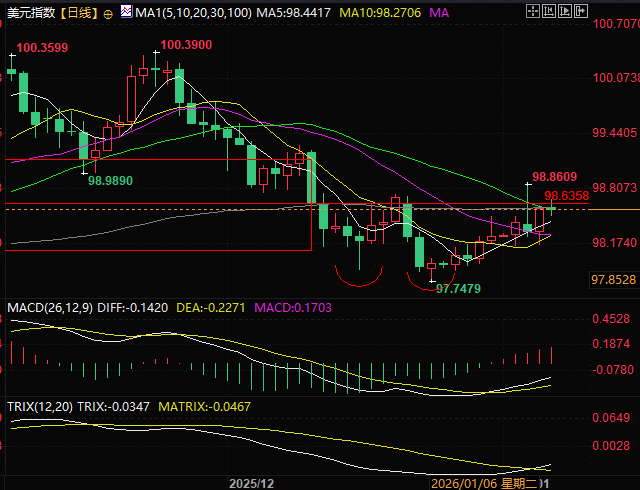
(US Dollar Index Daily Chart, Source: FX678)
At 19:41 Beijing time, the US dollar index is currently at 98.60.
According to the White House, the US president, who has long advocated for bringing Greenland under his control, has not ruled out using military means to complete the annexation.
US President Donald Trump is determined to gain control of Greenland. This island, straddling the Arctic and North Atlantic Oceans, is not only vast and sparsely populated, but also possesses astonishing reserves of mineral resources.
On Air Force One last Sunday, Trump emphasized that "its strategic position is irreplaceable. The waters around Greenland are currently a densely populated area for ships from Russia and other countries. From a national security perspective, taking over Greenland is imperative."
This statement, following the US's aggressive military action in Venezuela, quickly caused a huge uproar in Europe. The Danish government went so far as to warn that if the US forcibly seizes Greenland, the NATO military alliance will face a crisis of disintegration.
But Trump's stance has not wavered in the slightest.
Moreover, the White House further escalated transatlantic tensions on Tuesday, stating that the Trump team was developing a "package" to push for the island's annexation by the United States, with "using the U.S. military" prominently featured in it.
Strategic foundation: the dual advantages of geographical location and resource endowment
Greenland is situated between the two superpowers, the United States and Russia, and its strategic value is self-evident, especially in the Arctic security landscape where it occupies a pivotal position.
This territory, with a population of only about 57,000, is adjacent to the emerging Arctic shipping route. As the Arctic ice cap melts at an accelerated pace, this route will significantly shorten the sea route between Eurasia, and its commercial value is significantly superior to the traditional Suez Canal route.
Meanwhile, Greenland guards a crucial maritime chokepoint – the GIUK Gap.
This waterway, located between Greenland, Iceland, and the United Kingdom, is a vital link between the Arctic Ocean and the Atlantic Ocean, making it a strategically vital location.
In addition to its unique geographical advantages, Greenland also possesses a wealth of untapped natural resources, ranging from oil and gas to key minerals and strategically important rare earth elements, with considerable reserves. The island has proven reserves of approximately 30 million tons of rare earth elements, as well as abundant oil, gas, and mineral resources.
These minerals and rare earth elements are core raw materials for emerging industries such as wind power equipment, electric vehicles, and energy storage technology, as well as for the defense and military industries. Just last year, China repeatedly used its near-monopoly position in the rare earth sector to exert trade pressure on the United States.
In a video interview with CNBC, Clayton Allen, business director of the political risk consultancy Eurasia Group, bluntly stated that "Trump's businessman mindset is deeply ingrained, and Greenland is undoubtedly the most valuable strategic location in the world, with an eye on economic dividends and strategic defenses over the next three to fifty years."
Existing Structure: The Strategic Role of US Military Bases
It is worth mentioning that the United States has already completed its strategic deployment in Greenland. The Pitufik Space Base, located in northwestern Greenland, was formerly the Thule Air Force Base and faces Nunavut, Canada, across Baffin Bay.
According to statistics, the base currently has about 150 U.S. troops stationed there, a significant reduction from the 6,000 troops stationed there during the Cold War.
Otto Swensen, associate research fellow at the Center for Strategic and International Studies (CSIS), a Washington-based think tank, analyzed that "the U.S. deployment of an early warning air base in northwestern Greenland has a very real strategic consideration—the shortest path for Russian ballistic missiles to strike the U.S. mainland is through Greenland and the North Pole."
Svensson pointed out that the base not only has an active airport, but also the world's deepest deep-water port, and has long been a key point for monitoring Russian submarines crossing the GIUK gap.
In a telephone interview with CNBC, Swensen said, "In recent years, a new strategic variable has emerged—Greenland happens to control two key Arctic shipping routes, namely the Northwest Passage and the Transpolar Passage."
As climate change continues to enhance the navigability of Arctic shipping routes, the enormous commercial interests behind them undoubtedly amplify Greenland's national security value.
Previous polls clearly show that the vast majority of Greenlanders oppose US control, and calls for independence from Denmark are also the dominant sentiment.
Policy Alignment: The Key Pivot of the "Golden Top" Missile Defense System
Analysts point out that Greenland is expected to become a forward base for the United States to strengthen its defense deployments, including the deployment of missile interception systems, which is highly consistent with the Trump administration's core defense policy—the "Golden Top" missile defense system.
This multi-billion dollar project, launched last May, is often compared to Israel's Iron Dome defense system. Its ultimate goal is to build a comprehensive defense network capable of protecting the U.S. mainland from all types of missile attacks.
Allen of the Eurasia Group analyzed that "the United States urgently needs to broaden its access to the Arctic, but its current direct access is very limited, and Greenland can fill this gap. In order to deal with the new generation of Russian military equipment that existing weapons cannot defend against, the United States must deploy its air defense system closer to Russia, and Greenland is an ideal deployment point."
He stated bluntly that "Trump's goal is to build an indestructible 'golden dome' of defense for the United States, and the realization of this goal largely depends on the strategic support of Greenland."
The crux of the dispute: the motivations behind national security versus economic security.
For some observers, Trump's statement that the annexation of Greenland is a matter of core U.S. national security is highly questionable, and this stance represents a significant shift compared to nearly a year ago.
At the time, the president-elect cited "economic security" as the primary motivation for annexing the island.
Marion Mesmer, director of the International Security Program at Chatham House in London, admitted that Russia has indeed significantly increased its military activity in the Arctic region in recent years, and that if Russia were to launch a missile strike against the United States, the missile would most likely fly over Greenland.
In a written analysis released Tuesday, Mesmer questioned, "But the outside world has never been able to understand why the United States must have complete control over Greenland in order to ensure its homeland security."
She emphasized that the United States has not only long maintained a military presence at the Pitufik Space Center, but also signed a decades-long defense agreement with Denmark, which guarantees the United States' long-term use of the base.
Mesmer stated, "During the Cold War, the United States deployed up to 6,000 troops at multiple military bases in Greenland. Now, even if the United States intends to strengthen its military presence in the Arctic region, it can do so entirely through temporary troop increases, without having to cross Denmark's sovereignty red line."
Summary and Technical Analysis:
In the short term, the US's attempt at direct "annexation" is unlikely to succeed, but tensions will persist.
The United States will continue to exert pressure on Greenland under the guise of security cooperation and resource development, while Denmark and the European Union will seek to strengthen ties with Greenland and enhance their own defense capabilities.
This move will shake the foundations of the US-EU alliance, including security dependence, trade ties, and shared values, and Europe will be forced to accelerate its pursuit of "strategic autonomy."
Greenland is walking a tightrope between maintaining its autonomy, relying on Denmark for protection, and extracting practical development benefits from the interests of major powers.
Meanwhile, the simultaneous rebound in US Treasury prices and the US dollar index also reflects the attitude of safe-haven funds in the market, indicating that the market has not ruled out the possibility of the situation escalating further.
(US Treasury yields fell across the board, moving inversely to US Treasury prices.)
The US dollar index is approaching the 50% retracement level, a short-term support/resistance level. If it can hold above 98.63, the dollar is likely to continue its rebound.
(US Dollar Index Daily Chart, Source: FX678)
At 19:41 Beijing time, the US dollar index is currently at 98.60.
- Risk Warning and Disclaimer
- The market involves risk, and trading may not be suitable for all investors. This article is for reference only and does not constitute personal investment advice, nor does it take into account certain users’ specific investment objectives, financial situation, or other needs. Any investment decisions made based on this information are at your own risk.