A mysterious force caused a stunning reversal! Crude oil prices surged 5% in a single day.
2026-01-09 19:51:42
Recently, international oil prices have fluctuated dramatically under the combined influence of multiple positive and negative factors. Variables such as commodity index rebalancing, escalating geopolitical conflicts, adjustments in supply and demand patterns, and macroeconomic data together constitute the core trading logic of the crude oil market.

The anticipated annual rebalancing of commodity indices has become a key driver of short-term oil price increases. The market widely expects that the adjustment of index component weights will trigger a surge in passive buying of crude oil futures.
According to Citigroup's calculations, the world's two core commodity indices—the Bloomberg Commodity Index (BCOM) and the S&P GSCI Commodity Index—will see a $2.2 billion in inflow of futures contracts in the coming week, specifically for index rebalancing. This substantial passive buying will provide some support for oil prices in the short term.
The Middle East is once again engulfed in conflict, with large-scale clashes erupting between Israel and Hezbollah in Lebanon, setting a new record for the intensity of military confrontation between the two sides since 2006.
The Israeli military launched 100 warplanes early Sunday morning, prompting Hezbollah to retaliate by firing more than 340 rockets at 11 military facilities in Israel and the Golan Heights. This escalation of the conflict has severely disrupted the ceasefire negotiations that are currently underway in Egypt.
Libyan authorities in Benghazi issued a major announcement on Monday morning, declaring the closure of all oil fields and a complete suspension of crude oil production and export operations.
Although the authorities are not widely recognized by the international community, they effectively control the vast majority of crude oil production facilities in Libya.
The political situation in Libya has been escalating recently. The power struggle surrounding the removal of the central bank governor has triggered a full-scale confrontation between the armed factions on both sides, and the risk of supply-side disruption remains high.
The situation between Russia and Ukraine is also affecting the oil market. Russia launched coordinated missile and drone strikes against several key Ukrainian cities and critical infrastructure, causing power and water supply systems to be paralyzed in many parts of Ukraine.
Ukraine's retaliation has also targeted Russia's energy lifeline. In the past four months, Ukraine has attacked at least 28 Russian oil refineries with drones and missiles, weakening its crude oil export capacity.
With the implementation of a new round of restrictions imposed by the US and Europe on Russian oil companies, related infrastructure, and tankers, the scale of Russian crude oil exports continues to be limited.
President Trump warned Iran that he would take a “tough” approach if it caused the deaths of protesters, raising market concerns about potential supply disruptions from Iran, a core OPEC producer. Safe-haven buying pushed up oil price volatility in the short term.
Meanwhile, U.S. Senator Lindsey Graham revealed that Trump has approved a sanctions bill against Russia, further tightening Russia's crude oil export channels.
In addition, the US seizure of two oil tankers linked to Venezuela in the Atlantic highlights its strategic intention to strengthen control over energy flows in the Americas. With multiple geopolitical advantages combined, oil prices are poised for a significant short-term upward trend.
There are also negative factors suppressing oil prices in the market. The U.S. Department of Energy announced a selective easing of export sanctions on Venezuelan crude oil and petroleum products, allowing them to be transported and sold to the global market.
As OPEC's twelfth largest crude oil producer, the pace of Venezuela's crude oil export recovery will be a crucial variable in reshaping the global oil supply and demand landscape. This move also put downward pressure on oil prices on the day the news was announced.
OPEC+'s production policy has become an important cornerstone for stabilizing oil prices. At its November 2025 meeting, the organization made it clear that after increasing production by 137,000 barrels per day in December, it would suspend the production increase plan from the first quarter of 2026 in order to deal with the upcoming risk of global oil surplus.
The International Energy Agency (IEA) previously predicted that the global oil surplus would reach a record high of 4 million barrels per day in 2026, while OPEC+ still has 1.2 million barrels per day of production cuts to be restored.
In terms of production data, OPEC's crude oil production increased by 40,000 barrels per day to 29.03 million barrels per day in December, and the moderate increase did not cause a significant supply shock to the market.
The latest US economic data showed a slight improvement, providing some support for oil demand. Challenger job cuts in December fell 8.3% year-on-year to 35,553, the lowest level in 17 months.
Meanwhile, the recent strengthening of the US dollar index may also suggest that the non-farm payroll data might be quite good.
Meanwhile, the U.S. Energy Information Administration (EIA) inventory report showed a structural divergence. As of the week ending January 2, U.S. crude oil inventories were 4.1% lower than the five-year seasonal average, distillate fuel inventories were 3.1% lower than the five-year seasonal average, while gasoline inventories were 1.6% higher than the five-year seasonal average. This divergence reflects the uneven strength of current demand for refined oil products.
During the same period, U.S. crude oil production fell slightly by 0.1% month-on-month to 13.811 million barrels per day, slightly below the previous historical peak. The high production level has a potential downward pressure on oil prices.
Baker Hughes rig data also released an important signal: as of the week ending January 2, the number of active oil rigs in the United States increased by 3 to 412. Although this represents a mild recovery from the previous low, it is still significantly lower than the high point in December 2022. The long-term downward trend in the number of rigs suggests that the potential for growth in US crude oil production may have reached its ceiling, which also provides support for the medium- to long-term trend of oil prices.
In summary, the current crude oil market is characterized by a mix of bullish and bearish factors. Passive buying driven by the rebalancing of commodity indices, supply concerns triggered by escalating geopolitical conflicts, and increased supply resulting from the easing of sanctions against Venezuela, along with high levels of US crude oil production, are all interacting and competing.
Yesterday's analysis indicated a long-term bearish outlook for crude oil. However, from a trading perspective, oil prices entering a support zone do present a possibility of a rebound. For crude oil traders, it is crucial to closely monitor geopolitical developments, OPEC+ production policy adjustments, and changes in global macroeconomic data to better grasp the rhythm of oil price fluctuations and cope with complex market changes.
From a technical perspective, I have consistently described the movement of US crude oil in a trading range in my articles. This time, the oil price has reached the lower edge of the range, which, combined with the previous bottoming pattern, provides good short-term support. After the oil price breaks through the range, but before the breakdown is confirmed, the further away from the support level the price breaks through, the higher the safety margin for the bulls.
The current support level remains around 56.76, the lower edge of the trading range, while the resistance level is at the psychological level of 59. However, if oil prices test 56.76 again in the short term, we should be wary of a potential break below this level.
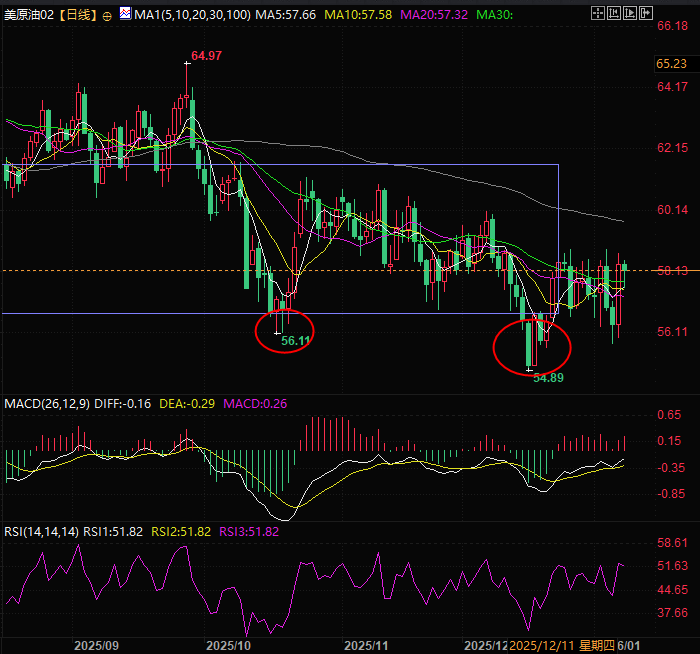
(Daily chart of US crude oil February futures contract, source: FX678)
At 19:44 Beijing time, the February futures contract for US crude oil was trading at $58.26 per barrel.
The expectation of index rebalancing has materialized, leading to passive buying that has supported the rise in oil prices.
The anticipated annual rebalancing of commodity indices has become a key driver of short-term oil price increases. The market widely expects that the adjustment of index component weights will trigger a surge in passive buying of crude oil futures.
According to Citigroup's calculations, the world's two core commodity indices—the Bloomberg Commodity Index (BCOM) and the S&P GSCI Commodity Index—will see a $2.2 billion in inflow of futures contracts in the coming week, specifically for index rebalancing. This substantial passive buying will provide some support for oil prices in the short term.
Geopolitical conflicts are escalating in multiple locations, causing a surge in supply-side disruption risks.
The Middle East is once again engulfed in conflict, with large-scale clashes erupting between Israel and Hezbollah in Lebanon, setting a new record for the intensity of military confrontation between the two sides since 2006.
The Israeli military launched 100 warplanes early Sunday morning, prompting Hezbollah to retaliate by firing more than 340 rockets at 11 military facilities in Israel and the Golan Heights. This escalation of the conflict has severely disrupted the ceasefire negotiations that are currently underway in Egypt.
Libyan authorities in Benghazi issued a major announcement on Monday morning, declaring the closure of all oil fields and a complete suspension of crude oil production and export operations.
Although the authorities are not widely recognized by the international community, they effectively control the vast majority of crude oil production facilities in Libya.
The political situation in Libya has been escalating recently. The power struggle surrounding the removal of the central bank governor has triggered a full-scale confrontation between the armed factions on both sides, and the risk of supply-side disruption remains high.
The situation between Russia and Ukraine is also affecting the oil market. Russia launched coordinated missile and drone strikes against several key Ukrainian cities and critical infrastructure, causing power and water supply systems to be paralyzed in many parts of Ukraine.
Ukraine's retaliation has also targeted Russia's energy lifeline. In the past four months, Ukraine has attacked at least 28 Russian oil refineries with drones and missiles, weakening its crude oil export capacity.
With the implementation of a new round of restrictions imposed by the US and Europe on Russian oil companies, related infrastructure, and tankers, the scale of Russian crude oil exports continues to be limited.
President Trump warned Iran that he would take a “tough” approach if it caused the deaths of protesters, raising market concerns about potential supply disruptions from Iran, a core OPEC producer. Safe-haven buying pushed up oil price volatility in the short term.
Meanwhile, U.S. Senator Lindsey Graham revealed that Trump has approved a sanctions bill against Russia, further tightening Russia's crude oil export channels.
In addition, the US seizure of two oil tankers linked to Venezuela in the Atlantic highlights its strategic intention to strengthen control over energy flows in the Americas. With multiple geopolitical advantages combined, oil prices are poised for a significant short-term upward trend.
Changes in the supply and demand dynamics have put downward pressure on oil price increases.
There are also negative factors suppressing oil prices in the market. The U.S. Department of Energy announced a selective easing of export sanctions on Venezuelan crude oil and petroleum products, allowing them to be transported and sold to the global market.
As OPEC's twelfth largest crude oil producer, the pace of Venezuela's crude oil export recovery will be a crucial variable in reshaping the global oil supply and demand landscape. This move also put downward pressure on oil prices on the day the news was announced.
OPEC+'s production policy has become an important cornerstone for stabilizing oil prices. At its November 2025 meeting, the organization made it clear that after increasing production by 137,000 barrels per day in December, it would suspend the production increase plan from the first quarter of 2026 in order to deal with the upcoming risk of global oil surplus.
The International Energy Agency (IEA) previously predicted that the global oil surplus would reach a record high of 4 million barrels per day in 2026, while OPEC+ still has 1.2 million barrels per day of production cuts to be restored.
In terms of production data, OPEC's crude oil production increased by 40,000 barrels per day to 29.03 million barrels per day in December, and the moderate increase did not cause a significant supply shock to the market.
The interplay between macroeconomic data and inventory signals continues to intensify, fueling a battle between bulls and bears.
The latest US economic data showed a slight improvement, providing some support for oil demand. Challenger job cuts in December fell 8.3% year-on-year to 35,553, the lowest level in 17 months.
Meanwhile, the recent strengthening of the US dollar index may also suggest that the non-farm payroll data might be quite good.
Meanwhile, the U.S. Energy Information Administration (EIA) inventory report showed a structural divergence. As of the week ending January 2, U.S. crude oil inventories were 4.1% lower than the five-year seasonal average, distillate fuel inventories were 3.1% lower than the five-year seasonal average, while gasoline inventories were 1.6% higher than the five-year seasonal average. This divergence reflects the uneven strength of current demand for refined oil products.
During the same period, U.S. crude oil production fell slightly by 0.1% month-on-month to 13.811 million barrels per day, slightly below the previous historical peak. The high production level has a potential downward pressure on oil prices.
Baker Hughes rig data also released an important signal: as of the week ending January 2, the number of active oil rigs in the United States increased by 3 to 412. Although this represents a mild recovery from the previous low, it is still significantly lower than the high point in December 2022. The long-term downward trend in the number of rigs suggests that the potential for growth in US crude oil production may have reached its ceiling, which also provides support for the medium- to long-term trend of oil prices.
Summary and Technical Analysis:
In summary, the current crude oil market is characterized by a mix of bullish and bearish factors. Passive buying driven by the rebalancing of commodity indices, supply concerns triggered by escalating geopolitical conflicts, and increased supply resulting from the easing of sanctions against Venezuela, along with high levels of US crude oil production, are all interacting and competing.
Yesterday's analysis indicated a long-term bearish outlook for crude oil. However, from a trading perspective, oil prices entering a support zone do present a possibility of a rebound. For crude oil traders, it is crucial to closely monitor geopolitical developments, OPEC+ production policy adjustments, and changes in global macroeconomic data to better grasp the rhythm of oil price fluctuations and cope with complex market changes.
From a technical perspective, I have consistently described the movement of US crude oil in a trading range in my articles. This time, the oil price has reached the lower edge of the range, which, combined with the previous bottoming pattern, provides good short-term support. After the oil price breaks through the range, but before the breakdown is confirmed, the further away from the support level the price breaks through, the higher the safety margin for the bulls.
The current support level remains around 56.76, the lower edge of the trading range, while the resistance level is at the psychological level of 59. However, if oil prices test 56.76 again in the short term, we should be wary of a potential break below this level.
(Daily chart of US crude oil February futures contract, source: FX678)
At 19:44 Beijing time, the February futures contract for US crude oil was trading at $58.26 per barrel.
- Risk Warning and Disclaimer
- The market involves risk, and trading may not be suitable for all investors. This article is for reference only and does not constitute personal investment advice, nor does it take into account certain users’ specific investment objectives, financial situation, or other needs. Any investment decisions made based on this information are at your own risk.