Trump declared a national emergency and confiscated Venezuelan oil revenues, causing crude oil risk premiums to rise.
2026-01-12 11:28:21
On Saturday (January 10), US President Trump signed an executive order declaring a national emergency, citing national security reasons, to place Venezuelan oil sales revenue stored in the United States under the direct control of the US government.
While the order aims to continue selling Venezuelan oil and may not cause supply disruptions in the short term, it significantly exacerbates geopolitical risks and legal uncertainties in the region, injecting a sustained political risk premium into the global crude oil market.
U.S. President Donald Trump signed an executive order on Saturday declaring a national emergency to protect Venezuelan oil revenues held in accounts at the U.S. Treasury Department. The order prohibits any judicial action against these funds, including seizure, detention, or asset forfeiture, and the U.S. government stated that these funds should be retained for diplomatic or governmental purposes, rather than falling into the hands of private creditors or foreign adversaries.
According to the White House, allowing courts or contractors to access such revenue could undermine U.S. efforts to promote stability and advance policy objectives in Venezuela and the surrounding region. The executive order cites the National Emergencies Act and the International Emergency Economic Powers Act as the legal basis for this action, viewing the potential outflow of these funds as a threat to U.S. national security and foreign policy interests.
The United States has recently intensified its intervention in Venezuela, including the recent arrest of President Nicolás Maduro and broader actions to control Venezuelan oil export flows. Under the order, proceeds from the sale of Venezuelan crude oil and related products, considered sovereign property, will be held in U.S. custody and will be protected from private claims. The directive also prohibits the unauthorized transfer or handling of these funds, replacing previous related executive orders.
Meanwhile, the U.S. government has signaled its intention to continue selling Venezuelan oil and manage future sales, including discussions with major U.S. oil companies regarding potential investments and participation in Venezuela's oil industry. However, industry giants such as ExxonMobil have stated that they remain cautious about investing without significant reforms, given the country's long-standing instability and legal uncertainty.
This statement has broader implications for international law and creditors' rights. It effectively excludes Venezuela's oil revenues from existing claims by companies like ExxonMobil and ConocoPhillips, whose long history of arbitration and compensation cases against Venezuela dates back to past nationalization events.
At the same time, by claiming control of these oil funds, the United States aims to use Venezuela’s resources to support its regional policy objectives, raising concerns among international observers about the balance between sovereign asset protection and geopolitical influence.
On Monday in Asian trading, U.S. crude oil prices rose slightly, continuing the gains of the previous two trading days, and once touched a near one-month high of $59.80 per barrel.
In conclusion, this move itself will not immediately cause a crude oil shortage, but it acts as a wedge, driving deeper into the political risk rifts of the global oil market. It increases the legal and political costs of the deal, reinforces "political uncertainty" on the supply side, and consolidates US control over key oil resources. For oil prices, this is more of a long-term risk premium support factor and a structurally bullish story than an immediate supply disruption shock.
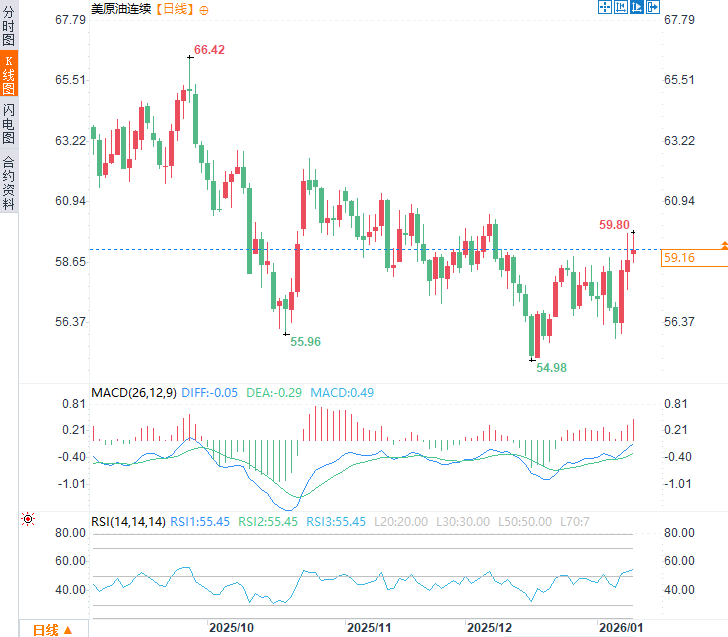
(US crude oil daily chart, source: FX678)
At 11:24 Beijing time, US crude oil futures were trading at $59.22 per barrel.
While the order aims to continue selling Venezuelan oil and may not cause supply disruptions in the short term, it significantly exacerbates geopolitical risks and legal uncertainties in the region, injecting a sustained political risk premium into the global crude oil market.
National Emergency Declaration to Protect Petroleum Fund
U.S. President Donald Trump signed an executive order on Saturday declaring a national emergency to protect Venezuelan oil revenues held in accounts at the U.S. Treasury Department. The order prohibits any judicial action against these funds, including seizure, detention, or asset forfeiture, and the U.S. government stated that these funds should be retained for diplomatic or governmental purposes, rather than falling into the hands of private creditors or foreign adversaries.
According to the White House, allowing courts or contractors to access such revenue could undermine U.S. efforts to promote stability and advance policy objectives in Venezuela and the surrounding region. The executive order cites the National Emergencies Act and the International Emergency Economic Powers Act as the legal basis for this action, viewing the potential outflow of these funds as a threat to U.S. national security and foreign policy interests.
Strategic Background and Law Enforcement
The United States has recently intensified its intervention in Venezuela, including the recent arrest of President Nicolás Maduro and broader actions to control Venezuelan oil export flows. Under the order, proceeds from the sale of Venezuelan crude oil and related products, considered sovereign property, will be held in U.S. custody and will be protected from private claims. The directive also prohibits the unauthorized transfer or handling of these funds, replacing previous related executive orders.
Meanwhile, the U.S. government has signaled its intention to continue selling Venezuelan oil and manage future sales, including discussions with major U.S. oil companies regarding potential investments and participation in Venezuela's oil industry. However, industry giants such as ExxonMobil have stated that they remain cautious about investing without significant reforms, given the country's long-standing instability and legal uncertainty.
International and domestic impact
This statement has broader implications for international law and creditors' rights. It effectively excludes Venezuela's oil revenues from existing claims by companies like ExxonMobil and ConocoPhillips, whose long history of arbitration and compensation cases against Venezuela dates back to past nationalization events.
At the same time, by claiming control of these oil funds, the United States aims to use Venezuela’s resources to support its regional policy objectives, raising concerns among international observers about the balance between sovereign asset protection and geopolitical influence.
On Monday in Asian trading, U.S. crude oil prices rose slightly, continuing the gains of the previous two trading days, and once touched a near one-month high of $59.80 per barrel.
In conclusion, this move itself will not immediately cause a crude oil shortage, but it acts as a wedge, driving deeper into the political risk rifts of the global oil market. It increases the legal and political costs of the deal, reinforces "political uncertainty" on the supply side, and consolidates US control over key oil resources. For oil prices, this is more of a long-term risk premium support factor and a structurally bullish story than an immediate supply disruption shock.
(US crude oil daily chart, source: FX678)
At 11:24 Beijing time, US crude oil futures were trading at $59.22 per barrel.
- Risk Warning and Disclaimer
- The market involves risk, and trading may not be suitable for all investors. This article is for reference only and does not constitute personal investment advice, nor does it take into account certain users’ specific investment objectives, financial situation, or other needs. Any investment decisions made based on this information are at your own risk.