Crude oil futures entered a period of consolidation amid a battle between oversupply and supply risks from Iran.
2026-01-12 20:02:10
On Monday (January 12), during the European session, West Texas Intermediate (WTI) crude oil touched a multi-week high (close to $59.8 per barrel) in early trading, but then fell back, closing at $58.62 per barrel, a drop of 0.85% ($-0.50).
Prices held above the 50-day moving average ($58.57/barrel) support, but the upward momentum was weak, indicating insufficient bullish momentum. Technically, the main trend remains upward, with oscillators and moving average indicators supporting a potential rebound. If the upward momentum continues, prices could test key targets, including the 50% Fibonacci retracement level at $60.70/barrel, the Fibonacci retracement level at $62.05/barrel, and the 200-day moving average at $62.45/barrel.
Conversely, if the 50-day moving average is breached, oil prices could see a significant pullback to the 50% Fibonacci retracement levels of $57.78/barrel and $57.39/barrel. WTI crude has recently retreated slightly from Friday's settlement price of $59.12/barrel, reflecting a short-term digestion of market concerns about supply disruptions. Key trend indicators remain at their upward technical targets.
The expectation of oversupply continues to suppress the price movement after the breakout.
The global oil market faces significant oversupply pressure. Institutions such as the International Energy Agency (IEA) and Goldman Sachs predict that supply will exceed demand by nearly 3-4 million barrels per day (approximately 3-4% of global demand) in 2026, primarily driven by strong growth in non-OPEC+ countries (such as the United States, Brazil, Canada, Guyana, and Argentina). Although OPEC+ suspended production increases in the first quarter of 2026, the overall trend of inventory accumulation remains unchanged, and large sellers continue to be active, limiting further increases in oil prices.
Goldman Sachs maintains its 2026 Brent/WTI average price forecast at $56/52 per barrel, and expects it to potentially bottom out at $54/50 per barrel in the fourth quarter. The EIA also anticipates continued increases in global inventories, which is the main source of structural downward pressure on oil prices. A break below the 50-day moving average could trigger a deep correction.
Iranian supply risks are providing short-term support, but the premium is fading.
President Trump was briefed on the situation in Iran and considered using military force to intervene in the crackdown on protesters, prompting speculators to bet on a disruption to Iranian oil supplies (the Strait of Hormuz risk), driving short covering and short-term buying. As OPEC's fourth-largest oil producer, Iran produces approximately 3.2 million barrels per day, and any disruption could push up prices. Iranian officials stated that the situation was "completely under control" after the weekend clashes, easing some concerns and causing oil prices to fall on Monday.
Saul Kavone, head of energy research at MST Marquee, summarized: "The market's attitude is clear: there will be no significant adjustment in oil prices until we see a real supply disruption." A revaluation of oil prices requires a substantial supply disruption; otherwise, the risk premium will be unsustainable. While the current protests from Iran are intense, they have not directly affected exports.
Assessment of the progress of Venezuela's export recovery
Last week, Trump stated that the Caracas government planned to transfer up to 50 million barrels of sanctioned crude oil to the United States, and with President Nicolás Maduro's resignation, Venezuela is expected to gradually resume exports. Analysts predict that if political stability is maintained and US investment is attracted, production could increase by 300,000-500,000 barrels per day over the next two years, but this will require substantial capital to repair infrastructure (costing tens of billions of dollars, or even $5.8 billion for pipeline upgrades). In the short term, this further exacerbates expectations of a global supply glut, becoming a potential downward pressure on oil prices. While several US oil companies (such as Chevron) have expressed interest, they have not yet initiated large-scale re-entry plans, and recovery will take several years. Traders are now focusing on whether the breakout level can be held.
Looking ahead
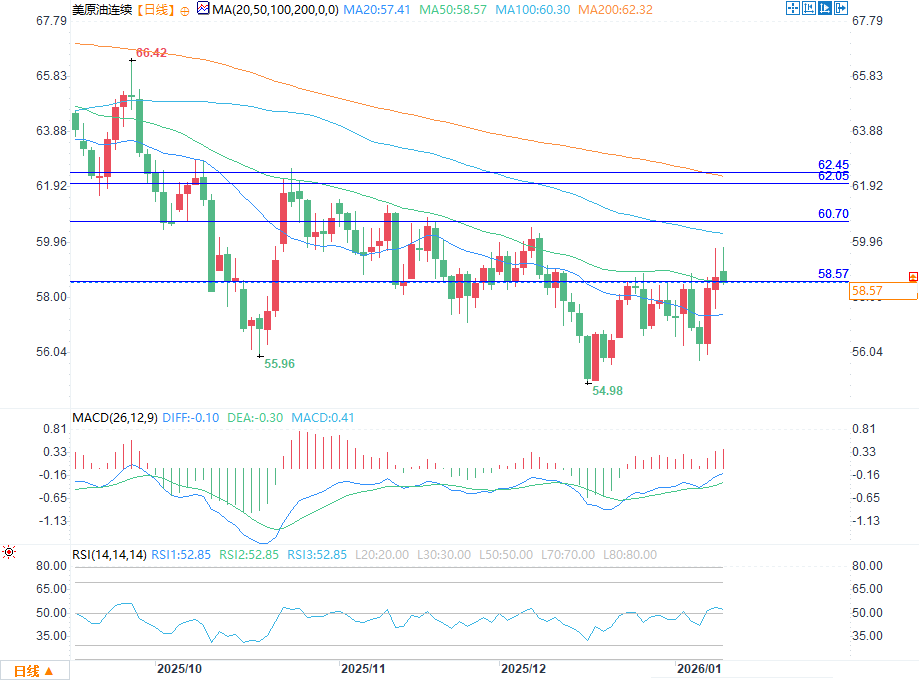
(WTI crude oil daily chart source: FX678)
As long as traders continue to hold above the 50-day moving average, the possibility of a rebound in oil prices remains, which would signal "firm buying" demand in the market, rather than simply short covering. The risk of significant supply disruptions from Iran continues to provide strong downside support for oil prices, but given the current oversupply, gains are likely to be limited. Traders need to pay attention to whether the breakout level holds, as well as upcoming inventory reports, economic data, and geopolitical developments.
Overall, the oil market is expected to maintain a wide range of fluctuations in 2026. The OPEC+ pause in production increases will provide a short-term buffer, but non-OPEC growth will dominate the long-term bear market trend.
Prices held above the 50-day moving average ($58.57/barrel) support, but the upward momentum was weak, indicating insufficient bullish momentum. Technically, the main trend remains upward, with oscillators and moving average indicators supporting a potential rebound. If the upward momentum continues, prices could test key targets, including the 50% Fibonacci retracement level at $60.70/barrel, the Fibonacci retracement level at $62.05/barrel, and the 200-day moving average at $62.45/barrel.
Conversely, if the 50-day moving average is breached, oil prices could see a significant pullback to the 50% Fibonacci retracement levels of $57.78/barrel and $57.39/barrel. WTI crude has recently retreated slightly from Friday's settlement price of $59.12/barrel, reflecting a short-term digestion of market concerns about supply disruptions. Key trend indicators remain at their upward technical targets.
The expectation of oversupply continues to suppress the price movement after the breakout.
The global oil market faces significant oversupply pressure. Institutions such as the International Energy Agency (IEA) and Goldman Sachs predict that supply will exceed demand by nearly 3-4 million barrels per day (approximately 3-4% of global demand) in 2026, primarily driven by strong growth in non-OPEC+ countries (such as the United States, Brazil, Canada, Guyana, and Argentina). Although OPEC+ suspended production increases in the first quarter of 2026, the overall trend of inventory accumulation remains unchanged, and large sellers continue to be active, limiting further increases in oil prices.
Goldman Sachs maintains its 2026 Brent/WTI average price forecast at $56/52 per barrel, and expects it to potentially bottom out at $54/50 per barrel in the fourth quarter. The EIA also anticipates continued increases in global inventories, which is the main source of structural downward pressure on oil prices. A break below the 50-day moving average could trigger a deep correction.
Iranian supply risks are providing short-term support, but the premium is fading.
President Trump was briefed on the situation in Iran and considered using military force to intervene in the crackdown on protesters, prompting speculators to bet on a disruption to Iranian oil supplies (the Strait of Hormuz risk), driving short covering and short-term buying. As OPEC's fourth-largest oil producer, Iran produces approximately 3.2 million barrels per day, and any disruption could push up prices. Iranian officials stated that the situation was "completely under control" after the weekend clashes, easing some concerns and causing oil prices to fall on Monday.
Saul Kavone, head of energy research at MST Marquee, summarized: "The market's attitude is clear: there will be no significant adjustment in oil prices until we see a real supply disruption." A revaluation of oil prices requires a substantial supply disruption; otherwise, the risk premium will be unsustainable. While the current protests from Iran are intense, they have not directly affected exports.
Assessment of the progress of Venezuela's export recovery
Last week, Trump stated that the Caracas government planned to transfer up to 50 million barrels of sanctioned crude oil to the United States, and with President Nicolás Maduro's resignation, Venezuela is expected to gradually resume exports. Analysts predict that if political stability is maintained and US investment is attracted, production could increase by 300,000-500,000 barrels per day over the next two years, but this will require substantial capital to repair infrastructure (costing tens of billions of dollars, or even $5.8 billion for pipeline upgrades). In the short term, this further exacerbates expectations of a global supply glut, becoming a potential downward pressure on oil prices. While several US oil companies (such as Chevron) have expressed interest, they have not yet initiated large-scale re-entry plans, and recovery will take several years. Traders are now focusing on whether the breakout level can be held.
Looking ahead
(WTI crude oil daily chart source: FX678)
As long as traders continue to hold above the 50-day moving average, the possibility of a rebound in oil prices remains, which would signal "firm buying" demand in the market, rather than simply short covering. The risk of significant supply disruptions from Iran continues to provide strong downside support for oil prices, but given the current oversupply, gains are likely to be limited. Traders need to pay attention to whether the breakout level holds, as well as upcoming inventory reports, economic data, and geopolitical developments.
Overall, the oil market is expected to maintain a wide range of fluctuations in 2026. The OPEC+ pause in production increases will provide a short-term buffer, but non-OPEC growth will dominate the long-term bear market trend.
- Risk Warning and Disclaimer
- The market involves risk, and trading may not be suitable for all investors. This article is for reference only and does not constitute personal investment advice, nor does it take into account certain users’ specific investment objectives, financial situation, or other needs. Any investment decisions made based on this information are at your own risk.