A rebound in the US dollar weighed on the British pound, with GBP/USD falling as it awaits policy signals from the US and UK.
2026-01-14 13:21:44
The British pound weakened against the US dollar (GBP/USD) during Wednesday's Asian trading session, trading around 1.3425, mainly due to renewed buying support for the US dollar.
The market is awaiting the release of U.S. retail sales and producer price index (PPI) data later in the day for further clues about the Federal Reserve's interest rate path.
Regarding inflation, data released by the U.S. Bureau of Labor Statistics showed that the U.S. Consumer Price Index (CPI) rose 2.7% year-on-year in December, the same as in November, in line with market expectations; the core CPI, excluding food and energy prices, rose 2.6% year-on-year, lower than the previous value of 2.7% and also lower than the market expectation of 2.7%.
This result initially boosted market expectations for further easing policies, but the impact was short-lived. Analysts at Interactive Brokers pointed out that the optimism brought about by the cooling core CPI quickly faded because the report did not prompt the market to move the next rate cut date from June to April.
Some fixed-income investors still believe that the Federal Reserve's rate cut in December last year may have been the last substantial easing during the current chairman's tenure.
Meanwhile, discussions surrounding the independence of the Federal Reserve have intensified again. Federal Reserve Chairman Jerome Powell stated that the Justice Department had subpoenaed him regarding statements made about the central bank's headquarters renovation project, calling the move a "pretext" to pressure the central bank to ease policy.
This event has increased policy uncertainty to some extent and may affect the dollar's performance in the medium term. From the perspective of the pound itself, the Bank of England's dovish stance remains a significant factor suppressing the exchange rate.
The Bank of England cut its benchmark interest rate to 3.75% in December last year and hinted that there is still room for further rate cuts in 2026 against the backdrop of continued decline in inflation.
Despite officials' emphasis on more cautious future decision-making, the market widely expects the February meeting to likely keep interest rates unchanged, with the next 25 basis point rate cut window likely appearing in March or April. This policy outlook limits the pound's upside potential.
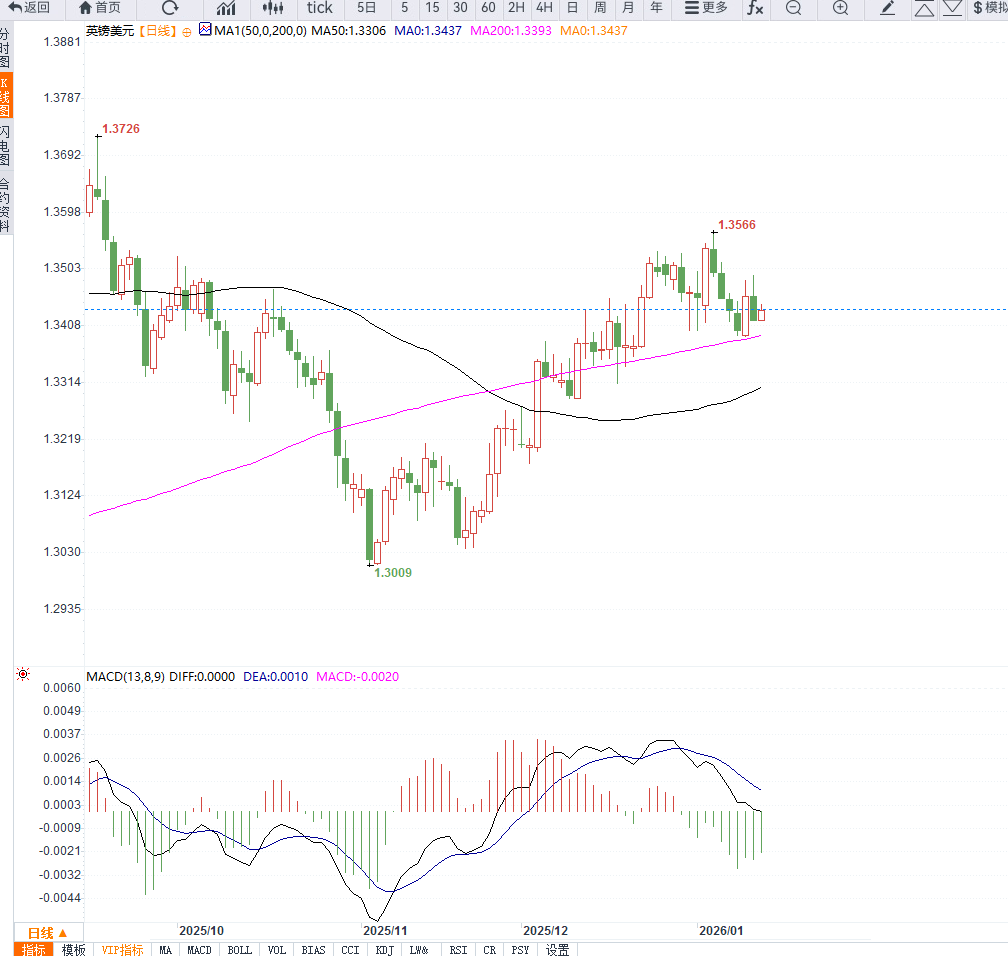
From the daily chart, the momentum of the British pound against the US dollar has weakened after the previous rebound, and the price has recently fallen from the previous high, retesting the support of the short-term moving average.
The 5-day and 10-day moving averages are beginning to flatten, indicating that bullish momentum is cooling. Technically, the daily RSI has fallen from a high level to near the neutral zone, suggesting the market has shifted from a one-sided upward trend to consolidation. If the RSI continues to decline, the exchange rate may still have room for further short-term correction.
At the key price level, 1.3400 forms an important psychological and technical support. If it is effectively broken, it may trigger a deeper pullback, targeting the 1.3320-1.3350 range.
The key resistance level to watch is around 1.3500, which also corresponds to the previous high area. Only by regaining a foothold in this range can the pound resume its upward trend. Overall, the daily chart shows that GBP/USD is biased towards short-term volatility and weakness, and its direction will depend on new macroeconomic data and policy signals.
Editor's Note:
The current pullback in the pound against the dollar is more likely a technical correction after its previous rise than a trend reversal. The dollar is supported in the short term by data and risk aversion, but in the medium term, changes in the Fed's policy independence and the pace of interest rate cuts still need to be observed.
In contrast, the Bank of England's dovish policy expectations exert a more sustained constraint on the pound. In the absence of significant positive catalysts, GBP/USD may maintain a range-bound trading pattern in the short term, with key attention focused on whether the 1.3400 level can be breached and changes in the monetary policy expectation gap between the US and the UK.
The market is awaiting the release of U.S. retail sales and producer price index (PPI) data later in the day for further clues about the Federal Reserve's interest rate path.
Regarding inflation, data released by the U.S. Bureau of Labor Statistics showed that the U.S. Consumer Price Index (CPI) rose 2.7% year-on-year in December, the same as in November, in line with market expectations; the core CPI, excluding food and energy prices, rose 2.6% year-on-year, lower than the previous value of 2.7% and also lower than the market expectation of 2.7%.
This result initially boosted market expectations for further easing policies, but the impact was short-lived. Analysts at Interactive Brokers pointed out that the optimism brought about by the cooling core CPI quickly faded because the report did not prompt the market to move the next rate cut date from June to April.
Some fixed-income investors still believe that the Federal Reserve's rate cut in December last year may have been the last substantial easing during the current chairman's tenure.
Meanwhile, discussions surrounding the independence of the Federal Reserve have intensified again. Federal Reserve Chairman Jerome Powell stated that the Justice Department had subpoenaed him regarding statements made about the central bank's headquarters renovation project, calling the move a "pretext" to pressure the central bank to ease policy.
This event has increased policy uncertainty to some extent and may affect the dollar's performance in the medium term. From the perspective of the pound itself, the Bank of England's dovish stance remains a significant factor suppressing the exchange rate.
The Bank of England cut its benchmark interest rate to 3.75% in December last year and hinted that there is still room for further rate cuts in 2026 against the backdrop of continued decline in inflation.
Despite officials' emphasis on more cautious future decision-making, the market widely expects the February meeting to likely keep interest rates unchanged, with the next 25 basis point rate cut window likely appearing in March or April. This policy outlook limits the pound's upside potential.
From the daily chart, the momentum of the British pound against the US dollar has weakened after the previous rebound, and the price has recently fallen from the previous high, retesting the support of the short-term moving average.
The 5-day and 10-day moving averages are beginning to flatten, indicating that bullish momentum is cooling. Technically, the daily RSI has fallen from a high level to near the neutral zone, suggesting the market has shifted from a one-sided upward trend to consolidation. If the RSI continues to decline, the exchange rate may still have room for further short-term correction.
At the key price level, 1.3400 forms an important psychological and technical support. If it is effectively broken, it may trigger a deeper pullback, targeting the 1.3320-1.3350 range.
The key resistance level to watch is around 1.3500, which also corresponds to the previous high area. Only by regaining a foothold in this range can the pound resume its upward trend. Overall, the daily chart shows that GBP/USD is biased towards short-term volatility and weakness, and its direction will depend on new macroeconomic data and policy signals.
Editor's Note:
The current pullback in the pound against the dollar is more likely a technical correction after its previous rise than a trend reversal. The dollar is supported in the short term by data and risk aversion, but in the medium term, changes in the Fed's policy independence and the pace of interest rate cuts still need to be observed.
In contrast, the Bank of England's dovish policy expectations exert a more sustained constraint on the pound. In the absence of significant positive catalysts, GBP/USD may maintain a range-bound trading pattern in the short term, with key attention focused on whether the 1.3400 level can be breached and changes in the monetary policy expectation gap between the US and the UK.
- Risk Warning and Disclaimer
- The market involves risk, and trading may not be suitable for all investors. This article is for reference only and does not constitute personal investment advice, nor does it take into account certain users’ specific investment objectives, financial situation, or other needs. Any investment decisions made based on this information are at your own risk.