The oil market is in a bind; if the Strait of Hormuz is blocked, oil prices could surge by $20 overnight!
2026-01-14 16:52:16
On Wednesday (January 14), the March crude oil futures contract in the United States experienced a pullback, trading at 60.48, down 0.8%, but still holding onto most of Tuesday's gains.
Since the beginning of 2026, the international crude oil market has shown a clear upward trend: Brent crude oil prices touched the key resistance level of $64 per barrel for the first time, and US WTI crude oil (US crude oil) once broke through the psychological level of $60 per barrel. On Tuesday morning in Asia, it even approached $62 per barrel. This price level is not only recognized by the market as the safe break-even point for most US shale oil producers, but also has important guiding significance for subsequent capacity release.
Geopolitical powder kegs continue to ignite the crude oil market, with oil prices breaking through the break-even point for shale oil; hidden dangers lurk in key regions for crude oil transportation, and the unpriced risk of ultimate disruption is quietly pushing up safe-haven premiums—a thrilling tug-of-war between supply, panic, and speculation has quietly escalated.
This oil price increase is the result of a combination of factors, including a concentrated outbreak of geopolitical risks, supply-side disruptions, and heightened market risk aversion.
The concentrated outbreak of geopolitical crises is the core driver of this oil price increase, especially the turmoil in key oil-producing countries in the Middle East and the Americas, which has directly amplified market concerns about disruptions to crude oil supply.
On the one hand, the escalating situation in Iran has become the biggest "trigger." As protests in Iran intensify, US President Trump has issued a strong signal, explicitly threatening to take countermeasures against the Iranian regime's crackdown on protesters, including military strikes, cyberattacks, and a 25% punitive tariff on Iran's trading partners.
As a key player in the global crude oil market, Iran's daily crude oil production is stable at 3.3 million to 4.1 million barrels, accounting for about 3% of the global supply. By 2025, 80% of its crude oil exports will go to China, with an average daily export volume of 1.38 million barrels to China.
Market concerns suggest that actual US intervention could trigger Iranian retaliation, disrupting the Middle East oil supply chain. Analysts predict this could push oil prices up by another $3-4 per barrel. The Iranian parliament speaker has also stated firmly that if the US launches an attack, Israel, US overseas military bases, and warships will become legitimate targets, further exacerbating regional uncertainty.
On the other hand, the situation in Venezuela has further fueled the rise in oil prices. Following the US military intervention in Venezuela and the capture of President Nicolás Maduro, the country's daily crude oil exports of 1.1 million barrels are now in jeopardy.
Although Venezuela's daily crude oil production remains at only 900,000 to 1 million barrels, accounting for less than 1% of global supply, and due to dilapidated infrastructure and restrictions limiting short-term production increases, the turbulent situation has exacerbated market concerns about the stability of supply from emerging market oil-producing countries, becoming a secondary driving force for rising oil prices.
Furthermore, the ongoing conflict between Russia and Ukraine, coupled with the continued precision strikes by drones on energy facilities, has further amplified concerns about the instability of the global crude oil supply chain.
As a vital artery of the global oil transportation system, the potential risks of the Strait of Hormuz have led to a repricing of oil prices, which has become a significant factor driving up oil prices.
The strait carries about 20% of the world's oil supply, with an average daily crude oil flow of 20 million barrels per day in 2024. It is the core channel for all major oil-producing countries in the Gulf region (including Saudi Arabia, the UAE, and Iran itself) to export to the Asian market.
More importantly, if blocked, there are almost no alternative routes to divert oil transport in the short term—currently only Saudi Arabia and the UAE have operational oil pipelines that can bypass the strait, while Iran's own bypass pipelines have long been underutilized and unable to meet large-scale transport demands.
Although mainstream forecasting agencies and investment banks believe that the probability of a complete blockade of the Strait of Hormuz is almost zero due to the deterrent effect of the United States’ strong naval power in the region, and this scenario has not been included in benchmark pricing, the “ultimate disruption risk” has re-entered traders’ pricing models.
Market consensus indicates that concerns about lockdowns alone have already driven oil prices up by several dollars per barrel, while Andy Lipoor, president of the Lipoor Petroleum Institute, has stated that if the extreme scenario of a complete lockdown materializes, oil prices could jump by as much as $10 to $20 per barrel.
Furthermore, the strait is also a major transportation route for Qatar's liquefied natural gas (LNG), and the risk of blockade could spread across markets, triggering a chain reaction in the global energy market. This expectation has further exacerbated risk aversion in the market.
In addition to core geopolitical risks, partial supply disruptions and increased safe-haven buying in the market have further strengthened the upward trend in oil prices.
On the supply side, the Caspian Pipeline Union crude oil terminal in Kazakhstan has recently been hit by multiple shocks. Severe weather, equipment maintenance, and drone attacks have caused its crude oil loading to be halved, dropping to an average of 900,000 barrels per day, exacerbating the regional supply shortage.
Meanwhile, although Iran has managed to rebound its crude oil production to near pre-restriction levels through discounted dumping, the continued deterrence of US restrictions has led buyers to adopt a wait-and-see attitude. The country's floating oil storage has reached a record high equivalent to 50 days of production, reflecting the limitations of its export channels and the limited potential supply elasticity.
At the market transaction level, safe-haven buying triggered by geopolitical uncertainty has increased significantly, becoming a direct driving force behind rising oil prices.
However, it should be noted that the global crude oil market is not currently in a state of complete supply shortage: record crude oil production in the United States, coupled with increased supply from non-OPEC oil-producing countries such as Brazil and Guyana, has formed a sufficient global supply buffer, which to some extent has restrained the momentum of oil prices continuing to rise.
Meanwhile, structural headwinds such as the gradual withdrawal of OPEC+ production cuts and weak growth in global crude oil demand have also exerted long-term downward pressure on oil prices.
This has resulted in a large number of short positions in the current oil market, but if these short sellers cannot close their positions, they will need to prepare physical delivery at the end of the month.
Recently, the term structure of WTI crude oil and Brent crude oil futures prices has changed significantly. Both WTI and Brent crude oil are showing a typical near-term backwardation, indicating that there is insufficient supply in the spot market. This forces short sellers to close their positions at very high spot prices or risk preparing for spot delivery at even higher price levels.
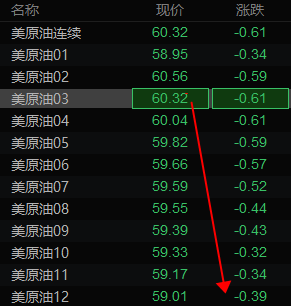
(Term structure of US crude oil futures contracts)
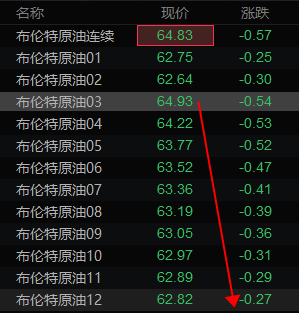
(Term structure of Brent crude oil futures contracts)
The daily chart of the March US crude oil futures contract also shows that oil prices fell back after reaching the upper edge of the trading range. Unless there is an unexpected deterioration in geopolitical conditions, oil prices are likely to fluctuate within a range after a rapid rise.
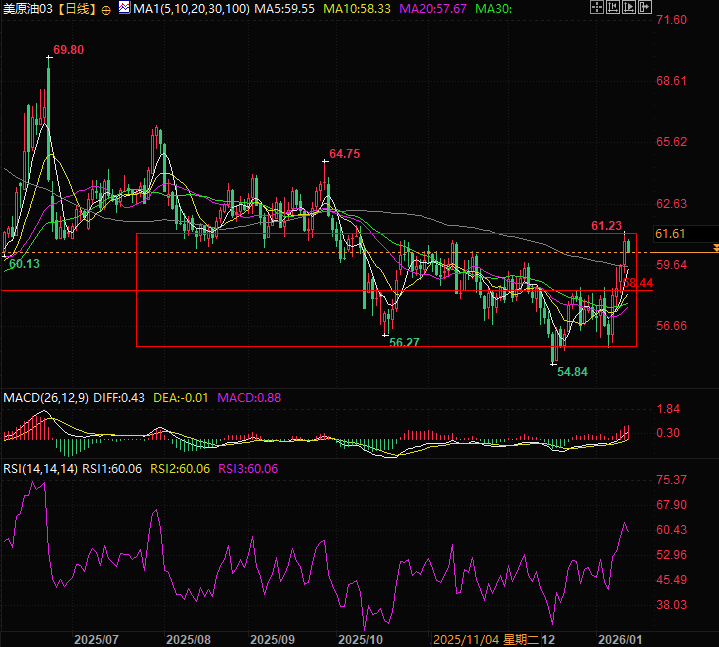
(Daily chart of US crude oil March futures contract, source: FX678)
At 16:47 Beijing time, the March futures contract for US crude oil was trading at $60.42 per barrel.
Since the beginning of 2026, the international crude oil market has shown a clear upward trend: Brent crude oil prices touched the key resistance level of $64 per barrel for the first time, and US WTI crude oil (US crude oil) once broke through the psychological level of $60 per barrel. On Tuesday morning in Asia, it even approached $62 per barrel. This price level is not only recognized by the market as the safe break-even point for most US shale oil producers, but also has important guiding significance for subsequent capacity release.
Geopolitical powder kegs continue to ignite the crude oil market, with oil prices breaking through the break-even point for shale oil; hidden dangers lurk in key regions for crude oil transportation, and the unpriced risk of ultimate disruption is quietly pushing up safe-haven premiums—a thrilling tug-of-war between supply, panic, and speculation has quietly escalated.
This oil price increase is the result of a combination of factors, including a concentrated outbreak of geopolitical risks, supply-side disruptions, and heightened market risk aversion.
Geopolitical risks are seamlessly integrated, becoming a core driver of the price increase.
The concentrated outbreak of geopolitical crises is the core driver of this oil price increase, especially the turmoil in key oil-producing countries in the Middle East and the Americas, which has directly amplified market concerns about disruptions to crude oil supply.
On the one hand, the escalating situation in Iran has become the biggest "trigger." As protests in Iran intensify, US President Trump has issued a strong signal, explicitly threatening to take countermeasures against the Iranian regime's crackdown on protesters, including military strikes, cyberattacks, and a 25% punitive tariff on Iran's trading partners.
As a key player in the global crude oil market, Iran's daily crude oil production is stable at 3.3 million to 4.1 million barrels, accounting for about 3% of the global supply. By 2025, 80% of its crude oil exports will go to China, with an average daily export volume of 1.38 million barrels to China.
Market concerns suggest that actual US intervention could trigger Iranian retaliation, disrupting the Middle East oil supply chain. Analysts predict this could push oil prices up by another $3-4 per barrel. The Iranian parliament speaker has also stated firmly that if the US launches an attack, Israel, US overseas military bases, and warships will become legitimate targets, further exacerbating regional uncertainty.
On the other hand, the situation in Venezuela has further fueled the rise in oil prices. Following the US military intervention in Venezuela and the capture of President Nicolás Maduro, the country's daily crude oil exports of 1.1 million barrels are now in jeopardy.
Although Venezuela's daily crude oil production remains at only 900,000 to 1 million barrels, accounting for less than 1% of global supply, and due to dilapidated infrastructure and restrictions limiting short-term production increases, the turbulent situation has exacerbated market concerns about the stability of supply from emerging market oil-producing countries, becoming a secondary driving force for rising oil prices.
Furthermore, the ongoing conflict between Russia and Ukraine, coupled with the continued precision strikes by drones on energy facilities, has further amplified concerns about the instability of the global crude oil supply chain.
Fears of a Strait of Hormuz blockade resurface, amplifying supply disruption panics.
As a vital artery of the global oil transportation system, the potential risks of the Strait of Hormuz have led to a repricing of oil prices, which has become a significant factor driving up oil prices.
The strait carries about 20% of the world's oil supply, with an average daily crude oil flow of 20 million barrels per day in 2024. It is the core channel for all major oil-producing countries in the Gulf region (including Saudi Arabia, the UAE, and Iran itself) to export to the Asian market.
More importantly, if blocked, there are almost no alternative routes to divert oil transport in the short term—currently only Saudi Arabia and the UAE have operational oil pipelines that can bypass the strait, while Iran's own bypass pipelines have long been underutilized and unable to meet large-scale transport demands.
Although mainstream forecasting agencies and investment banks believe that the probability of a complete blockade of the Strait of Hormuz is almost zero due to the deterrent effect of the United States’ strong naval power in the region, and this scenario has not been included in benchmark pricing, the “ultimate disruption risk” has re-entered traders’ pricing models.
Market consensus indicates that concerns about lockdowns alone have already driven oil prices up by several dollars per barrel, while Andy Lipoor, president of the Lipoor Petroleum Institute, has stated that if the extreme scenario of a complete lockdown materializes, oil prices could jump by as much as $10 to $20 per barrel.
Furthermore, the strait is also a major transportation route for Qatar's liquefied natural gas (LNG), and the risk of blockade could spread across markets, triggering a chain reaction in the global energy market. This expectation has further exacerbated risk aversion in the market.
Localized supply-side disruptions, coupled with safe-haven buying, strengthened the upward momentum.
In addition to core geopolitical risks, partial supply disruptions and increased safe-haven buying in the market have further strengthened the upward trend in oil prices.
On the supply side, the Caspian Pipeline Union crude oil terminal in Kazakhstan has recently been hit by multiple shocks. Severe weather, equipment maintenance, and drone attacks have caused its crude oil loading to be halved, dropping to an average of 900,000 barrels per day, exacerbating the regional supply shortage.
Meanwhile, although Iran has managed to rebound its crude oil production to near pre-restriction levels through discounted dumping, the continued deterrence of US restrictions has led buyers to adopt a wait-and-see attitude. The country's floating oil storage has reached a record high equivalent to 50 days of production, reflecting the limitations of its export channels and the limited potential supply elasticity.
Summary and Technical Analysis:
At the market transaction level, safe-haven buying triggered by geopolitical uncertainty has increased significantly, becoming a direct driving force behind rising oil prices.
However, it should be noted that the global crude oil market is not currently in a state of complete supply shortage: record crude oil production in the United States, coupled with increased supply from non-OPEC oil-producing countries such as Brazil and Guyana, has formed a sufficient global supply buffer, which to some extent has restrained the momentum of oil prices continuing to rise.
Meanwhile, structural headwinds such as the gradual withdrawal of OPEC+ production cuts and weak growth in global crude oil demand have also exerted long-term downward pressure on oil prices.
This has resulted in a large number of short positions in the current oil market, but if these short sellers cannot close their positions, they will need to prepare physical delivery at the end of the month.
Recently, the term structure of WTI crude oil and Brent crude oil futures prices has changed significantly. Both WTI and Brent crude oil are showing a typical near-term backwardation, indicating that there is insufficient supply in the spot market. This forces short sellers to close their positions at very high spot prices or risk preparing for spot delivery at even higher price levels.
(Term structure of US crude oil futures contracts)
(Term structure of Brent crude oil futures contracts)
The daily chart of the March US crude oil futures contract also shows that oil prices fell back after reaching the upper edge of the trading range. Unless there is an unexpected deterioration in geopolitical conditions, oil prices are likely to fluctuate within a range after a rapid rise.
(Daily chart of US crude oil March futures contract, source: FX678)
At 16:47 Beijing time, the March futures contract for US crude oil was trading at $60.42 per barrel.
- Risk Warning and Disclaimer
- The market involves risk, and trading may not be suitable for all investors. This article is for reference only and does not constitute personal investment advice, nor does it take into account certain users’ specific investment objectives, financial situation, or other needs. Any investment decisions made based on this information are at your own risk.