Gold is soaring! Continuing to hit new all-time highs: Who's buying like crazy? And what are they afraid of?
2026-01-14 17:45:22
On Wednesday (January 14), spot gold prices once again reached a record high, touching $4,639.49 per ounce, and remained near this high during the European session. This surge was not accidental, but rather driven by two clear main themes: firstly, moderate US inflation data reignited market expectations for a Federal Reserve rate cut this year; secondly, rising global risk aversion, coupled with increased concerns about the Fed's independence, significantly enhanced gold's appeal as the "ultimate safe-haven asset."
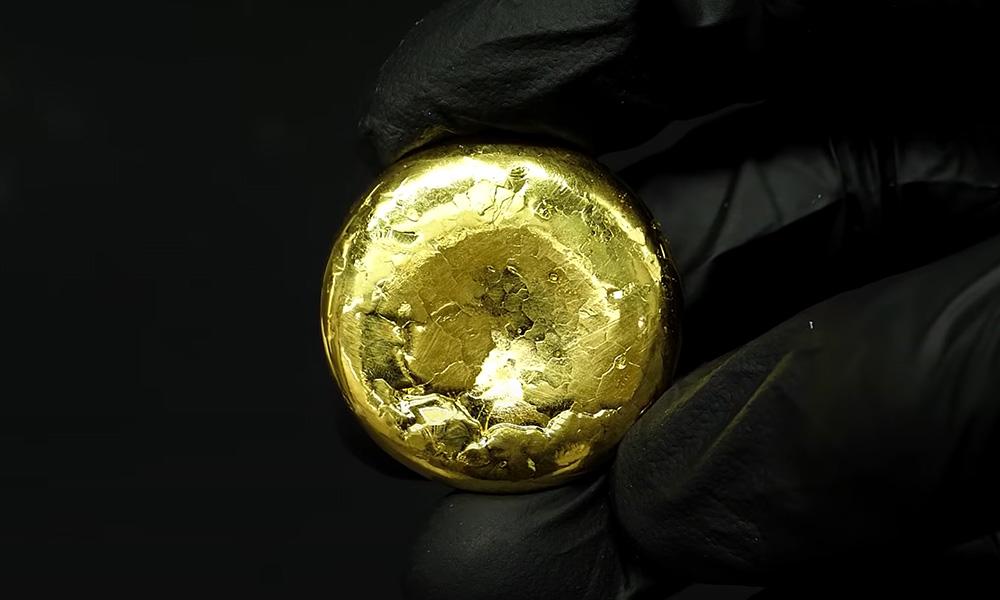
According to the latest macroeconomic data released by the United States, the core consumer price index (excluding food and energy) rose by only 0.2% month-on-month in December, lower than market expectations, and the year-on-year growth rate was 2.6%, consistent with the lowest level in the past four years. The overall CPI rose 0.3% month-on-month, in line with expectations, and the year-on-year growth of 2.7% was also within expectations. This means that inflationary pressures have not rebounded, price trends are stabilizing, and there are even signs of further slowdown. This combination of "controllable inflation but weakening growth momentum" opens a window for a shift in monetary policy towards easing. Interest rate futures markets show that traders are currently betting on two or three rate cuts this year, a significantly higher expectation than the "one rate cut" previously predicted by Federal Reserve officials. It is under this expectation of an "early policy shift" that gold has ushered in a new round of pricing revaluation—as long as there is a possibility of a decline in real interest rates, the allocation value of gold will be continuously amplified.
Meanwhile, the slight weakening of the US dollar index around 99.10 also provided external support for gold priced in US dollars. A weaker dollar means lower costs for buyers holding other currencies to purchase gold, thus attracting international capital inflows. More importantly, in the global financial system, gold often serves as an alternative store of value when markets have doubts about the credibility or policy stability of the US dollar.
Following the release of the December non-farm payroll data, the market reaction was complex but ultimately leaned towards a positive outlook for gold. The month saw only 50,000 new jobs added, lower than the revised 56,000 in November and far below market expectations of 60,000, indicating a slowdown in economic expansion. However, the unemployment rate fell from 4.6% to 4.4%, and the year-on-year increase in average hourly earnings rose from 3.6% to 3.8%. This seemingly contradictory data—weak hiring on one hand, and rising wages and an improved unemployment rate on the other—what signals does it actually send?
For gold, the key is not whether the data itself is good or bad, but whether it is enough to prompt the Federal Reserve to begin a rate-cutting cycle more quickly. A decline in new job growth is easily interpreted as an economic slowdown, giving the Fed more reason to consider easing monetary policy; while wage increases may bring the risk of recurring inflation, they have not yet posed a systemic threat in the current environment. Therefore, the mainstream market interpretation remains "slower growth takes precedence over rising inflation," which in turn strengthens expectations of rate cuts and indirectly supports gold prices.
Besides economic data, a series of non-economic factors have recently been quietly pushing up the risk premium for gold. Most notably, federal prosecutors have issued a strong signal regarding the Federal Reserve Chairman's previous testimony before Congress and statements on building renovation projects, sparking widespread discussion about the institution's independence. Although the details of the events remain unclear, any speculation about a breach of central bank independence will shake market confidence in the neutrality and long-term stability of monetary policy.
Historically, when the public begins to question the independent decision-making ability of central banks, it often triggers concerns about currency devaluation and policy malfunctions. This uncertainty naturally benefits gold. Because gold is not backed by national credit and is not controlled by a single government, it is seen as a "trust anchor beyond sovereignty." In the current context, such risk events affect gold prices through two channels: first, they directly stimulate safe-haven buying, causing funds to flow into highly liquid and safe assets; second, they increase term premiums and risk premiums, indirectly lowering real interest rate expectations and further enhancing the attractiveness of gold.
Furthermore, the geopolitical situation remains highly sensitive, with the possibility of internal unrest and external intervention in some regions continuing to affect market sentiment. Whenever risk appetite cools, gold quickly becomes the preferred safe haven for funds. Recent price movements confirm this: gold prices have seen very shallow pullbacks during their new highs, exhibiting the typical characteristics of a safe-haven asset—"rising quickly and falling slowly." This structural strength indicates that the market is gradually accepting gold as a core holding in an era of uncertainty.
Despite a bullish fundamental and sentiment environment, technical charts are beginning to show some overheating signals. The daily chart shows spot gold has risen continuously, with bulls currently in clear control. However, the RSI indicator (14), which measures momentum, has reached 71.72, placing it in overbought territory and suggesting increased risk of chasing higher prices, with short-term cost-effectiveness declining. Although the MACD remains healthy—DIFF around 90.97, DEA around 77.04, and the histogram is positive and expanding, indicating that trend momentum has not yet weakened—the high-level consolidation warrants attention.
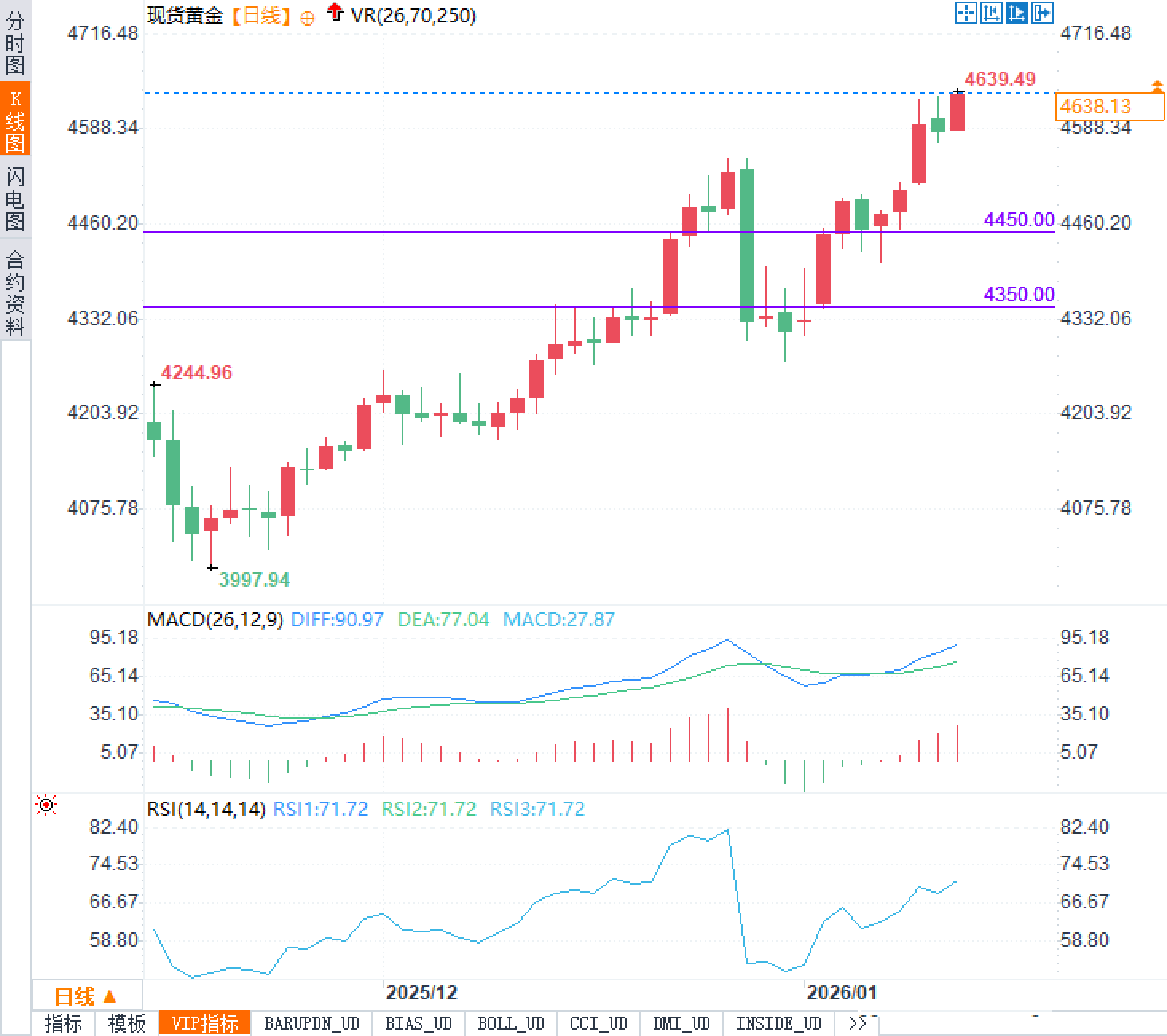
From a support perspective, $4450.00 is the first line of defense against a pullback. A break below this level could trigger selling pressure from technical traders, leading to a deeper correction. $4350.00, on the other hand, is a key trendline; a breach of this level could signify a fundamental shift in the current bullish trend. Therefore, the key to the market going forward is not whether it can break new highs, but whether it can hold above those highs and maintain that level with sustained volume. A rapid, impulsive rise followed by a quick decline is more likely a signal of a temporary top driven by market sentiment.
Overall, gold is currently operating in a favorable environment: the expectation of interest rate cuts has not been disproven, safe-haven demand persists, and the US dollar lacks a strong foundation. However, as prices approach historical highs, volatility is bound to increase. Analysts believe that future trends will depend on the interplay of two types of variables: first, whether inflation and employment data can continue to support the narrative of a "soft landing + early interest rate cuts"; and second, whether policy uncertainty and geopolitical risks will further escalate.
According to the latest macroeconomic data released by the United States, the core consumer price index (excluding food and energy) rose by only 0.2% month-on-month in December, lower than market expectations, and the year-on-year growth rate was 2.6%, consistent with the lowest level in the past four years. The overall CPI rose 0.3% month-on-month, in line with expectations, and the year-on-year growth of 2.7% was also within expectations. This means that inflationary pressures have not rebounded, price trends are stabilizing, and there are even signs of further slowdown. This combination of "controllable inflation but weakening growth momentum" opens a window for a shift in monetary policy towards easing. Interest rate futures markets show that traders are currently betting on two or three rate cuts this year, a significantly higher expectation than the "one rate cut" previously predicted by Federal Reserve officials. It is under this expectation of an "early policy shift" that gold has ushered in a new round of pricing revaluation—as long as there is a possibility of a decline in real interest rates, the allocation value of gold will be continuously amplified.
Meanwhile, the slight weakening of the US dollar index around 99.10 also provided external support for gold priced in US dollars. A weaker dollar means lower costs for buyers holding other currencies to purchase gold, thus attracting international capital inflows. More importantly, in the global financial system, gold often serves as an alternative store of value when markets have doubts about the credibility or policy stability of the US dollar.
Contradictory employment data unexpectedly boosted gold prices.
Following the release of the December non-farm payroll data, the market reaction was complex but ultimately leaned towards a positive outlook for gold. The month saw only 50,000 new jobs added, lower than the revised 56,000 in November and far below market expectations of 60,000, indicating a slowdown in economic expansion. However, the unemployment rate fell from 4.6% to 4.4%, and the year-on-year increase in average hourly earnings rose from 3.6% to 3.8%. This seemingly contradictory data—weak hiring on one hand, and rising wages and an improved unemployment rate on the other—what signals does it actually send?
For gold, the key is not whether the data itself is good or bad, but whether it is enough to prompt the Federal Reserve to begin a rate-cutting cycle more quickly. A decline in new job growth is easily interpreted as an economic slowdown, giving the Fed more reason to consider easing monetary policy; while wage increases may bring the risk of recurring inflation, they have not yet posed a systemic threat in the current environment. Therefore, the mainstream market interpretation remains "slower growth takes precedence over rising inflation," which in turn strengthens expectations of rate cuts and indirectly supports gold prices.
Amidst escalating political turmoil, demand for safe-haven assets is quietly rising.
Besides economic data, a series of non-economic factors have recently been quietly pushing up the risk premium for gold. Most notably, federal prosecutors have issued a strong signal regarding the Federal Reserve Chairman's previous testimony before Congress and statements on building renovation projects, sparking widespread discussion about the institution's independence. Although the details of the events remain unclear, any speculation about a breach of central bank independence will shake market confidence in the neutrality and long-term stability of monetary policy.
Historically, when the public begins to question the independent decision-making ability of central banks, it often triggers concerns about currency devaluation and policy malfunctions. This uncertainty naturally benefits gold. Because gold is not backed by national credit and is not controlled by a single government, it is seen as a "trust anchor beyond sovereignty." In the current context, such risk events affect gold prices through two channels: first, they directly stimulate safe-haven buying, causing funds to flow into highly liquid and safe assets; second, they increase term premiums and risk premiums, indirectly lowering real interest rate expectations and further enhancing the attractiveness of gold.
Furthermore, the geopolitical situation remains highly sensitive, with the possibility of internal unrest and external intervention in some regions continuing to affect market sentiment. Whenever risk appetite cools, gold quickly becomes the preferred safe haven for funds. Recent price movements confirm this: gold prices have seen very shallow pullbacks during their new highs, exhibiting the typical characteristics of a safe-haven asset—"rising quickly and falling slowly." This structural strength indicates that the market is gradually accepting gold as a core holding in an era of uncertainty.
Technical indicators are flashing warning signs, suggesting that high-level consolidation may be on the horizon.
Despite a bullish fundamental and sentiment environment, technical charts are beginning to show some overheating signals. The daily chart shows spot gold has risen continuously, with bulls currently in clear control. However, the RSI indicator (14), which measures momentum, has reached 71.72, placing it in overbought territory and suggesting increased risk of chasing higher prices, with short-term cost-effectiveness declining. Although the MACD remains healthy—DIFF around 90.97, DEA around 77.04, and the histogram is positive and expanding, indicating that trend momentum has not yet weakened—the high-level consolidation warrants attention.
From a support perspective, $4450.00 is the first line of defense against a pullback. A break below this level could trigger selling pressure from technical traders, leading to a deeper correction. $4350.00, on the other hand, is a key trendline; a breach of this level could signify a fundamental shift in the current bullish trend. Therefore, the key to the market going forward is not whether it can break new highs, but whether it can hold above those highs and maintain that level with sustained volume. A rapid, impulsive rise followed by a quick decline is more likely a signal of a temporary top driven by market sentiment.
Overall, gold is currently operating in a favorable environment: the expectation of interest rate cuts has not been disproven, safe-haven demand persists, and the US dollar lacks a strong foundation. However, as prices approach historical highs, volatility is bound to increase. Analysts believe that future trends will depend on the interplay of two types of variables: first, whether inflation and employment data can continue to support the narrative of a "soft landing + early interest rate cuts"; and second, whether policy uncertainty and geopolitical risks will further escalate.
- Risk Warning and Disclaimer
- The market involves risk, and trading may not be suitable for all investors. This article is for reference only and does not constitute personal investment advice, nor does it take into account certain users’ specific investment objectives, financial situation, or other needs. Any investment decisions made based on this information are at your own risk.