Gold Trading Alert: Greenland Dispute Escalates! Trump's Tariff Threatens Europe, Gold Prices Jump Nearly $100 to New Record High
2026-01-19 07:43:44
Amid escalating global geopolitical tensions, US President Trump's tariff strategy announced last Saturday (January 17) triggered significant volatility in international markets. This strategy, aimed at forcing European countries to negotiate control of Greenland through economic pressure, caused spot gold prices to surge by nearly $100 at the open on Monday, setting a new record high. By 7:35 AM, it had reached a high of $4690 per ounce. Simultaneously, several European countries swiftly responded, forming a united front to retaliate. This rift in transatlantic relations not only exacerbates trade frictions but also risks triggering broader international conflicts, further attracting safe-haven funds into the gold market and providing strong upward momentum for gold prices.

US President Donald Trump announced his latest move to gain control of Greenland in a statement released via social media on Saturday morning local time. The core of this strategy is to use new tariffs on several European countries as leverage until they agree to participate in negotiations regarding the sale of Greenland.
Specifically, Trump announced that tariffs would be imposed on imports from Denmark, Norway, Sweden, France, Germany, the United Kingdom, the Netherlands, and Finland starting February 1, and further increased to 25% on June 1, until an agreement is reached on the complete and full purchase of Greenland by the United States. This move was seen as a bold attempt by the Trump administration in foreign policy, aiming to achieve geostrategic goals through economic means. However, this announcement immediately triggered a strong backlash from the international community, highlighting the underlying contradictions in US-EU relations.
Influenced by Trump's tariff strategy, spot gold prices surged after opening on Monday, reaching an opening price of $4,624.54 per ounce, more than $30 higher than the previous trading day. Subsequently, gold prices continued to rise, accumulating a gain of nearly $100, reaching a peak of $4,690.46 per ounce by 7:35 AM, setting a new all-time high, with an overall increase of approximately 1.9%. This rise was mainly driven by investors' concerns about geopolitical uncertainty, making gold a top choice as a safe-haven asset.
In contrast, gold prices retreated on Friday, falling more than 1% to around $4,537 per ounce, but subsequently recovered some ground with the support of bargain hunting, closing at $4,595.53 per ounce, still achieving a weekly gain of 1.9%. This reflects the tug-of-war between profit-taking and easing geopolitical risks, but Trump's latest moves have undoubtedly reignited safe-haven demand, pushing gold prices to new highs.
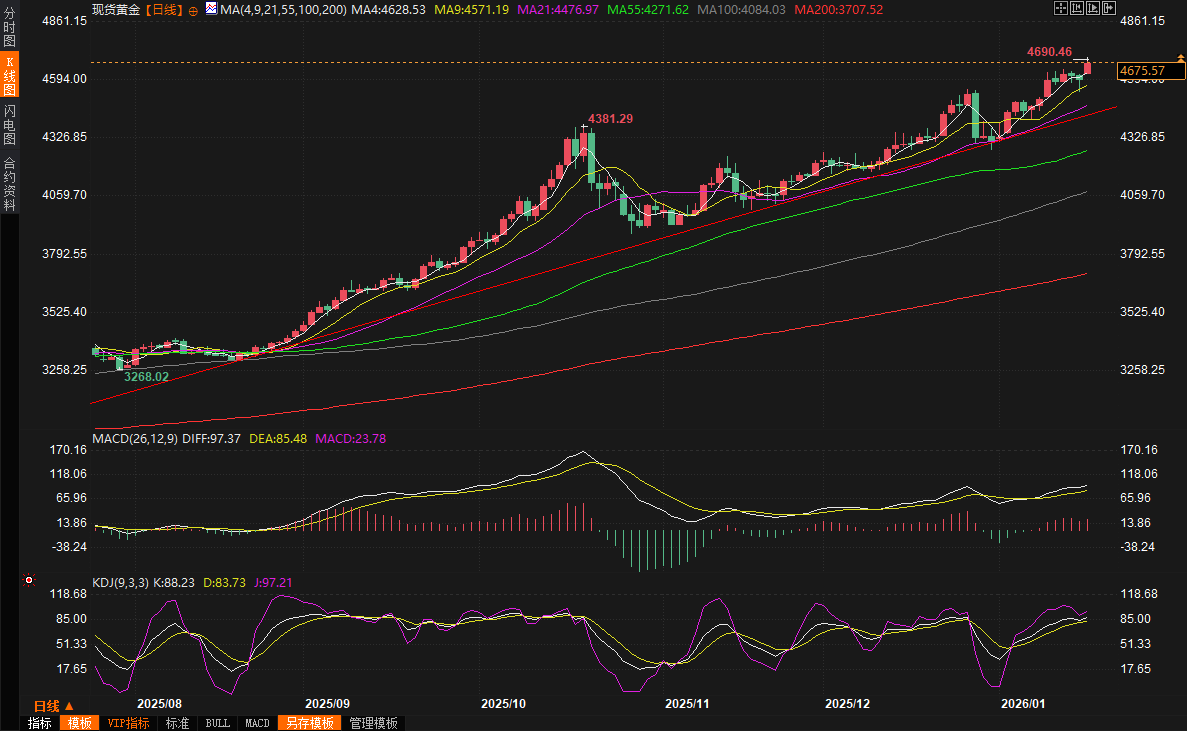
(Spot gold daily chart, source: FX678)
Jacob Fink Kierkegaard, a senior fellow at the Bruegel Institute, a Brussels-based think tank, offered sharp commentary on Trump's tariff policies. He pointed out that this new tariff measure is likely to completely undermine the 15% tariff agreement reached last year between European Commission President Ursula von der Leyen and the United States in Turnberry, Scotland. This means the Turnberry Agreement is at risk of termination, and a full-blown trade war between the US and the EU is possible. In his view, European countries currently face a dilemma: either confront each other through a trade war or get involved in a more serious military conflict.
Kierkegaard emphasized that Europe is hoping the US Supreme Court will issue a ruling as soon as possible on the legality of Trump's tariff policies, which might prompt judges to seriously examine the issues. His analysis reveals the potential damaging impact of this event on the transatlantic alliance, reminding all parties to act cautiously to avoid further escalation.
After Trump's tariff threats were exposed, Danish Prime Minister Frederiksen quickly spoke with leaders including German Chancellor Merz, French President Macron, and British Prime Minister Starmer, and publicly stated that she would not accept such "blackmail."
According to Danish media reports, Frederiksen emphasized on social media that Denmark has received broad international support, and the impact of this issue extends far beyond its borders. She expressed hope that the issue could be resolved through cooperation rather than conflict, and was pleased with the unified message from other European countries that Europe will not succumb to blackmail. This response demonstrates Denmark's determination to uphold its sovereignty and injects cohesion into the overall European position.
In response to the escalating threat of tariffs from the United States, eight countries—Denmark, Finland, France, Germany, the Netherlands, Norway, Sweden, and the United Kingdom—issued a joint statement on the 18th, clearly stating that such additional tariffs would damage transatlantic relations and could trigger a dangerous vicious cycle.
The statement emphasized that the G8 will respond in a united and coordinated manner, and firmly stand with the Kingdom of Denmark and the people of Greenland, and are willing to engage in dialogue based on the principles of sovereignty and territorial integrity.
The statement also clarified Trump's accusations regarding the "Arctic Endurance" military exercise, pointing out that it was a routine activity pre-coordinated by Denmark and its allies, aimed at strengthening security in the Arctic region, in line with transatlantic common interests, and posing no threat to any party. This joint statement highlights the collective action of European countries in the crisis, aiming to resolve differences through diplomatic means.
According to the Financial Times, several EU countries are actively exploring options to counter Trump's tariff strategy, including imposing tariffs on €93 billion worth of US goods imported into the EU or restricting US companies' access to the EU market. This move is aimed at responding to US tariff pressure on eight European countries in exchange for Greenland.
Furthermore, the European Parliament's Revival Europe group called on the EU on the 18th to activate its "anti-coercion tools" to counter US economic pressure. Group leader Valerie Ayer warned in a press release that if the US views Europe as weak, it will face dire consequences. She emphasized that although the anti-coercion tools have not yet been activated, they are the EU's "economic nuclear weapon," allowing the EU to retaliate without relying on UN or World Trade Organization procedures, including punitive tariffs, market restrictions, financial sanctions, and suspension of patent licenses.
Ayer also wrote to European Council President Costa and European Commission President von der Leyen, proposing a package of policy recommendations, such as leveraging military and economic power to build deterrence, strengthening relations with Greenland, and enhancing the EU's geopolitical capabilities. These measures demonstrate that the EU is shifting from passive defense to proactive deterrence.
Beyond the US-EU tariff dispute, noteworthy developments have emerged in other parts of the world. Ukrainian President Volodymyr Zelenskyy posted on social media on the 18th, accusing Russia of using over 1,300 drones, approximately 1,050 guided-missile bombs, and 29 missiles to attack Ukrainian territory this week. The attacks in the early hours of the 18th targeted Sumy and Kharkiv regions, resulting in two deaths and dozens of injuries, including a child.
Meanwhile, Ukraine's power system faces severe challenges. The Russian Ministry of Defense reported that its air defense systems intercepted and destroyed nearly 100 Ukrainian drones within a specified timeframe, indicating that the conflict is ongoing.
On the other hand, the foreign ministers of Iran and Iraq held a joint press conference on the 18th. Iranian Foreign Minister Araqchi welcomed the withdrawal of US troops from the Al-Asad Air Base in Iraq, viewing it as a sign of the consolidation of Iraqi sovereignty. Both sides agreed to advance diplomatic efforts to jointly address challenges and to develop a comprehensive strategic cooperation agreement to maintain regional stability. These events further highlight the complexity of global geopolitics.
In the global gold market, although gold prices saw a pullback last Friday, the overall weekly trend remained upward. Marex analyst Edward Meir pointed out that after several weeks of significant gains, profit-taking occurred in the commodities market, and easing tensions in the Middle East also weakened gold's safe-haven premium. However, with the Iranian protests subsiding, Trump adopting a wait-and-see approach, and Russian President Putin's mediation, geopolitical risks have eased somewhat. He predicts that gold prices may reach $5,000 this year, but with significant pullbacks along the way.
The US bond market saw yields rise, with the 10-year Treasury yield climbing to 4.229% and the 30-year yield to 4.838%. Investors assessed economic data, pressure from the White House on the Federal Reserve, and the situation in the Middle East. TD Securities analyst Gennady Goldberg stated that the bond market's direction is uncertain, primarily influenced by the Fed's actions and economic performance. Fed officials emphasized the need for caution in cutting interest rates, and the market expects the first rate cut to be delayed until June.
In global currency markets, the US dollar index strengthened to 99.41 on Friday, benefiting from Trump's praise of economic advisor Hassett, which reduced the likelihood of Hassett becoming the Federal Reserve Chair. Analyst Adam Barton believes this highlights the political factor in Fed nominations, with Hassett being seen as a dovish candidate. Currently, Walsh is the most favored successor.
Kitco News' weekly gold survey shows that Wall Street analysts are clearly divided on the short-term outlook, with 50% bullish, 25% bearish, and 25% expecting consolidation. Retail investors, on the other hand, are 78% bullish on further gains, 11% bearish, and 11% neutral. This week, the market will focus on the Davos World Economic Forum, Trump's speech, and several economic data releases, such as the final reading of US Q3 GDP, US November PCE data, inflation data, and the PMI index.
Overall, Trump's tariff strategy not only ignited the Greenland dispute but also triggered a historic surge in gold prices and a wave of retaliation from Europe. This event exposed the fragility of US-EU relations, which could potentially escalate into a broader trade or geopolitical conflict. Financial markets are oscillating between safe-haven demand and economic uncertainty; investors need to closely monitor subsequent developments to grasp potential opportunities and risks.
At 07:43 Beijing time, spot gold was trading at $4666.82 per ounce.
The official announcement of Trump's tariff strategy
US President Donald Trump announced his latest move to gain control of Greenland in a statement released via social media on Saturday morning local time. The core of this strategy is to use new tariffs on several European countries as leverage until they agree to participate in negotiations regarding the sale of Greenland.
Specifically, Trump announced that tariffs would be imposed on imports from Denmark, Norway, Sweden, France, Germany, the United Kingdom, the Netherlands, and Finland starting February 1, and further increased to 25% on June 1, until an agreement is reached on the complete and full purchase of Greenland by the United States. This move was seen as a bold attempt by the Trump administration in foreign policy, aiming to achieve geostrategic goals through economic means. However, this announcement immediately triggered a strong backlash from the international community, highlighting the underlying contradictions in US-EU relations.
The dramatic fluctuations in the gold price market
Influenced by Trump's tariff strategy, spot gold prices surged after opening on Monday, reaching an opening price of $4,624.54 per ounce, more than $30 higher than the previous trading day. Subsequently, gold prices continued to rise, accumulating a gain of nearly $100, reaching a peak of $4,690.46 per ounce by 7:35 AM, setting a new all-time high, with an overall increase of approximately 1.9%. This rise was mainly driven by investors' concerns about geopolitical uncertainty, making gold a top choice as a safe-haven asset.
In contrast, gold prices retreated on Friday, falling more than 1% to around $4,537 per ounce, but subsequently recovered some ground with the support of bargain hunting, closing at $4,595.53 per ounce, still achieving a weekly gain of 1.9%. This reflects the tug-of-war between profit-taking and easing geopolitical risks, but Trump's latest moves have undoubtedly reignited safe-haven demand, pushing gold prices to new highs.
(Spot gold daily chart, source: FX678)
In-depth analysis of tariff policy by European think tanks
Jacob Fink Kierkegaard, a senior fellow at the Bruegel Institute, a Brussels-based think tank, offered sharp commentary on Trump's tariff policies. He pointed out that this new tariff measure is likely to completely undermine the 15% tariff agreement reached last year between European Commission President Ursula von der Leyen and the United States in Turnberry, Scotland. This means the Turnberry Agreement is at risk of termination, and a full-blown trade war between the US and the EU is possible. In his view, European countries currently face a dilemma: either confront each other through a trade war or get involved in a more serious military conflict.
Kierkegaard emphasized that Europe is hoping the US Supreme Court will issue a ruling as soon as possible on the legality of Trump's tariff policies, which might prompt judges to seriously examine the issues. His analysis reveals the potential damaging impact of this event on the transatlantic alliance, reminding all parties to act cautiously to avoid further escalation.
The Danish Prime Minister's firm response
After Trump's tariff threats were exposed, Danish Prime Minister Frederiksen quickly spoke with leaders including German Chancellor Merz, French President Macron, and British Prime Minister Starmer, and publicly stated that she would not accept such "blackmail."
According to Danish media reports, Frederiksen emphasized on social media that Denmark has received broad international support, and the impact of this issue extends far beyond its borders. She expressed hope that the issue could be resolved through cooperation rather than conflict, and was pleased with the unified message from other European countries that Europe will not succumb to blackmail. This response demonstrates Denmark's determination to uphold its sovereignty and injects cohesion into the overall European position.
Coordinated Response to the Joint Statement of the Eight European Nations
In response to the escalating threat of tariffs from the United States, eight countries—Denmark, Finland, France, Germany, the Netherlands, Norway, Sweden, and the United Kingdom—issued a joint statement on the 18th, clearly stating that such additional tariffs would damage transatlantic relations and could trigger a dangerous vicious cycle.
The statement emphasized that the G8 will respond in a united and coordinated manner, and firmly stand with the Kingdom of Denmark and the people of Greenland, and are willing to engage in dialogue based on the principles of sovereignty and territorial integrity.
The statement also clarified Trump's accusations regarding the "Arctic Endurance" military exercise, pointing out that it was a routine activity pre-coordinated by Denmark and its allies, aimed at strengthening security in the Arctic region, in line with transatlantic common interests, and posing no threat to any party. This joint statement highlights the collective action of European countries in the crisis, aiming to resolve differences through diplomatic means.
EU countermeasures under consideration
According to the Financial Times, several EU countries are actively exploring options to counter Trump's tariff strategy, including imposing tariffs on €93 billion worth of US goods imported into the EU or restricting US companies' access to the EU market. This move is aimed at responding to US tariff pressure on eight European countries in exchange for Greenland.
Furthermore, the European Parliament's Revival Europe group called on the EU on the 18th to activate its "anti-coercion tools" to counter US economic pressure. Group leader Valerie Ayer warned in a press release that if the US views Europe as weak, it will face dire consequences. She emphasized that although the anti-coercion tools have not yet been activated, they are the EU's "economic nuclear weapon," allowing the EU to retaliate without relying on UN or World Trade Organization procedures, including punitive tariffs, market restrictions, financial sanctions, and suspension of patent licenses.
Ayer also wrote to European Council President Costa and European Commission President von der Leyen, proposing a package of policy recommendations, such as leveraging military and economic power to build deterrence, strengthening relations with Greenland, and enhancing the EU's geopolitical capabilities. These measures demonstrate that the EU is shifting from passive defense to proactive deterrence.
Other developments in the international situation
Beyond the US-EU tariff dispute, noteworthy developments have emerged in other parts of the world. Ukrainian President Volodymyr Zelenskyy posted on social media on the 18th, accusing Russia of using over 1,300 drones, approximately 1,050 guided-missile bombs, and 29 missiles to attack Ukrainian territory this week. The attacks in the early hours of the 18th targeted Sumy and Kharkiv regions, resulting in two deaths and dozens of injuries, including a child.
Meanwhile, Ukraine's power system faces severe challenges. The Russian Ministry of Defense reported that its air defense systems intercepted and destroyed nearly 100 Ukrainian drones within a specified timeframe, indicating that the conflict is ongoing.
On the other hand, the foreign ministers of Iran and Iraq held a joint press conference on the 18th. Iranian Foreign Minister Araqchi welcomed the withdrawal of US troops from the Al-Asad Air Base in Iraq, viewing it as a sign of the consolidation of Iraqi sovereignty. Both sides agreed to advance diplomatic efforts to jointly address challenges and to develop a comprehensive strategic cooperation agreement to maintain regional stability. These events further highlight the complexity of global geopolitics.
The interconnected reaction of the global gold and bond markets
In the global gold market, although gold prices saw a pullback last Friday, the overall weekly trend remained upward. Marex analyst Edward Meir pointed out that after several weeks of significant gains, profit-taking occurred in the commodities market, and easing tensions in the Middle East also weakened gold's safe-haven premium. However, with the Iranian protests subsiding, Trump adopting a wait-and-see approach, and Russian President Putin's mediation, geopolitical risks have eased somewhat. He predicts that gold prices may reach $5,000 this year, but with significant pullbacks along the way.
The US bond market saw yields rise, with the 10-year Treasury yield climbing to 4.229% and the 30-year yield to 4.838%. Investors assessed economic data, pressure from the White House on the Federal Reserve, and the situation in the Middle East. TD Securities analyst Gennady Goldberg stated that the bond market's direction is uncertain, primarily influenced by the Fed's actions and economic performance. Fed officials emphasized the need for caution in cutting interest rates, and the market expects the first rate cut to be delayed until June.
Outlook for the Global Forex Market and Gold
In global currency markets, the US dollar index strengthened to 99.41 on Friday, benefiting from Trump's praise of economic advisor Hassett, which reduced the likelihood of Hassett becoming the Federal Reserve Chair. Analyst Adam Barton believes this highlights the political factor in Fed nominations, with Hassett being seen as a dovish candidate. Currently, Walsh is the most favored successor.
Kitco News' weekly gold survey shows that Wall Street analysts are clearly divided on the short-term outlook, with 50% bullish, 25% bearish, and 25% expecting consolidation. Retail investors, on the other hand, are 78% bullish on further gains, 11% bearish, and 11% neutral. This week, the market will focus on the Davos World Economic Forum, Trump's speech, and several economic data releases, such as the final reading of US Q3 GDP, US November PCE data, inflation data, and the PMI index.
Overall, Trump's tariff strategy not only ignited the Greenland dispute but also triggered a historic surge in gold prices and a wave of retaliation from Europe. This event exposed the fragility of US-EU relations, which could potentially escalate into a broader trade or geopolitical conflict. Financial markets are oscillating between safe-haven demand and economic uncertainty; investors need to closely monitor subsequent developments to grasp potential opportunities and risks.
At 07:43 Beijing time, spot gold was trading at $4666.82 per ounce.
- Risk Warning and Disclaimer
- The market involves risk, and trading may not be suitable for all investors. This article is for reference only and does not constitute personal investment advice, nor does it take into account certain users’ specific investment objectives, financial situation, or other needs. Any investment decisions made based on this information are at your own risk.