The yen strengthened for the second consecutive day, with the USD/JPY pair falling to recent lows.
2026-01-19 13:47:27
The US dollar continued its correction against the Japanese yen (USD/JPY) in early Asian trading on Monday, falling to a recent one-week low. Weakening market risk appetite and safe-haven inflows into the yen provided some temporary support.
Meanwhile, Japanese policymakers' focus on currency market volatility has also boosted the yen's performance. Japan's Finance Minister recently emphasized that the authorities are considering all options, including direct intervention, to address the yen's excessive weakness.

This strong expression of official intervention boosted market confidence in the yen. Some market analysts pointed out that some policymakers within the Bank of Japan believe that, given the continued emergence of inflation, the Bank of Japan may consider raising interest rates sooner than the market expects, potentially taking action in April.
In addition, US President Trump's announcement of tariffs on eight European countries that opposed his plan to acquire Greenland further escalated trade tensions and increased the attractiveness of safe-haven currencies, including the Japanese yen.
Major EU countries have reached an agreement to discourage tariffs while preparing retaliatory actions, and this policy uncertainty is further stimulating demand for safe-haven assets.
On the other hand, the latest US labor market data showed strong performance, delaying market expectations for a near-term interest rate cut by the Federal Reserve. This fundamental factor provided some support for the US dollar, but the overall market is more focused on the combined effect of risk sentiment and policy direction.
Furthermore, the possibility that the Japanese Prime Minister might dissolve parliament early and call a general election to consolidate support for fiscal expansion policies could have a dual impact on the yen's exchange rate. On the one hand, it could intensify attention to yen intervention, while on the other hand, market uncertainty regarding future fiscal and monetary policies remains.
Overall, USD/JPY is expected to fluctuate and decline in the short term. Influenced by multiple factors, the exchange rate will continue to fluctuate around policy signals and global risk sentiment.
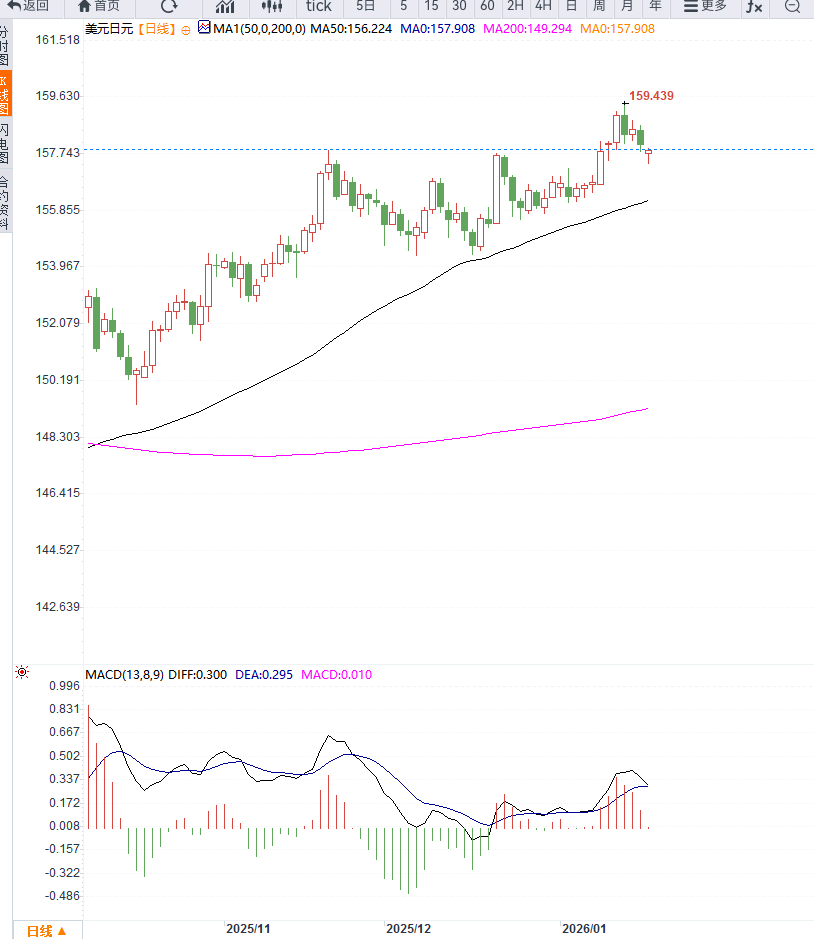
From a daily chart perspective, USD/JPY retreated after reaching a high of around 158 last week, indicating a slowdown in the short-term trend. Although the US dollar still has some upward momentum supported by strong US economic data, daily technical indicators suggest that the yen's rebound is putting real pressure on prices.
The MACD remains slightly above the zero line, indicating that bullish momentum still exists but is weakening; the RSI has fallen back to the neutral zone and no longer shows a significant overbought condition. Key short-term support lies in the 157.00 and 156.50 range; a break below this level could lead to a test of even lower support levels.
Resistance is seen in the 158.00-158.50 area; a break above this level is needed to reconfirm the uptrend. Overall, the daily chart reflects a slightly bearish, oscillating pattern for USD/JPY, but the larger trend remains driven by fundamentals and policy.
Editor's Note:
The recent rebound in the yen is mainly due to warnings of official intervention and changes in policy expectations, which have been quickly transmitted to the foreign exchange market driven by risk aversion. Tensions in US foreign trade, coupled with global geopolitical risks, have also provided "safe-haven support" for the yen.
However, strong US fundamentals continue to provide some support for the US dollar, creating a mixed picture of bullish and bearish forces. In the short term, the key factors determining the next phase of USD/JPY's movement will be the further clarification of the Bank of Japan's interest rate path, signals of actual government intervention, and changes in the pace of Federal Reserve policy.
Meanwhile, Japanese policymakers' focus on currency market volatility has also boosted the yen's performance. Japan's Finance Minister recently emphasized that the authorities are considering all options, including direct intervention, to address the yen's excessive weakness.
This strong expression of official intervention boosted market confidence in the yen. Some market analysts pointed out that some policymakers within the Bank of Japan believe that, given the continued emergence of inflation, the Bank of Japan may consider raising interest rates sooner than the market expects, potentially taking action in April.
In addition, US President Trump's announcement of tariffs on eight European countries that opposed his plan to acquire Greenland further escalated trade tensions and increased the attractiveness of safe-haven currencies, including the Japanese yen.
Major EU countries have reached an agreement to discourage tariffs while preparing retaliatory actions, and this policy uncertainty is further stimulating demand for safe-haven assets.
On the other hand, the latest US labor market data showed strong performance, delaying market expectations for a near-term interest rate cut by the Federal Reserve. This fundamental factor provided some support for the US dollar, but the overall market is more focused on the combined effect of risk sentiment and policy direction.
Furthermore, the possibility that the Japanese Prime Minister might dissolve parliament early and call a general election to consolidate support for fiscal expansion policies could have a dual impact on the yen's exchange rate. On the one hand, it could intensify attention to yen intervention, while on the other hand, market uncertainty regarding future fiscal and monetary policies remains.
Overall, USD/JPY is expected to fluctuate and decline in the short term. Influenced by multiple factors, the exchange rate will continue to fluctuate around policy signals and global risk sentiment.
From a daily chart perspective, USD/JPY retreated after reaching a high of around 158 last week, indicating a slowdown in the short-term trend. Although the US dollar still has some upward momentum supported by strong US economic data, daily technical indicators suggest that the yen's rebound is putting real pressure on prices.
The MACD remains slightly above the zero line, indicating that bullish momentum still exists but is weakening; the RSI has fallen back to the neutral zone and no longer shows a significant overbought condition. Key short-term support lies in the 157.00 and 156.50 range; a break below this level could lead to a test of even lower support levels.
Resistance is seen in the 158.00-158.50 area; a break above this level is needed to reconfirm the uptrend. Overall, the daily chart reflects a slightly bearish, oscillating pattern for USD/JPY, but the larger trend remains driven by fundamentals and policy.
Editor's Note:
The recent rebound in the yen is mainly due to warnings of official intervention and changes in policy expectations, which have been quickly transmitted to the foreign exchange market driven by risk aversion. Tensions in US foreign trade, coupled with global geopolitical risks, have also provided "safe-haven support" for the yen.
However, strong US fundamentals continue to provide some support for the US dollar, creating a mixed picture of bullish and bearish forces. In the short term, the key factors determining the next phase of USD/JPY's movement will be the further clarification of the Bank of Japan's interest rate path, signals of actual government intervention, and changes in the pace of Federal Reserve policy.
- Risk Warning and Disclaimer
- The market involves risk, and trading may not be suitable for all investors. This article is for reference only and does not constitute personal investment advice, nor does it take into account certain users’ specific investment objectives, financial situation, or other needs. Any investment decisions made based on this information are at your own risk.