Trade uncertainty concerns pressured the dollar lower, and it is expected to remain volatile in the short term.
2026-01-19 14:37:51
The US dollar weakened at the beginning of the week, with the dollar index falling to around 99.15, placing it among the weakest major currencies. Market sentiment was affected by diplomatic friction between the US and Europe over Greenland, leading to a decline in investor confidence in dollar assets.
Trump announced on social media that he plans to impose a 10% tariff on goods from Denmark, Sweden, France, Germany, the Netherlands, Finland, the United Kingdom, and Norway, starting February 1, as part of his "Buy Greenland" initiative.

This move quickly triggered a strong reaction from Europe. European Commission President Ursula von der Leyen warned that the US plan could threaten regional sovereignty and territorial integrity and could create a "dangerous downward spiral" in transatlantic relations.
Analysts believe this event could have a long-term negative impact on US-EU relations, and Europe may seek more alternatives in trade settlement and financial cooperation, thereby weakening the dollar's dominant position in the international payment system.
Fund flows show that the US dollar has weakened significantly against safe-haven currencies such as the Swiss franc, indicating a repricing of market risk appetite. Meanwhile, policy signals from within the Federal Reserve are also weighing on the dollar's performance.
Federal Reserve Vice Chairman for Supervision Bowman stated that given the continued fragility of the labor market, the Fed should be prepared to gradually lower interest rates to a neutral level. This statement was interpreted by the market as a dovish stance, contrasting with previous expectations of delaying rate cuts due to strong economic data.
From a currency market perspective, the US dollar generally fell against most major currencies on Monday, with the largest decline against the Swiss franc, and also weakening to varying degrees against the euro, pound sterling, and yen. The return of funds to non-US dollar assets indicates that market confidence in the dollar is weakening in the short term.
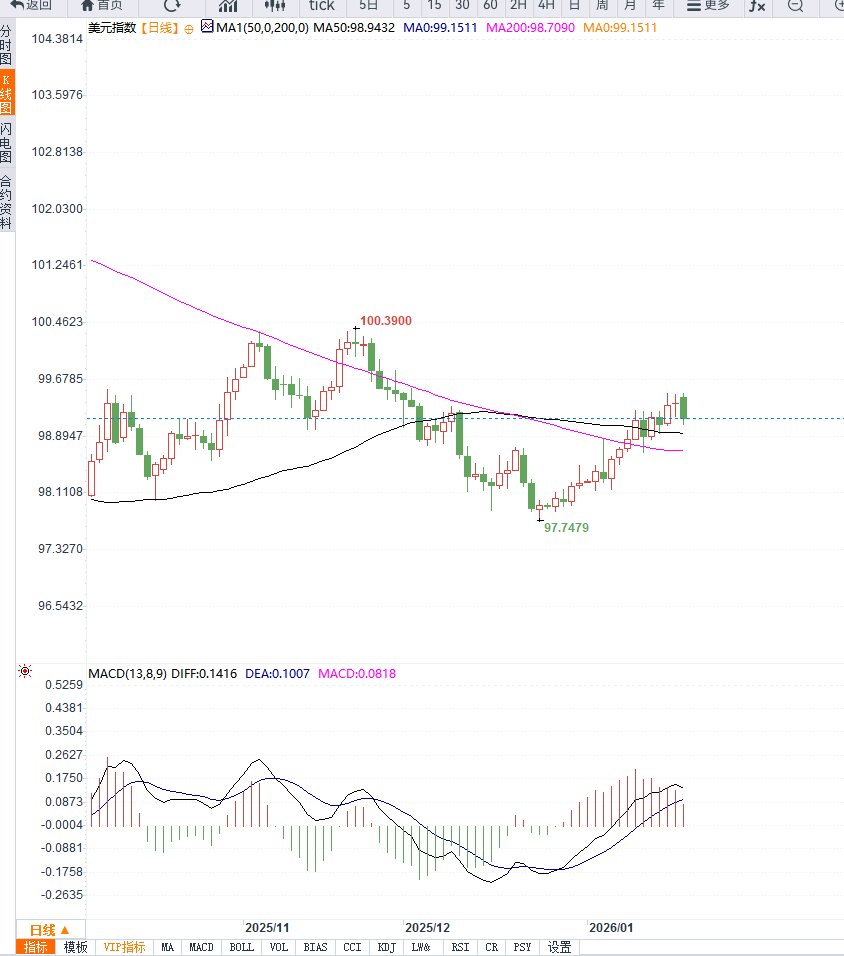
The daily chart shows that the US dollar index retreated after touching around 99.60 and is currently trading around 99.15, with short-term bullish momentum clearly slowing. The 5-day moving average has begun to turn downwards and is approaching 99.20, providing short-term resistance. The 10-day moving average is providing initial support around 99.05, while the 20-day moving average remains around 98.80, maintaining a medium-term support structure.
The MACD histogram continues to narrow, and the fast and slow lines are gradually approaching the zero axis, indicating that the upward momentum is weakening; the RSI has fallen back to around 52, moving away from the previous strong range, indicating that market sentiment has shifted from bullish to volatile.
If the index breaks below the 99.00-98.90 support zone, it may further test 98.50. Key resistance levels are at 99.40 and 99.60; only a sustained move above 99.60 will restore a bullish trend. Overall, the US dollar index has turned to a slightly weaker, volatile pattern in the short term, with a technical risk of further pullback.
Editor's Note:
The current decline in the US dollar is not due to a single economic factor, but rather a result of the convergence of geopolitical and monetary policy expectations. The Greenland dispute has exacerbated transatlantic uncertainty; at the same time, dovish statements from Federal Reserve officials have weakened interest rate differentials.
In the short term, if the tariff threat continues to escalate, the US dollar may remain under pressure; conversely, if the situation eases, the dollar may stabilize and rebound near its support level. Close attention should be paid to how the policy game between the US and Europe, and the Fed's statements, reshape market expectations.
Trump announced on social media that he plans to impose a 10% tariff on goods from Denmark, Sweden, France, Germany, the Netherlands, Finland, the United Kingdom, and Norway, starting February 1, as part of his "Buy Greenland" initiative.
This move quickly triggered a strong reaction from Europe. European Commission President Ursula von der Leyen warned that the US plan could threaten regional sovereignty and territorial integrity and could create a "dangerous downward spiral" in transatlantic relations.
Analysts believe this event could have a long-term negative impact on US-EU relations, and Europe may seek more alternatives in trade settlement and financial cooperation, thereby weakening the dollar's dominant position in the international payment system.
Fund flows show that the US dollar has weakened significantly against safe-haven currencies such as the Swiss franc, indicating a repricing of market risk appetite. Meanwhile, policy signals from within the Federal Reserve are also weighing on the dollar's performance.
Federal Reserve Vice Chairman for Supervision Bowman stated that given the continued fragility of the labor market, the Fed should be prepared to gradually lower interest rates to a neutral level. This statement was interpreted by the market as a dovish stance, contrasting with previous expectations of delaying rate cuts due to strong economic data.
From a currency market perspective, the US dollar generally fell against most major currencies on Monday, with the largest decline against the Swiss franc, and also weakening to varying degrees against the euro, pound sterling, and yen. The return of funds to non-US dollar assets indicates that market confidence in the dollar is weakening in the short term.
The daily chart shows that the US dollar index retreated after touching around 99.60 and is currently trading around 99.15, with short-term bullish momentum clearly slowing. The 5-day moving average has begun to turn downwards and is approaching 99.20, providing short-term resistance. The 10-day moving average is providing initial support around 99.05, while the 20-day moving average remains around 98.80, maintaining a medium-term support structure.
The MACD histogram continues to narrow, and the fast and slow lines are gradually approaching the zero axis, indicating that the upward momentum is weakening; the RSI has fallen back to around 52, moving away from the previous strong range, indicating that market sentiment has shifted from bullish to volatile.
If the index breaks below the 99.00-98.90 support zone, it may further test 98.50. Key resistance levels are at 99.40 and 99.60; only a sustained move above 99.60 will restore a bullish trend. Overall, the US dollar index has turned to a slightly weaker, volatile pattern in the short term, with a technical risk of further pullback.
Editor's Note:
The current decline in the US dollar is not due to a single economic factor, but rather a result of the convergence of geopolitical and monetary policy expectations. The Greenland dispute has exacerbated transatlantic uncertainty; at the same time, dovish statements from Federal Reserve officials have weakened interest rate differentials.
In the short term, if the tariff threat continues to escalate, the US dollar may remain under pressure; conversely, if the situation eases, the dollar may stabilize and rebound near its support level. Close attention should be paid to how the policy game between the US and Europe, and the Fed's statements, reshape market expectations.
- Risk Warning and Disclaimer
- The market involves risk, and trading may not be suitable for all investors. This article is for reference only and does not constitute personal investment advice, nor does it take into account certain users’ specific investment objectives, financial situation, or other needs. Any investment decisions made based on this information are at your own risk.