The decline in crude oil prices, coupled with trade concerns, pressured the US dollar to fluctuate lower against the Canadian dollar.
2026-01-20 11:13:21
During Tuesday's Asian trading session, the US dollar rose slightly against the Canadian dollar (USD/CAD) to around 1.3870, regaining support after a mild pullback in the previous session.
Given the high correlation between the Canadian dollar and energy prices, the weakening of crude oil prices was the main factor driving the currency's rebound. WTI crude oil prices fell back again after two consecutive days of rebound and are currently trading around $59.30.
Trade concerns between the US and Europe continue to escalate, with markets worried that escalating tensions could dampen the global economic and energy consumption outlook. As Canada's largest crude oil supplier to the US, the decline in oil prices has directly weakened the Canadian dollar, providing upward momentum for the USD/CAD exchange rate.
 However, the dollar's rise has not been without its challenges. Diplomatic uncertainty surrounding the Greenland issue has made some investors cautious about the dollar. The US plan to impose tariffs on goods from several European countries starting February 1st, and the EU's indication that it will strengthen coordination and prepare countermeasures, have further complicated market sentiment.
Foreign exchange strategist James O'Connor said, "Trade concerns have had a more direct impact on the Canadian dollar, while the US dollar is oscillating between safe-haven demand and policy uncertainty, making it difficult for USD/CAD to form a one-sided trend."
On the monetary policy front, robust US employment market data has significantly delayed market expectations for further interest rate cuts by the Federal Reserve. Several Fed officials emphasized that there is no urgency to continue easing until inflation clearly returns to the 2% target, providing medium-term support for the dollar.
Morgan Stanley analysts noted, "We have revised our 2026 rate cut schedule to one in June and one in September, instead of the previously expected one in January and one in April. This means that interest rates will remain high for a longer period of time."
This anticipated shift reinforced the relative advantage of the US dollar and limited the downside potential for the USD/CAD pair. However, bullish sentiment remained cautious ahead of uncertainty regarding the outlook for trade and energy demand.
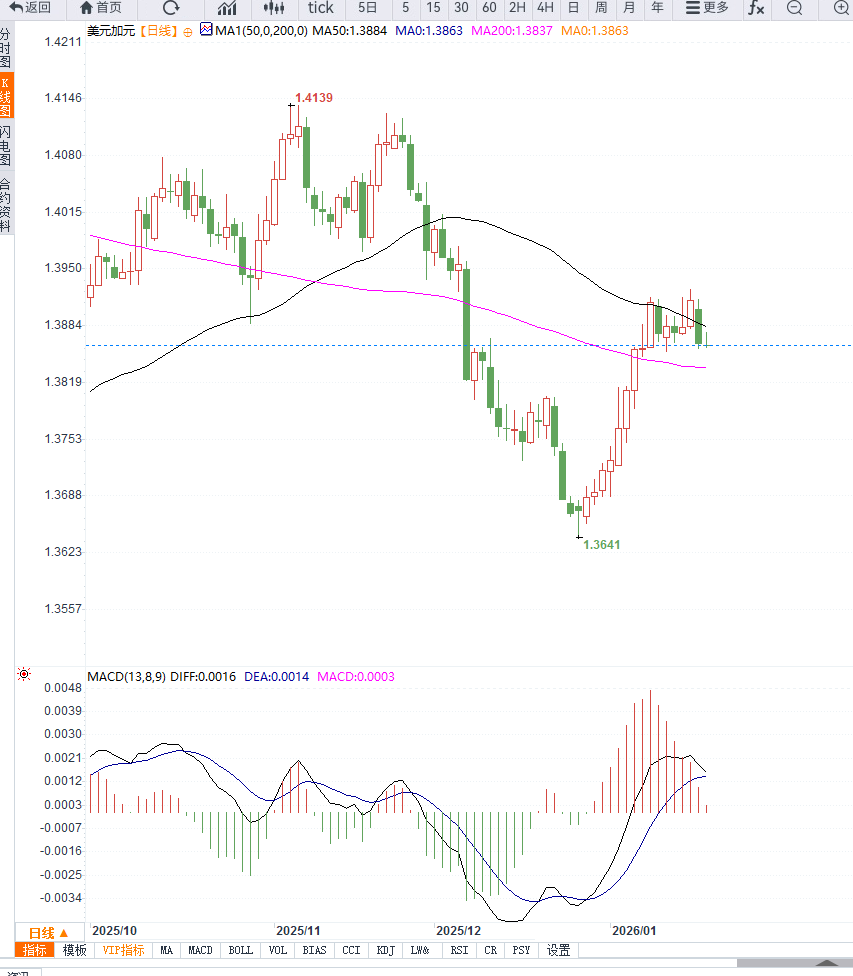
From a daily chart perspective, USD/CAD is generally in a slightly bullish, range-bound pattern. The price has found support above 1.3800 multiple times, and the short-term moving averages are showing signs of converging upwards, indicating a slight advantage for the bulls. However, significant resistance remains in the 1.3900-1.3920 area, with the price failing to break through effectively after several attempts.
In terms of technical indicators, the MACD is expanding moderately above the zero line, with the red bars slightly increasing, suggesting a recovery in upward momentum; the RSI is running around 55, in a neutral to slightly bullish range, and has not yet shown an overbought signal. If the price can hold above 1.3900, the next target may be 1.3980.
Conversely, if the 1.3820 support level is broken, it may retest the 1.3750 level. Overall, the daily chart remains range-bound, and a clear trend will depend on further guidance from oil prices and expectations regarding US dollar policy.
Editor's Note:
The performance of the USD/CAD pair is essentially a game between oil price movements and expectations regarding US dollar policy. In the short term, trade concerns are suppressing oil prices, dragging down the Canadian dollar; while the Federal Reserve's hawkish stance is providing support for the US dollar.
It is expected that the exchange rate will likely remain range-bound between 1.38 and 1.39 until macroeconomic risks dissipate significantly. Key factors to watch include whether crude oil prices can stabilize and the impact of US economic data on expectations of interest rate cuts.
Given the high correlation between the Canadian dollar and energy prices, the weakening of crude oil prices was the main factor driving the currency's rebound. WTI crude oil prices fell back again after two consecutive days of rebound and are currently trading around $59.30.
Trade concerns between the US and Europe continue to escalate, with markets worried that escalating tensions could dampen the global economic and energy consumption outlook. As Canada's largest crude oil supplier to the US, the decline in oil prices has directly weakened the Canadian dollar, providing upward momentum for the USD/CAD exchange rate.
However, the dollar's rise has not been without its challenges. Diplomatic uncertainty surrounding the Greenland issue has made some investors cautious about the dollar. The US plan to impose tariffs on goods from several European countries starting February 1st, and the EU's indication that it will strengthen coordination and prepare countermeasures, have further complicated market sentiment.Foreign exchange strategist James O'Connor said, "Trade concerns have had a more direct impact on the Canadian dollar, while the US dollar is oscillating between safe-haven demand and policy uncertainty, making it difficult for USD/CAD to form a one-sided trend."
On the monetary policy front, robust US employment market data has significantly delayed market expectations for further interest rate cuts by the Federal Reserve. Several Fed officials emphasized that there is no urgency to continue easing until inflation clearly returns to the 2% target, providing medium-term support for the dollar.
Morgan Stanley analysts noted, "We have revised our 2026 rate cut schedule to one in June and one in September, instead of the previously expected one in January and one in April. This means that interest rates will remain high for a longer period of time."
This anticipated shift reinforced the relative advantage of the US dollar and limited the downside potential for the USD/CAD pair. However, bullish sentiment remained cautious ahead of uncertainty regarding the outlook for trade and energy demand.
From a daily chart perspective, USD/CAD is generally in a slightly bullish, range-bound pattern. The price has found support above 1.3800 multiple times, and the short-term moving averages are showing signs of converging upwards, indicating a slight advantage for the bulls. However, significant resistance remains in the 1.3900-1.3920 area, with the price failing to break through effectively after several attempts.
In terms of technical indicators, the MACD is expanding moderately above the zero line, with the red bars slightly increasing, suggesting a recovery in upward momentum; the RSI is running around 55, in a neutral to slightly bullish range, and has not yet shown an overbought signal. If the price can hold above 1.3900, the next target may be 1.3980.
Conversely, if the 1.3820 support level is broken, it may retest the 1.3750 level. Overall, the daily chart remains range-bound, and a clear trend will depend on further guidance from oil prices and expectations regarding US dollar policy.
Editor's Note:
The performance of the USD/CAD pair is essentially a game between oil price movements and expectations regarding US dollar policy. In the short term, trade concerns are suppressing oil prices, dragging down the Canadian dollar; while the Federal Reserve's hawkish stance is providing support for the US dollar.
It is expected that the exchange rate will likely remain range-bound between 1.38 and 1.39 until macroeconomic risks dissipate significantly. Key factors to watch include whether crude oil prices can stabilize and the impact of US economic data on expectations of interest rate cuts.
- Risk Warning and Disclaimer
- The market involves risk, and trading may not be suitable for all investors. This article is for reference only and does not constitute personal investment advice, nor does it take into account certain users’ specific investment objectives, financial situation, or other needs. Any investment decisions made based on this information are at your own risk.