Geopolitical risks and trade concerns fueled gold prices to new highs.
2026-01-20 14:46:47
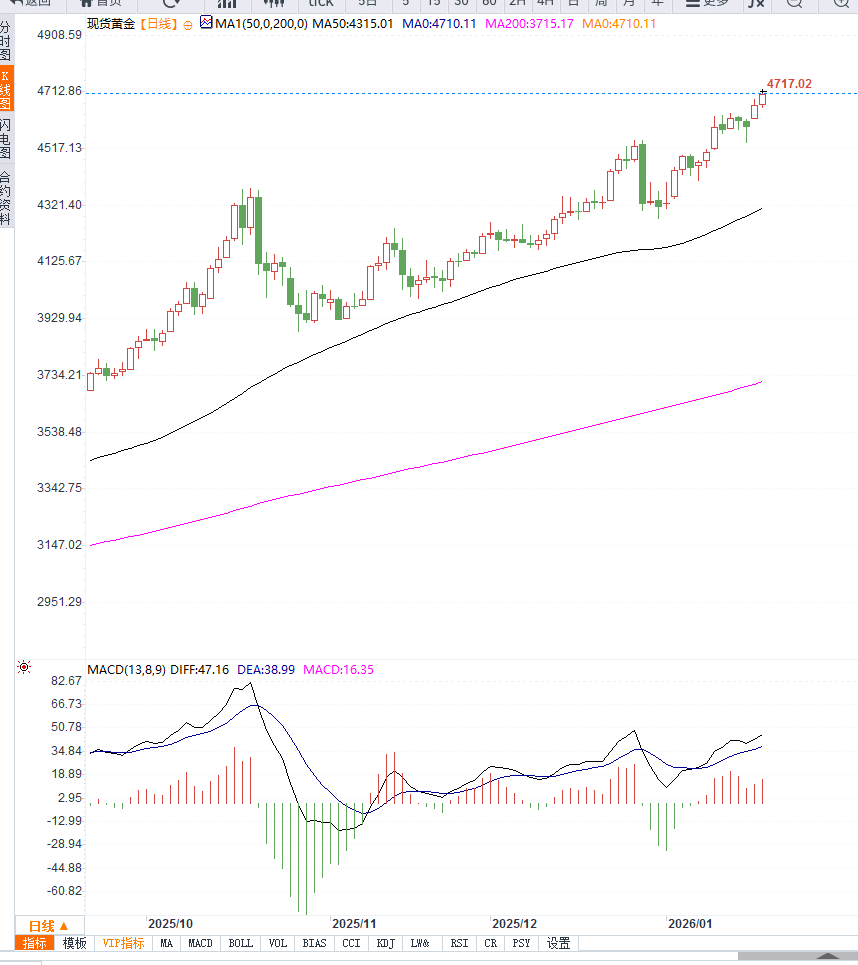
Driven by continued inflows of safe-haven funds, gold (XAU/USD) broke through the $4,700 mark in Asian trading on Tuesday, setting a new all-time high.
The protracted Russia-Ukraine conflict has kept geopolitical risks high, offsetting the impact of the temporary easing of tensions in Iran. Meanwhile, trade concerns stemming from the Greenland issue continue to weigh on market confidence, providing support for gold, a non-interest-bearing asset.
Risk aversion dominated the market, with renewed tariff threats from the US triggering a sell-off in dollar assets, causing the dollar index to continue its weakness. Although market expectations for more aggressive easing by the Federal Reserve in 2026 have somewhat subsided, the dollar has not received a significant boost; instead, it has further benefited gold's performance.
 Market analysts say, "In an environment of multiple uncertainties, funds are more inclined to allocate to assets with safe-haven attributes, and gold naturally becomes the first choice."
News reports indicate that Russia launched a large-scale drone attack on Ukrainian energy facilities, causing power outages in multiple locations; meanwhile, Europe is considering a series of economic countermeasures in response to the latest US tariff stance, fueling continued trade anxieties.
These factors collectively solidified gold's safe-haven status. Key data is now the next guide, with investors turning their attention to Thursday's release of the US Personal Consumption Expenditures (PCE) price index and the final Q3 GDP figure. This data will provide important clues for judging the Fed's future interest rate path and could also trigger short-term fluctuations in gold prices.
From a daily chart perspective, the upward channel formed by gold remains intact, with the price approaching the upper edge of the channel around $4720. The MACD fast line continues to be above the signal line, and both lines are above the zero axis, with the positive histogram expanding, indicating that the bulls are still in control.
The RSI rose to around 70.95, entering the overbought zone, indicating strong momentum but also signs of overheating. If gold prices fail to break through the upper boundary of the channel, they may enter a period of consolidation at higher levels or a slight pullback in the short term, with the first support level around $4630.
If the MACD histogram contracts and the RSI falls from the overbought zone, it indicates weakening upward momentum; conversely, if the price breaks through and holds above the upper Bollinger Band with increased volume, the upward trend is likely to extend further. Overall, the trend remains bullish, but the risk of chasing highs is accumulating.
Traders noted, "Gold is currently driven more by sentiment and events, and the importance of macroeconomic data has increased significantly in the short term."
Editor's Note:
This recent breakout in gold prices was not driven by a single factor, but rather by a confluence of geopolitical risks, policy uncertainties, and a weakening US dollar. While the technical pattern remains strong, overbought signals warn investors to be wary of increased volatility.
The future pace will depend on the evolution of US inflation data and trade concerns: if the PCE shows rising price pressures, it may limit the rise; if risk events escalate again, gold prices still have the potential to hit higher levels.
The protracted Russia-Ukraine conflict has kept geopolitical risks high, offsetting the impact of the temporary easing of tensions in Iran. Meanwhile, trade concerns stemming from the Greenland issue continue to weigh on market confidence, providing support for gold, a non-interest-bearing asset.
Risk aversion dominated the market, with renewed tariff threats from the US triggering a sell-off in dollar assets, causing the dollar index to continue its weakness. Although market expectations for more aggressive easing by the Federal Reserve in 2026 have somewhat subsided, the dollar has not received a significant boost; instead, it has further benefited gold's performance.
Market analysts say, "In an environment of multiple uncertainties, funds are more inclined to allocate to assets with safe-haven attributes, and gold naturally becomes the first choice."News reports indicate that Russia launched a large-scale drone attack on Ukrainian energy facilities, causing power outages in multiple locations; meanwhile, Europe is considering a series of economic countermeasures in response to the latest US tariff stance, fueling continued trade anxieties.
These factors collectively solidified gold's safe-haven status. Key data is now the next guide, with investors turning their attention to Thursday's release of the US Personal Consumption Expenditures (PCE) price index and the final Q3 GDP figure. This data will provide important clues for judging the Fed's future interest rate path and could also trigger short-term fluctuations in gold prices.
From a daily chart perspective, the upward channel formed by gold remains intact, with the price approaching the upper edge of the channel around $4720. The MACD fast line continues to be above the signal line, and both lines are above the zero axis, with the positive histogram expanding, indicating that the bulls are still in control.
The RSI rose to around 70.95, entering the overbought zone, indicating strong momentum but also signs of overheating. If gold prices fail to break through the upper boundary of the channel, they may enter a period of consolidation at higher levels or a slight pullback in the short term, with the first support level around $4630.
If the MACD histogram contracts and the RSI falls from the overbought zone, it indicates weakening upward momentum; conversely, if the price breaks through and holds above the upper Bollinger Band with increased volume, the upward trend is likely to extend further. Overall, the trend remains bullish, but the risk of chasing highs is accumulating.
Traders noted, "Gold is currently driven more by sentiment and events, and the importance of macroeconomic data has increased significantly in the short term."
Editor's Note:
This recent breakout in gold prices was not driven by a single factor, but rather by a confluence of geopolitical risks, policy uncertainties, and a weakening US dollar. While the technical pattern remains strong, overbought signals warn investors to be wary of increased volatility.
The future pace will depend on the evolution of US inflation data and trade concerns: if the PCE shows rising price pressures, it may limit the rise; if risk events escalate again, gold prices still have the potential to hit higher levels.
- Risk Warning and Disclaimer
- The market involves risk, and trading may not be suitable for all investors. This article is for reference only and does not constitute personal investment advice, nor does it take into account certain users’ specific investment objectives, financial situation, or other needs. Any investment decisions made based on this information are at your own risk.