The IMF urges Europe to take action in the US-EU tariff dispute.
2026-01-20 20:12:53
The geopolitical and trade rivalry between the US and Europe continues to escalate, with US President Trump's two rounds of tariff threats pushing transatlantic trade tensions to a new high.
The deterioration of US-EU relations constitutes a substantial negative factor. In addition to affecting US export profits, it will likely force Europe to accelerate the diversification of trade settlement currencies. This move will fundamentally weaken the US dollar's status as a global reserve currency and exert long-term pressure on the US dollar index.
The World Bank and IMF chiefs addressed the Davos Forum about Europe's excessive capital allocation in the US and the need for European revitalization. Market concerns about European assets withdrawing from the US led to a rapid rebound in the euro against the dollar.
The immediate trigger for this conflict was Trump's retaliatory actions after his two core demands were thwarted.
On the one hand, Trump’s plan to acquire Greenland, a semi-autonomous territory of Denmark, was opposed. He then publicly stated that if no agreement could be reached, he would impose tiered tariffs on eight countries: Denmark, Norway, Sweden, France, Germany, the United Kingdom, the Netherlands, and Finland. A 10% tariff would be imposed starting February 1, and if the agreement was not reached by June 1, the tariff rate would be increased to 25%.
On the other hand, French President Macron refused to join the Trump-led Gaza Peace Committee, prompting Trump to retaliate again by threatening to impose a punitive tariff of 200% on French wines and champagne, further escalating trade tensions.
In response to Trump’s trade bullying, European leaders immediately retaliated strongly, stating that the new round of tariff threats was “completely unacceptable” and calling for high-level dialogue with the US to resolve differences.
In terms of countermeasures, France is leading the effort to push the EU to utilize its strongest economic weapon—the "anti-coercion tool"—to counter unreasonable pressure from the US. However, it is widely believed that this passive response is insufficient to fundamentally solve the problem, and Europe needs a more long-term solution.
At this critical juncture, with the shadow of the US-EU trade war still looming, IMF Managing Director Kristalina Georgieva, speaking at the World Economic Forum in Davos, issued a strong call to European leaders: "Take concrete action immediately."
In a media interview, Georgieva pointed out that Europe has not effectively revitalized its economic resources and has failed to transform its massive economic size into strategic leverage in global geopolitical games.
She stated bluntly that Europe has long fallen behind in productivity growth and the development of small and medium-sized enterprises, and this passive situation must be completely reversed.
To this end, she clearly outlined a list of four core reform tasks: finalizing the capital market alliance, promoting the integrated development of the energy alliance, breaking down barriers to labor mobility among EU member states, and increasing strategic investment in research and innovation.
Georgieva further pointed out the deep-seated pain points of the European economy, directly addressing the problems of resource misallocation and inefficient execution.
She revealed that as much as 300 billion euros (equivalent to US$351.75 billion) of European savings are currently tied up in the US market, failing to serve the development of the domestic economy and causing a huge waste of resources.
At the same time, the independent energy systems of the 27 EU member states have left Europe uncompetitive in the global energy game.
Cross-border employment barriers between member states directly restrict the optimal allocation of labor resources.
Georgieva bluntly criticized that "European policymakers are well aware of the direction of reform, but are slow and sluggish in implementation."
In response to external trade pressures and internal demands for reform, European Commission President Ursula von der Leyen gave a clear answer in her keynote speech at the forum.
She emphasized that in the current context of normalized geopolitical shocks, Europe can no longer rely on the old international order and must accelerate the construction of an independent strategic framework.
Ursula von der Leyen stated that "if the changes in the global landscape are irreversible, then the changes in Europe itself must also be profound and permanent. Now is the critical moment to seize historical opportunities and build a 'new, independent Europe,' and a brand-new Europe has already begun to emerge in the wave of change."
It is worth noting that while continuing to exert pressure, Trump also released signs of easing tensions.
He said on Tuesday morning (January 20) local time that he had agreed to meet with European officials in Davos to discuss his claims regarding Greenland.
This news provides a breather in the tense US-EU relations and raises market expectations for a de-escalation of trade frictions.
From a global economic perspective, the IMF slightly raised its global economic growth forecast the day before, predicting that the growth rate will reach 3.3% this year and remain at 3.2% in 2027.
Georgieva stated that the core support for this upward revision of expectations is that the impact of tariffs on the global economy is lower than the market expected, and that no large-scale retaliatory trade war has broken out.
She called on policymakers and market investors to exercise rationality and restraint, and to carefully weigh the costs and benefits of using trade tools.
Looking back at last year, the market panicked excessively due to tariff issues, and many institutions even predicted that the global economy would fall into recession, but in the end, the recession did not materialize.
Georgieva argues that this is because the rational logic of economic fundamentals has dominated market trends, offsetting the short-term disturbances caused by trade frictions.
For Europe, only by translating reform blueprints into concrete actions can it truly escape its passive situation and gain a foothold in the ever-changing global landscape.
The IMF chief's speech was a boost to the euro, but there is still a long way to go before it is fully implemented. Rapid appreciation is also not conducive to the eurozone's foreign trade, and there is a risk that the exchange rate may pull back.
From a technical perspective, the euro has rebounded directly from the bottom of the trading range to the top, and is currently testing the support at the top of the range. The resistance levels are at 1.1750 and the currently tested 1.1725.
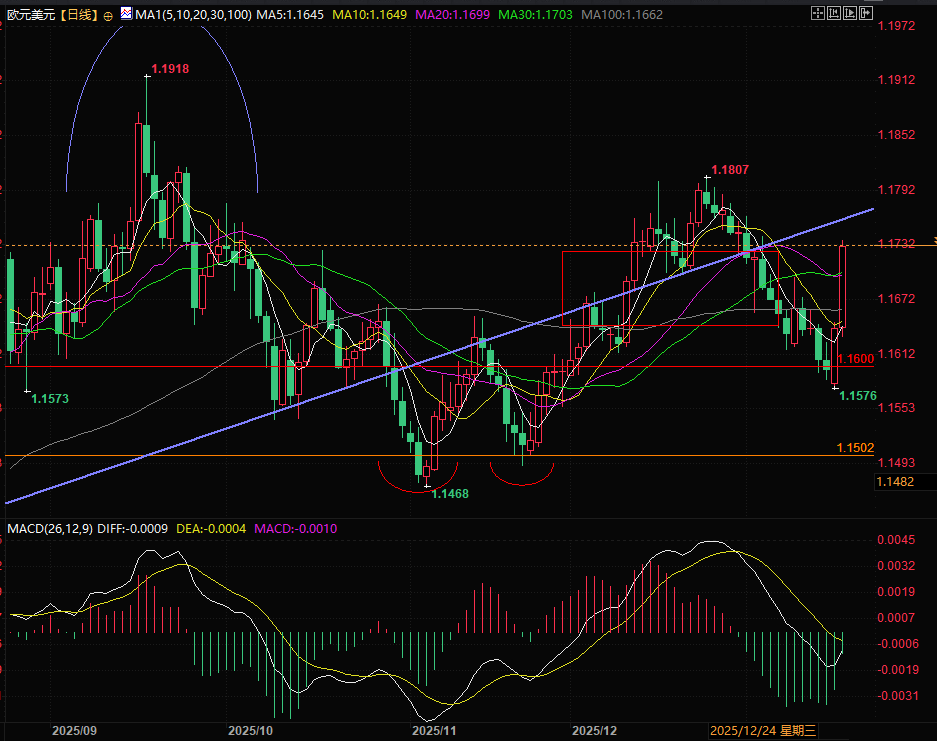
(Euro/USD daily chart, source: FX678)
At 20:09 Beijing time, the euro was trading at 1.1733/34 against the US dollar.
The deterioration of US-EU relations constitutes a substantial negative factor. In addition to affecting US export profits, it will likely force Europe to accelerate the diversification of trade settlement currencies. This move will fundamentally weaken the US dollar's status as a global reserve currency and exert long-term pressure on the US dollar index.
The World Bank and IMF chiefs addressed the Davos Forum about Europe's excessive capital allocation in the US and the need for European revitalization. Market concerns about European assets withdrawing from the US led to a rapid rebound in the euro against the dollar.
The immediate trigger for this conflict was Trump's retaliatory actions after his two core demands were thwarted.
On the one hand, Trump’s plan to acquire Greenland, a semi-autonomous territory of Denmark, was opposed. He then publicly stated that if no agreement could be reached, he would impose tiered tariffs on eight countries: Denmark, Norway, Sweden, France, Germany, the United Kingdom, the Netherlands, and Finland. A 10% tariff would be imposed starting February 1, and if the agreement was not reached by June 1, the tariff rate would be increased to 25%.
On the other hand, French President Macron refused to join the Trump-led Gaza Peace Committee, prompting Trump to retaliate again by threatening to impose a punitive tariff of 200% on French wines and champagne, further escalating trade tensions.
Europe's passive response: calls for dialogue and preparations for countermeasures running in parallel.
In response to Trump’s trade bullying, European leaders immediately retaliated strongly, stating that the new round of tariff threats was “completely unacceptable” and calling for high-level dialogue with the US to resolve differences.
In terms of countermeasures, France is leading the effort to push the EU to utilize its strongest economic weapon—the "anti-coercion tool"—to counter unreasonable pressure from the US. However, it is widely believed that this passive response is insufficient to fundamentally solve the problem, and Europe needs a more long-term solution.
IMF Managing Director calls for action, outlining a roadmap for reforms to address Europe's weaknesses.
At this critical juncture, with the shadow of the US-EU trade war still looming, IMF Managing Director Kristalina Georgieva, speaking at the World Economic Forum in Davos, issued a strong call to European leaders: "Take concrete action immediately."
In a media interview, Georgieva pointed out that Europe has not effectively revitalized its economic resources and has failed to transform its massive economic size into strategic leverage in global geopolitical games.
She stated bluntly that Europe has long fallen behind in productivity growth and the development of small and medium-sized enterprises, and this passive situation must be completely reversed.
To this end, she clearly outlined a list of four core reform tasks: finalizing the capital market alliance, promoting the integrated development of the energy alliance, breaking down barriers to labor mobility among EU member states, and increasing strategic investment in research and innovation.
Deep-seated problems become apparent: resource misallocation and sluggish execution hinder development.
Georgieva further pointed out the deep-seated pain points of the European economy, directly addressing the problems of resource misallocation and inefficient execution.
She revealed that as much as 300 billion euros (equivalent to US$351.75 billion) of European savings are currently tied up in the US market, failing to serve the development of the domestic economy and causing a huge waste of resources.
At the same time, the independent energy systems of the 27 EU member states have left Europe uncompetitive in the global energy game.
Cross-border employment barriers between member states directly restrict the optimal allocation of labor resources.
Georgieva bluntly criticized that "European policymakers are well aware of the direction of reform, but are slow and sluggish in implementation."
Europe's response: Building a "new, independent Europe"
In response to external trade pressures and internal demands for reform, European Commission President Ursula von der Leyen gave a clear answer in her keynote speech at the forum.
She emphasized that in the current context of normalized geopolitical shocks, Europe can no longer rely on the old international order and must accelerate the construction of an independent strategic framework.
Ursula von der Leyen stated that "if the changes in the global landscape are irreversible, then the changes in Europe itself must also be profound and permanent. Now is the critical moment to seize historical opportunities and build a 'new, independent Europe,' and a brand-new Europe has already begun to emerge in the wave of change."
A glimmer of hope for easing tensions: US-EU consultations in Davos are expected.
It is worth noting that while continuing to exert pressure, Trump also released signs of easing tensions.
He said on Tuesday morning (January 20) local time that he had agreed to meet with European officials in Davos to discuss his claims regarding Greenland.
This news provides a breather in the tense US-EU relations and raises market expectations for a de-escalation of trade frictions.
Global economic context: Tariff shocks are manageable, and rational restraint is the consensus.
From a global economic perspective, the IMF slightly raised its global economic growth forecast the day before, predicting that the growth rate will reach 3.3% this year and remain at 3.2% in 2027.
Georgieva stated that the core support for this upward revision of expectations is that the impact of tariffs on the global economy is lower than the market expected, and that no large-scale retaliatory trade war has broken out.
She called on policymakers and market investors to exercise rationality and restraint, and to carefully weigh the costs and benefits of using trade tools.
Looking back at last year, the market panicked excessively due to tariff issues, and many institutions even predicted that the global economy would fall into recession, but in the end, the recession did not materialize.
Georgieva argues that this is because the rational logic of economic fundamentals has dominated market trends, offsetting the short-term disturbances caused by trade frictions.
For Europe, only by translating reform blueprints into concrete actions can it truly escape its passive situation and gain a foothold in the ever-changing global landscape.
Summary and Technical Analysis:
The IMF chief's speech was a boost to the euro, but there is still a long way to go before it is fully implemented. Rapid appreciation is also not conducive to the eurozone's foreign trade, and there is a risk that the exchange rate may pull back.
From a technical perspective, the euro has rebounded directly from the bottom of the trading range to the top, and is currently testing the support at the top of the range. The resistance levels are at 1.1750 and the currently tested 1.1725.
(Euro/USD daily chart, source: FX678)
At 20:09 Beijing time, the euro was trading at 1.1733/34 against the US dollar.
- Risk Warning and Disclaimer
- The market involves risk, and trading may not be suitable for all investors. This article is for reference only and does not constitute personal investment advice, nor does it take into account certain users’ specific investment objectives, financial situation, or other needs. Any investment decisions made based on this information are at your own risk.