Is it still worth chasing? Three major hidden risks looming at gold's high levels: a single piece of news could cause a "surge followed by a crash."
2026-01-20 20:54:42
On Tuesday (January 20), spot gold was trading around $4,730 in pre-market US trading, near historical highs, with the daily chart showing a clear upward trend. This rally is not accidental, but rather driven by a "safe-haven engine" ignited by multiple uncertainties. The most attention-grabbing recent development is the escalation of transatlantic trade tensions: the US proposed imposing tariffs on some imports from eight European countries, immediately triggering high market alert.

More importantly, the EU has prepared retaliatory measures totaling €93 billion, targeting US exports. While their implementation remains uncertain, the tug-of-war between negotiation and confrontation is enough to raise market risk premiums. Financial markets fear not bad news, but the uncertainty of what will happen. As trade disputes shift from verbal discussions to actual competition, businesses and investors are choosing to reduce risk exposure and embrace defensive assets. Gold, with its unique cross-market and cross-credit system status, has become the preferred safe haven, naturally leading to a continuous influx of buying.
Besides trade tensions, macroeconomic fundamentals have also provided solid support for gold prices. Inflationary stickiness remains significant, price pressures have not fully subsided, and the policy paths of central banks around the world are becoming increasingly unclear. For example, the market widely expects the Federal Reserve to keep interest rates unchanged this month. Against the backdrop of an uncertain economic growth outlook and persistently high inflation, investors' focus has shifted from "how high or low interest rates" to "whether purchasing power can be preserved." At this point, gold is no longer just seen as an investment, but more like an "insurance policy" to hedge against currency devaluation and tail risks.
Meanwhile, the recent weakness of the US dollar, falling to recent lows, has provided additional support for gold. Since gold is priced in US dollars, a weaker dollar means holders of other currencies can purchase gold at a lower cost, thus stimulating inflows of non-US dollar funds. The current weakness of the dollar reflects market concerns about its policy outlook and a repricing of external risks, which in turn amplifies the relative attractiveness of gold. It can be said that, both from the perspective of real interest rates and the exchange rate transmission mechanism, the current environment is favorable for gold.
If trade and macroeconomic factors provide the fundamental support, then geopolitical turmoil acts as a catalyst, igniting market panic. In recent years, tensions have persisted in many parts of the world, with frequent and often unpredictable unforeseen events. For institutional investors, such risks cannot be hedged with a single financial instrument, making gold, as a historically significant, highly liquid asset unaffected by sovereign credit restrictions, an ideal "ballast" for portfolio diversification. Especially during periods of increased volatility, many funds actively increase their gold holdings to mitigate the overall portfolio's drawdown in extreme circumstances.
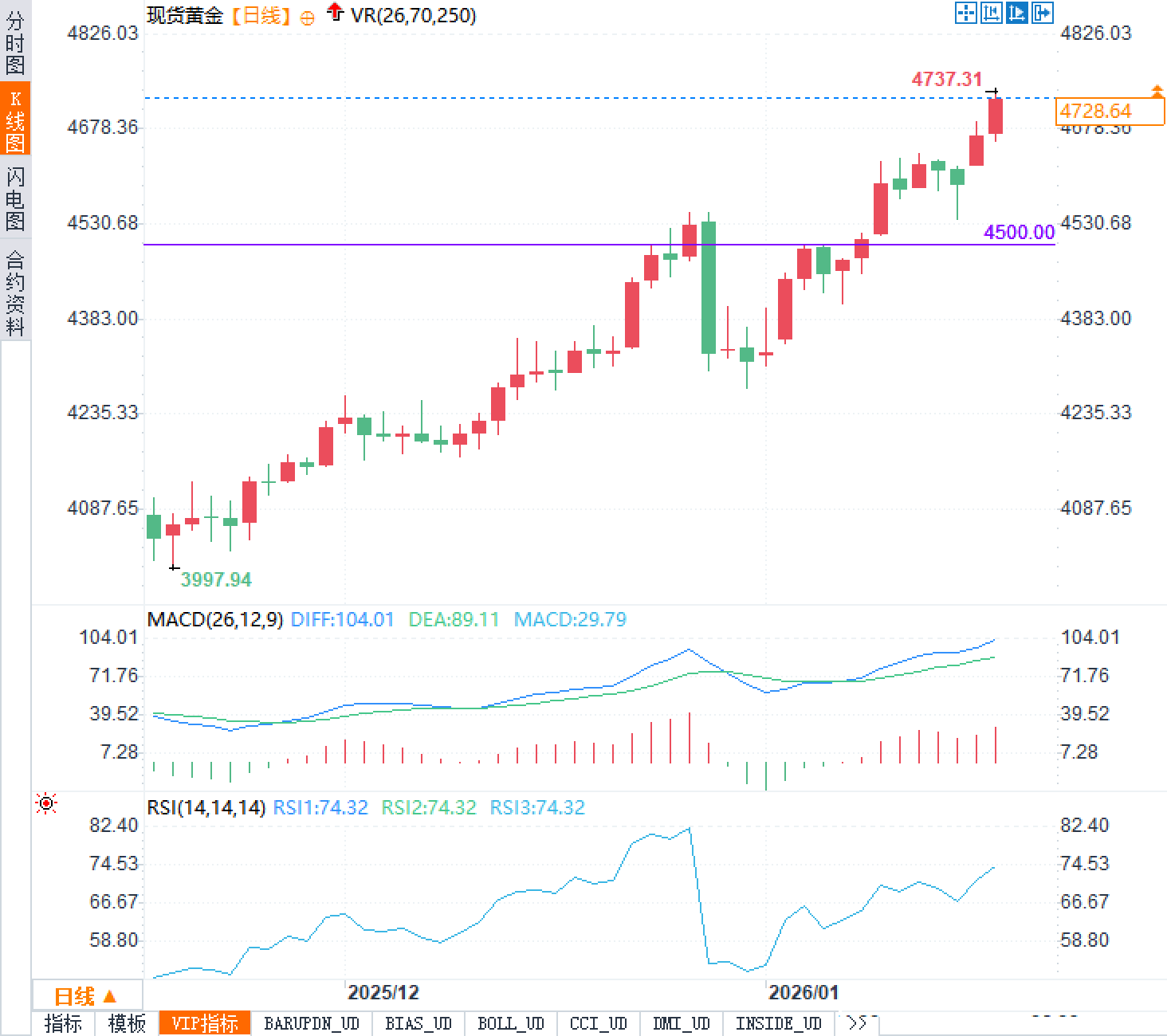
From a technical chart perspective, spot gold has exhibited a clear, stepped upward trend since its low of $3997.94. Each pullback has been brief and rapid, indicating strong bullish control. Currently, the price is approaching the key resistance zone of $4737.31. A successful breakout and hold above this level could open up further upside potential. Important support lies around $4500.00, an area that has historically acted as a dividing line between bullish and bearish trends, possessing strong medium-term defensive significance. In terms of indicators, the MACD remains bullish, with the DIFF at 104.01, DEA at 89.11, and the MACD histogram at 29.79, indicating continued strong trend momentum. However, the RSI has reached 74.32, entering overbought territory, suggesting short-term overheating and profit-taking pressure. This means that even if the medium-term trend remains unchanged, a short-term consolidation pattern of "rallies followed by pullbacks and confirmation" is possible.
Despite the current strong momentum in gold, analysts warn that the closer it gets to historical highs, the greater the market divergence and the more dramatic the potential volatility. Blindly chasing the rally at this point could lead to catching a falling knife. Three variables deserve close attention: First, if there are signs of easing trade tensions, such as both sides returning to the negotiating table or canceling some tariff plans, market risk appetite could quickly rebound, causing a rapid retracement of the safe-haven premium and putting technical correction pressure on gold prices. Second, if subsequent economic data is significantly stronger than expected, especially employment or inflation data, it could trigger a repricing of a shift towards a hawkish monetary policy, pushing up real interest rates, which would directly impact gold. Third, uncertainties in the implementation or legal review of related policies could also cause a sharp adjustment in market expectations regarding the impact of tariffs, thus triggering a period of pullback.
In summary, the core logic behind gold's continued high performance above $4,700 lies in the comprehensive revaluation of the "uncertainty premium." As long as the four major factors—trade disputes, inflationary resilience, policy uncertainty, and geopolitical risks—do not experience systemic easing, the medium-term support for gold prices will not easily crumble.
More importantly, the EU has prepared retaliatory measures totaling €93 billion, targeting US exports. While their implementation remains uncertain, the tug-of-war between negotiation and confrontation is enough to raise market risk premiums. Financial markets fear not bad news, but the uncertainty of what will happen. As trade disputes shift from verbal discussions to actual competition, businesses and investors are choosing to reduce risk exposure and embrace defensive assets. Gold, with its unique cross-market and cross-credit system status, has become the preferred safe haven, naturally leading to a continuous influx of buying.
With inflation persisting and the dollar weakening, gold is now in a favorable position.
Besides trade tensions, macroeconomic fundamentals have also provided solid support for gold prices. Inflationary stickiness remains significant, price pressures have not fully subsided, and the policy paths of central banks around the world are becoming increasingly unclear. For example, the market widely expects the Federal Reserve to keep interest rates unchanged this month. Against the backdrop of an uncertain economic growth outlook and persistently high inflation, investors' focus has shifted from "how high or low interest rates" to "whether purchasing power can be preserved." At this point, gold is no longer just seen as an investment, but more like an "insurance policy" to hedge against currency devaluation and tail risks.
Meanwhile, the recent weakness of the US dollar, falling to recent lows, has provided additional support for gold. Since gold is priced in US dollars, a weaker dollar means holders of other currencies can purchase gold at a lower cost, thus stimulating inflows of non-US dollar funds. The current weakness of the dollar reflects market concerns about its policy outlook and a repricing of external risks, which in turn amplifies the relative attractiveness of gold. It can be said that, both from the perspective of real interest rates and the exchange rate transmission mechanism, the current environment is favorable for gold.
Geopolitical turmoil coupled with strong technicals have propelled gold into a "the more uncertain, the stronger" pattern.
If trade and macroeconomic factors provide the fundamental support, then geopolitical turmoil acts as a catalyst, igniting market panic. In recent years, tensions have persisted in many parts of the world, with frequent and often unpredictable unforeseen events. For institutional investors, such risks cannot be hedged with a single financial instrument, making gold, as a historically significant, highly liquid asset unaffected by sovereign credit restrictions, an ideal "ballast" for portfolio diversification. Especially during periods of increased volatility, many funds actively increase their gold holdings to mitigate the overall portfolio's drawdown in extreme circumstances.
From a technical chart perspective, spot gold has exhibited a clear, stepped upward trend since its low of $3997.94. Each pullback has been brief and rapid, indicating strong bullish control. Currently, the price is approaching the key resistance zone of $4737.31. A successful breakout and hold above this level could open up further upside potential. Important support lies around $4500.00, an area that has historically acted as a dividing line between bullish and bearish trends, possessing strong medium-term defensive significance. In terms of indicators, the MACD remains bullish, with the DIFF at 104.01, DEA at 89.11, and the MACD histogram at 29.79, indicating continued strong trend momentum. However, the RSI has reached 74.32, entering overbought territory, suggesting short-term overheating and profit-taking pressure. This means that even if the medium-term trend remains unchanged, a short-term consolidation pattern of "rallies followed by pullbacks and confirmation" is possible.
Is it still worth chasing the rally? Three types of risks are quietly approaching.
Despite the current strong momentum in gold, analysts warn that the closer it gets to historical highs, the greater the market divergence and the more dramatic the potential volatility. Blindly chasing the rally at this point could lead to catching a falling knife. Three variables deserve close attention: First, if there are signs of easing trade tensions, such as both sides returning to the negotiating table or canceling some tariff plans, market risk appetite could quickly rebound, causing a rapid retracement of the safe-haven premium and putting technical correction pressure on gold prices. Second, if subsequent economic data is significantly stronger than expected, especially employment or inflation data, it could trigger a repricing of a shift towards a hawkish monetary policy, pushing up real interest rates, which would directly impact gold. Third, uncertainties in the implementation or legal review of related policies could also cause a sharp adjustment in market expectations regarding the impact of tariffs, thus triggering a period of pullback.
In summary, the core logic behind gold's continued high performance above $4,700 lies in the comprehensive revaluation of the "uncertainty premium." As long as the four major factors—trade disputes, inflationary resilience, policy uncertainty, and geopolitical risks—do not experience systemic easing, the medium-term support for gold prices will not easily crumble.
- Risk Warning and Disclaimer
- The market involves risk, and trading may not be suitable for all investors. This article is for reference only and does not constitute personal investment advice, nor does it take into account certain users’ specific investment objectives, financial situation, or other needs. Any investment decisions made based on this information are at your own risk.